Date Published:

When a large advisory network gets acquired, most of the attention goes to one question: how many of the acquired firm's assets stayed put. But the more important development for the RIA market is easy to miss. Every time one of these deals happens, a wave of advisors decides not to go along with the new owner and leaves to start their own independent firms instead. A whole batch of brand-new RIAs is created at the same moment, all at roughly the same early stage of building a company.
The LPL–Commonwealth integration is the live example. Nearly 700 advisors left Commonwealth across 2025 following the sale — but only about 36% chose the RIA route, according to a report from Muriel Consulting; most went to another broker-dealer instead, led by Raymond James, Kestra, and Cambridge. That minority who did go independent created a distinct cohort of newly registered RIAs — six ex-Commonwealth teams alone combined to launch Kintra with roughly $4 billion in assets, while active acquirers like Merit Financial Advisors picked up others, including the $208 million GlennCo practice. The RIA share has only narrowed since, falling to about 27% of departures so far in 2026.
Those new RIAs are now twelve to twenty-four months old. Many will be approached about a sale within three years, and most of their founders have no framework for how a young firm is valued. This article is that framework: what a buyer sees when a firm has a short filing history, which characteristics of a network-breakup firm are read as strengths, which are read as risks, and what the first thirty-six months should be used for.
Why a Short History Is a Pricing Problem
Valuation of an established RIA rests substantially on demonstrated durability. A firm with a ten-year filing history has shown how its assets behaved through at least one drawdown, whether clients stayed, and whether growth came from markets or from net new relationships.
A firm formed eighteen months ago has none of that. Its Form ADV shows one or two annual filings. Its asset base arrived in a single transition event rather than accumulating through client acquisition. Its organic growth rate, calculated conventionally, is either meaningless or spectacular, depending on whether the initial transition is counted.
This is not a judgment about quality. A $900 million practice that moved intact is a real business with real relationships, often decades old. But the entity is new, and buyers underwrite entities.
What a buyer cannot yet see
Three things specifically.
Whether the assets that transitioned have stabilized. Advisors who change platforms typically bring 70% to 90% of their prior book. The remainder can take two to three years to fully resolve, and the trajectory is not visible from a single filing.
Whether the firm can grow independently of the transition. Net new client assets in year two, excluding the transition cohort, is the number that separates a business from a book that changed addresses. Most firms in their first two years cannot yet demonstrate it, because the team is absorbed in operating a company for the first time.
Whether the operating structure holds. A newly independent firm has just taken on compliance, technology, billing, HR, and vendor management that a network previously handled. Whether it has built that capability or is improvising is the central operational question, and it takes two years of filings to become legible from outside.
What Buyers Read as Strengths in This Cohort
Firms born from a network breakup share characteristics that acquirers value, and founders routinely underweight them.
The transition is proof of client loyalty. An advisor who moved and retained 85% of assets has produced evidence most established firms cannot: clients followed the individual rather than the institution, and they signed new paperwork to do it. That is a client-relationship signal from a real-world stress test.
Decisions have already been made deliberately. A firm that chose its own custodian, technology stack, and investment process, twelve months ago, has a coherent and current infrastructure. Established firms often carry a decade of accumulated legacy systems that a buyer must unwind.
The founders have chosen independence twice. They left a network rather than accept a new owner, which tells a buyer something specific about what they value and what they will accept. That is useful information for a buyer who intends to preserve autonomy — and disqualifying information for one who does not.
No entrenched integration debt. There is no twenty-year-old proprietary process to dismantle, no legacy fee schedule grandfathered across three generations of clients, no custodial arrangement nobody can explain.
What Buyers Read as Risks
Risk | What the buyer is testing | How to address it |
|---|---|---|
Unstabilized asset base | Whether transition attrition has finished | Provide monthly asset detail from launch, separating transitioned from new assets |
Single-advisor concentration | Whether the firm survives one departure | Document which advisors hold primary relationships and how coverage is shared |
Client AUM concentration | Whether too much of the book sits with a few relationships | Show the spread of AUM across clients and households; flag any outsized relationships and their tenure |
Unproven organic growth | Whether the firm can add clients, not just retain them | Track and report net new households and net new assets excluding the transition cohort |
Thin operating infrastructure | Whether compliance and operations are real functions | Name the owner of each function; document the compliance calendar |
Short filing history | Whether reported figures are consistent | File carefully and consistently from the start; inconsistencies compound |
Founder fatigue | Whether the sale is a strategy or an exhaustion response | Have a written three-year plan that does not depend on a sale |
Two of those rows move price more than the others, and they compound each other.
The advisor-concentration row is the first. In a firm formed by two or three advisors from a network, the relationships almost always sit with individuals rather than with the entity — because the entity is eighteen months old. Buyers price that directly, and no amount of narrative changes the arithmetic.
Client AUM concentration is the second. A young breakaway firm often carries a book that is not only held by a handful of advisors but is itself concentrated in a handful of large relationships — frequently the anchor clients who made the move worth doing in the first place. That concentration cuts against the durability a buyer is paying for: the departure of one or two major households can move the firm's revenue in a way that would be survivable at a broader-based firm. A buyer will want to understand how AUM is distributed across the client base and how long the largest relationships have been in place, because a firm whose value depends heavily on a few clients is a different risk than one with the same AUM spread across many. Founders who can show a reasonably diversified base — or a credible plan to broaden it — remove a discount before it is applied.
The Productivity Read on a Young Firm
Newly independent firms often post unusual efficiency ratios, and it is worth understanding why before a buyer draws the wrong conclusion.
Illustrative example (hypothetical numbers only). A firm formed in early 2025 by three advisors leaving a network reports $900M in AUM, three IARs, and seven total employees at its second annual filing. AUM per advisor: $300M. AUM per employee: $128.6M.
Those ratios look exceptional against typical mid-market benchmarks. The caution is that a firm at that stage is frequently running lean because it has not yet built the support bench it needs, not because it has designed a superior operating model. The AUM per advisor figure counts only IARs registered on Form ADV, so it excludes non-IAR staff — client service, operations, planning support — and a thin non-IAR bench inflates the ratio while creating capacity risk.
A sophisticated buyer therefore reads high productivity in a year-two firm as an open question rather than a finding: is this leverage, or is it three advisors carrying more than they can sustain? The way to answer it is to show what happened to those ratios as headcount was added — which requires having added headcount deliberately and having filings that show it.
Data Advantage: Making a Short Filing History Legible
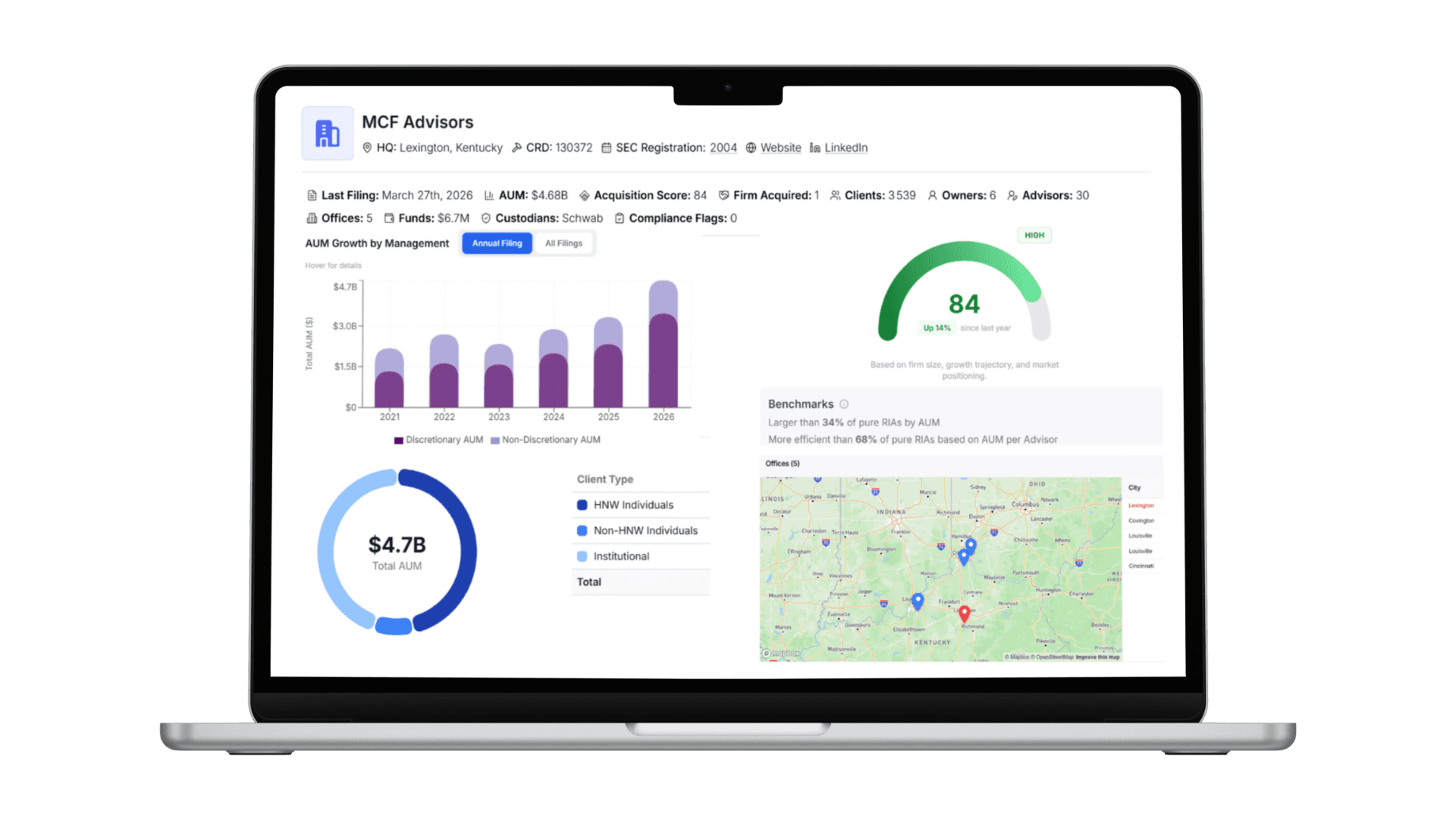
RIA Catalyst tracks AUM, IAR counts, total employee counts, office footprints, and disclosed regulatory history across 15,000+ SEC-registered RIAs, including newly registered entities from their first filing forward. For a firm formed out of a network breakup, that history is short but it is the primary external record a buyer will build a view from — which means the consistency and trajectory of those early filings carry disproportionate weight. Founders who understand what their own filing trail shows can address the gaps deliberately over two or three filing cycles rather than explaining them under time pressure during a process.
Using the First Thirty-Six Months
The window between launch and the first serious acquisition conversation is when value is created or lost. Four priorities.
Separate your growth accounting from day one
Track transitioned assets and new-client assets in separate columns, monthly, permanently. In year three this becomes the single most persuasive exhibit you have. Firms that did not track it from the start cannot reconstruct it credibly, and buyers will assume the less favorable interpretation.
Move relationships from individuals toward the firm
Introduce a second advisor into every significant client relationship. Document who covers whom. This is the highest-return use of the first three years, and it works only if it starts early — a client introduced to a second advisor in year one accepts it as how the firm works, while the same introduction in year four looks like preparation for a sale.
Build the compliance record you will be diligenced on
A young firm's Form ADV Item 11 record is short, which makes any disclosure disproportionately visible. Establish the compliance calendar, the annual review, and the documentation habit in year one, when the volume is manageable, rather than reconstructing three years of evidence during diligence.
Decide what you are building before someone else frames it
Firms formed in a network breakup receive inbound acquisition interest early, precisely because acquirers know this cohort exists and is unstabilized. Owners without a written three-year plan tend to evaluate those approaches against nothing, which is the weakest possible negotiating position. Owners with one evaluate them against a specific alternative.
FAQ
How long until a new RIA is valued like an established firm?
Roughly three to five years of filing history, in practice, and specifically once the firm can show two to three consecutive periods of net new client assets excluding the original transition cohort. Time alone does not do it; demonstrated independent growth does.
Does the transition retention rate matter to a buyer?
Considerably, and it is one of the first questions asked. High retention through a platform change is the strongest client-loyalty evidence a young firm possesses. Be ready with the actual figure and its trajectory by quarter, not a rounded recollection.
Should a firm this young entertain acquisition conversations at all?
Taking the meeting costs nothing and teaches you how the market reads your firm. Transacting in year one or two usually costs real money, because the firm cannot yet demonstrate the things that support a strong valuation. The exception is a founder whose actual objective is to be part of a larger organization rather than to build a company — in which case waiting adds risk without adding value.
Are we penalized for being small as well as young?
They are separate discounts. Size affects the buyer universe and the multiple range. Youth affects how much of the value is deferred into earnout, because the buyer is being asked to underwrite durability that has not been demonstrated. A young small firm typically sees more of its consideration pushed into contingent structure than either factor alone would produce.
What if our assets are still moving over?
Say so plainly and quantify it. A buyer who discovers mid-diligence that reported AUM includes assets still in transition will reprice the entire deal and question everything else you presented. A buyer told upfront can structure around it, usually with a post-close true-up.
Conclusion
Network consolidation at the top of the market keeps producing new independent firms at the bottom, and that cohort is now large enough to matter — from six teams combining into a single $4 billion launch to solo practices setting up on their own.
For their founders, the useful frame is that the transition is over and the harder work has just started. The retention figure proves clients follow you. It does not yet prove the firm grows, that relationships belong to the entity, or that the book is diversified enough to survive the loss of a big client. Those are the things a buyer pays for, and they are all built in the first thirty-six months — well before anyone opens a conversation about price.