Date Published:

For most acquirers, deal flow means waiting. A banker or business broker calls, sends a teaser, and invites the firm into a process. The buyer evaluates the opportunity, submits a bid, and competes against a field of other interested parties for a firm that is now, by definition, for sale to the highest bidder. This is the default model of RIA acquisition, and it is structurally disadvantaged.
The problem is not that auctions are unfair — they are efficient at finding the highest price, which is exactly the point from the seller's side. The problem is that by the time a buyer receives the call, every advantage that produces a good acquisition has already been surrendered. The firm is in competition, the price is being bid up, the diligence window is compressed, and the buyer's odds of being the end acquirer are low. The deal that creates real value was available 12 to 18 months earlier, before any of that was true.
This article explains why a reactive, banker-led sourcing model is a losing position, what an auction actually costs a buyer, and why the firms with the strongest returns build the capability to identify and engage targets before a process ever begins.
The Banker's Call Means the Auction Has Started
When an intermediary reaches out, it signals that the seller has already made the decision to sell, already engaged professional representation, and already committed to a competitive process designed to maximize their price. The buyer is being invited into a structure built entirely around the seller's interests.
Everything about that structure works against the acquirer. The information is curated and released on the seller's timeline. The pace is controlled to maintain competitive tension. Multiple credible buyers are looking at the same firm, which means the price will rise toward the highest bidder's reservation point. And the buyer has no relationship advantage — every participant arrived through the same call, with the same materials, at the same moment. The call is not the beginning of an opportunity. It is the announcement that the opportunity has become a contest the buyer is unlikely to win on favorable terms.
What an Auction Actually Costs a Buyer
Competitive processes impose costs that go well beyond the headline price, and they compound.
The first cost is the premium. Competition exists to drive price up, and it works. A firm acquired through a contested auction routinely clears at a higher multiple than the same firm would have commanded in a bilateral, off-market conversation. The buyer pays a premium for the privilege of having competed for a desirable asset.
The second cost is compressed diligence. Auctions run on the seller's schedule, with limited time and controlled information access. A buyer must form conviction and commit on a pre-determined and set timeline, which raises the risk of missing problems or overpaying for a firm whose issues only surface later.
The third cost is a low win rate. For every auction a buyer wins, they typically lose several — each consuming diligence resources, legal spend, and senior time with nothing to show for it. A sourcing model built entirely on auctions means paying repeatedly to compete and walking away empty-handed most of the time.
The fourth cost is adverse selection. The firms most likely to run a full competitive auction are often the ones that know they will attract many bidders — which is not always the same as the firms that represent the best risk-adjusted value. The most attractive targets, ironically, are frequently the ones a thoughtful buyer can reach before they ever decide to run a process at all.
The Proprietary Window: 12–18 Months Before the Process
The alternative is to engage a firm during the window between when a founder begins contemplating a transition and when they formally go to market. This is the proprietary window, and it is where the structural advantages reverse in the buyer's favor.
In this window, there is no auction, so there is no competitive premium. There is time to build a genuine relationship and understand the firm deeply rather than through a curated data room. There is the opportunity to shape the eventual transaction — to be the founder's preferred partner before any banker is involved. And there is the chance to transact bilaterally, often at a more reasonable price and on terms that suit both sides, because the seller values certainty and fit over squeezing the last dollar from a contest.
Reaching a firm in this window is not about pressuring a founder to sell before they are ready. It is about being present, trusted, and top of mind when the founder does decide — so that the natural next step is a conversation with you rather than a call to a banker.
The Economics of Early vs. Late
The two models produce different economics across nearly every dimension that matters.
Dimension | Reactive (banker-led auction) | Proactive (proprietary window) |
|---|---|---|
Competition | High — multiple bidders | Low to none — bilateral |
Price | Bid up to the highest reservation | Negotiated, typically more reasonable |
Diligence | Compressed, seller-controlled | Extended, relationship-based |
Information access | Curated data room | Direct, over time |
Buyer's position | One of many | Preferred partner |
Win rate | Low — most auctions are lost | High — limited competition |
Cost per closed deal | High — repeated losses | Lower — targeted effort |
Why Most Buyers Stay Reactive Anyway
If the proprietary window is so clearly superior, the natural question is why most buyers still wait for the call. The answer is that proactive sourcing is harder, and the difficulty masks the payoff.
Waiting for bankers is easy: the deals arrive pre-packaged, pre-qualified, and ready to evaluate. Building a proprietary pipeline requires identifying targets before anyone else knows they are targets, investing relationship time that may not pay off for years, and tolerating a long lead time between effort and outcome. It demands a sourcing capability — data, process, and discipline — that an auction model does not. Many buyers default to the reactive model not because it works better but because it requires less infrastructure and delivers the comfortable illusion of activity, even as it produces a low win rate at inflated prices.
Building a Pre-Banker Sourcing Capability
Escaping the auction trap requires building the capability to find and engage firms early. That starts with identification: a systematic way to surface the firms most likely to transact in the next 12 to 18 months, based on the demographic, structural, and behavioral signals that precede a sale. It continues with relationship infrastructure: a process for engaging those founders authentically and consistently over time, so the buyer becomes a trusted presence rather than a cold caller. And it depends on patience — accepting that the payoff comes over a multi-year horizon, not from this quarter's pipeline.
The buyers who build this capability stop competing in auctions they are likely to lose and start having conversations no one else is having. That shift, more than any single deal, is what separates serial acquirers who compound value from those who overpay one contested deal at a time.
Data Advantage: Reaching Founders Before the Process Begins
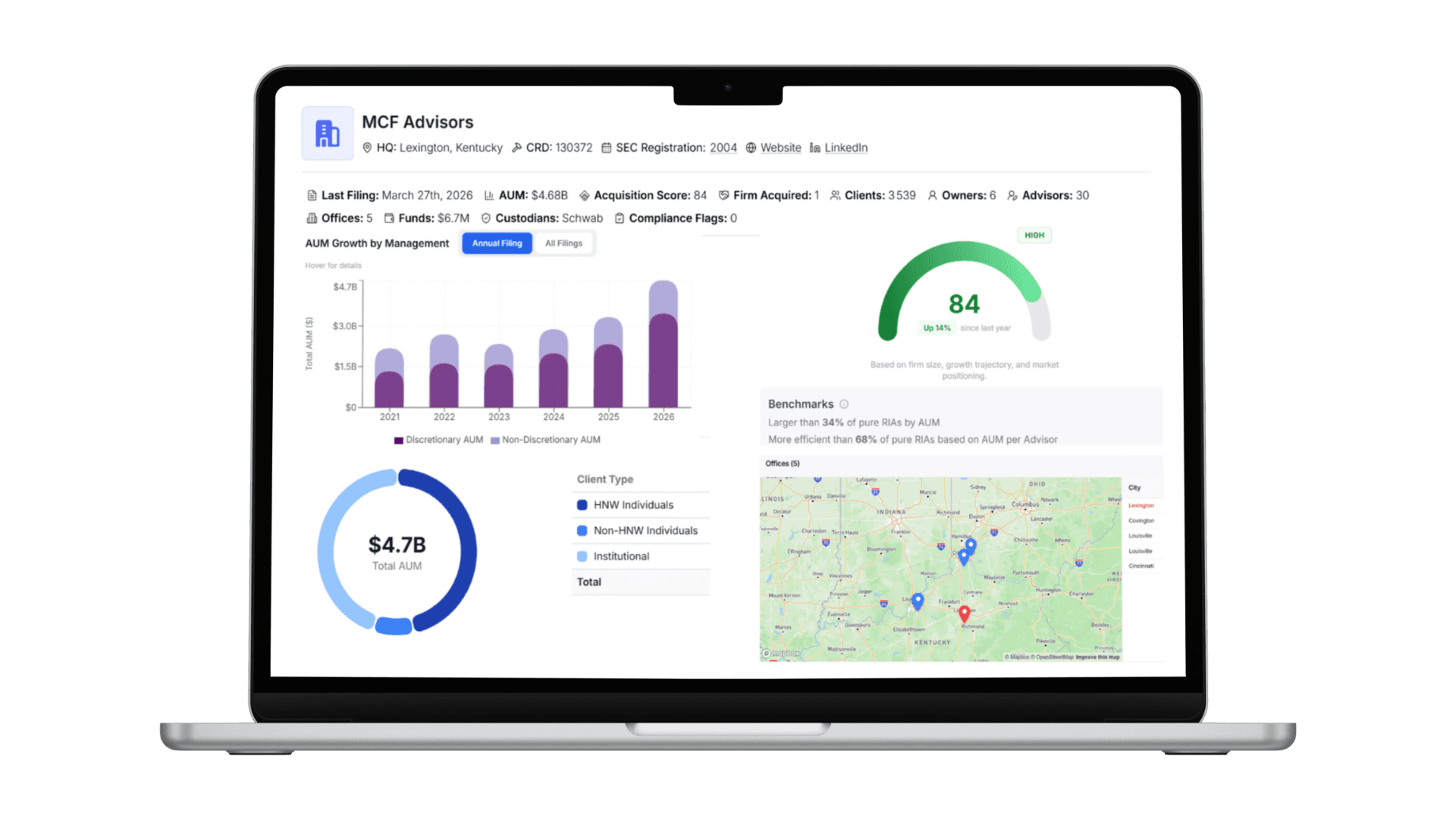
RIA Catalyst identifies firms entering the succession and transition window — using founder lifecycle, ownership structure, advisor depth, and growth signals across 15,000+ SEC-registered RIAs — 12 to 18 months before they typically engage an intermediary. For acquirers, this turns sourcing from a reactive wait for the banker's call into a proactive program of reaching the right founders during the proprietary window, when competition is lowest and relationship-building is most productive.
FAQ
Why is waiting for a banker to call a disadvantage?
Because the call means the seller has already decided to sell and launched a competitive process built to maximize their price. The buyer arrives as one of many bidders, with curated information, compressed diligence, and a low probability of winning on favorable terms. The advantageous moment was 12 to 18 months earlier, before the process began.
What does a competitive auction actually cost an acquirer?
More than the price premium. Auctions impose compressed, seller-controlled diligence, a low win rate that wastes resources across deals that are lost, and adverse selection. A sourcing model built entirely on auctions means paying repeatedly to compete and closing only a fraction of what is pursued.
What is the "proprietary window" in RIA M&A?
The period between when a founder begins contemplating a transition and when they formally go to market — typically 12 to 18 months. In this window there is no auction, so a buyer can build a real relationship, understand the firm deeply, and often transact bilaterally at a more reasonable price and on better terms.
Does proactive sourcing mean pressuring founders to sell?
No. It means being present, trusted, and top of mind before the founder decides, so the natural next step is a conversation with you rather than a banker. Pressuring a founder who is not ready tends to damage the relationship; the goal is to earn the first call when the decision is eventually made.
Why do most buyers still rely on bankers if it's disadvantaged?
Because reactive sourcing is easier — deals arrive pre-packaged and ready to evaluate. Building a proprietary pipeline requires data, process, relationship investment, and patience for a payoff that comes over years. Many buyers default to the auction model for its convenience, accepting a low win rate at inflated prices as the cost of doing less work.
Conclusion
The banker's call feels like opportunity, but it is the signal that the advantageous moment has passed. By the time a firm is in a process, the buyer faces competition, a bid-up price, compressed diligence, and long odds — and pays repeatedly to lose most of the time. The firms that compound value source the other way: they identify targets in the proprietary window 12 to 18 months out, build relationships before any intermediary is involved, and transact bilaterally on terms a contest would never produce. Waiting for the call is not patience. It is conceding the advantage before the deal has even begun.