Date Published:

Every RIA acquisition model starts with AUM. The revenue assumption is built on it. The multiple is applied to earnings derived from it. The earnout is calibrated to it. But AUM is not what a buyer acquires in an RIA deal — it is what a buyer hopes to retain. The distinction matters more than any other in wealth management M&A, and most buyers don't give it enough weight until it is too late.
Client retention is the single metric that determines whether an RIA acquisition creates or destroys value. A firm with $1B in AUM at close that retains 85% of clients generates materially different economics than a firm that retains 95% — and the gap compounds rapidly. Yet most acquisition models treat retention as an assumption rather than a variable, benchmark it loosely against industry averages, and address it only after close. The buyers who get this right treat retention not as a post-close integration concern but as a pre-LOI due diligence priority and deal structuring input.
This article explains why client retention is systematically underweighted in RIA M&A, what the real economics of attrition look like, and how to build retention analysis into the deal process from the beginning.
Why Client Retention Gets Underweighted
The AUM Anchoring Problem
Buyers anchor on AUM because it is visible, comparable, and the basis for the revenue assumption that drives valuation. A firm with $800M in AUM generating 80 bps in blended fees produces $6.4M in revenue — a figure that can be applied a multiple to and called a deal. The problem is that this calculation assumes 100% AUM retention indefinitely, which is never true and in transitions can be dangerously optimistic.
The mental model that allows buyers to anchor on AUM is the implicit assumption that clients are assets attached to the firm — that they will stay because they have always stayed. In most advisory businesses, clients are attached to advisors, not firms. The distinction is foundational, and ignoring it is the most expensive mistake in RIA M&A.
Retention Risk Is Hard to Quantify Before Diligence
Unlike revenue or margins, client retention risk cannot be read off a financial statement. It requires understanding the nature of client relationships at the individual advisor level — who introduced the client to the firm, how long they have been a client, how deeply the relationship extends beyond investment management, and what their awareness of and attitude toward the acquisition is likely to be. This kind of intelligence is not available in a CIM. It requires direct diligence with the target, which most buyers defer to late stage.
The result is that retention assumptions in early-stage models are typically based on industry averages — which can be significantly more optimistic than the specific risk profile of the target being acquired.
The Cost of Post-Close Attrition Shows Up Late
Revenue from lost clients doesn't disappear on day one. It erodes gradually over the months following close, as clients process the transition, speak to advisors at other firms, receive competing proposals, and eventually decide whether to stay. By the time attrition is measurable in the income statement — typically six to eighteen months post-close — the deal is already signed, the purchase price is already paid, and the earnout structure may already be stressing the relationship between buyer and seller.
The delayed visibility of attrition creates a systematic bias toward underestimating retention risk during deal structuring. What is not yet visible in the numbers feels less real than what is — which is why revenue retention risk gets less structural attention than it deserves.
The Real Economics of Attrition
The Compounding Math
A firm that closes at $800M in AUM and experiences 10% client attrition in the first year doesn't just lose $80M. It loses the fee stream on that $80M for the full remaining horizon — and if the acquisition was priced at a 7x revenue multiple, the implied value of that lost AUM at acquisition pricing is approximately $4.5M. That's a $4.5M value destruction on a 10% attrition rate — from a firm that looked financially sound at close.
The compounding problem is that early attrition creates momentum. Clients who see other long-standing clients leave begin to wonder whether they should too. Advisors who lose their largest clients become less productive and more likely to leave themselves. And client attrition and advisor attrition are correlated — when a senior advisor departs, they often take clients with them.
The Loyalty Distribution Problem
Not all AUM carries equal retention risk. In most RIA firms, a significant portion of AUM sits with a small number of long-tenured clients who have deep, multi-decade relationships with the founding advisor. These clients are extremely sticky with the current advisor and extremely vulnerable to departing if that advisor is replaced, reduces their involvement, or signals lack of enthusiasm for the new ownership.
At the same time, a portion of AUM sits with clients who are newer, less engaged, or whose relationship was primarily driven by a referral source that may or may not continue to direct business. These clients have lower switching costs and higher transition sensitivity.
The blended attrition rate in any acquisition masks this distribution. Buyers who model a single retention assumption across all AUM are averaging together highly loyal and highly fragile client segments — and likely understating the risk in both the most and least loyal cohorts for different reasons.
Historical Attrition as a Predictor
The best available predictor of post-close attrition is the target's historical attrition rate — measured by both client count and AUM — over the preceding three to five years. Firms that have maintained annual attrition below 3% through market cycles and advisor changes have demonstrated structural client loyalty. Firms running at 7–10% annual attrition before the acquisition should be modeled at significantly higher post-close attrition, because transitions add disruption to an already fragile client base.
Historical attrition data is not always volunteered in a management presentation. It should be a mandatory diligence request.
The Metrics That Actually Predict Retention
Building retention analysis into deal diligence requires a specific set of metrics that most buyers do not systematically collect. The most predictive are:
Metric | What It Measures | Why It Matters |
|---|---|---|
Historical client attrition rate (3-year) | Annual % of clients and AUM lost | The most direct predictor of post-close attrition |
Average client tenure | How long clients have been with the firm | Longer tenure correlates with higher loyalty |
Advisor-to-client relationship mapping | Which advisor owns each client relationship | Identifies key-person dependency and portability risk |
Revenue concentration (top 20 clients) | % of revenue from largest relationships | High concentration = high attrition risk from a small number of departures |
Net new client growth (3-year) | New clients added minus clients lost | Distinguishes firms with organic momentum from those with declining books |
Referral source concentration | % of new clients from a single source | Loss of the referral source means loss of the pipeline |
Client demographic profile | Average age, wealth tier, planning complexity | Older clients with simpler needs have higher mobility |
None of these metrics are available from a single ADV filing. They require direct diligence engagement with the target — and the discipline to ask for the data before LOI rather than after.
How Retention Risk Should Affect Deal Structure
When retention risk is high — defined by elevated historical attrition, high advisor-to-client concentration, an aging client base, or a recent advisor departure — it should show up in deal structure, not just in a verbal comfort that "the clients know us well."
The most effective structural mechanisms for protecting against retention risk are covered in detail in a companion article on deal structuring. The key principle: retention risk should be priced through earnout design, transition period requirements, and purchase price adjustments — not absorbed silently into the base case revenue model.
A buyer who pays a full multiple on a firm's AUM without adjusting for measurable retention risk is transferring value from themselves to the seller. The seller is being paid for AUM that may not survive the transition. The buyer is absorbing the risk that it won't.
Data Advantage: Surfacing Retention Signals Before Diligence
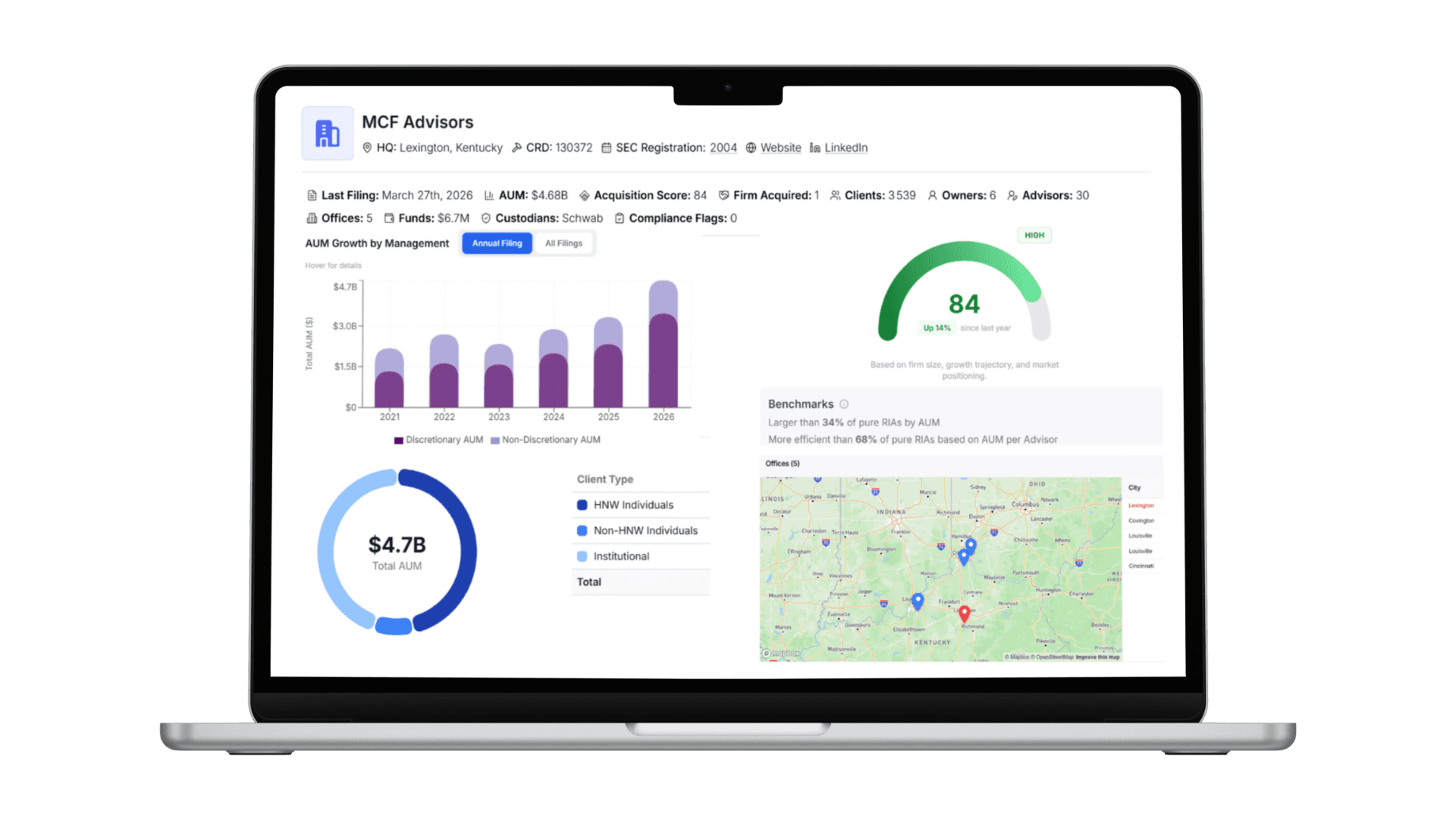
RIA Catalyst tracks the longitudinal signals that predict client retention risk across 15,000+ registered RIAs — including AUM changes net of market appreciation, advisor headcount movements correlated with AUM shifts, and organic net-new client flows across consecutive ADV filings. These signals allow buyers to identify firms with strong client loyalty foundations before the first management meeting, and to deprioritize targets where the AUM figure may be more fragile than it appears from a single snapshot.
FAQ
How much AUM should a buyer expect to retain after closing an RIA acquisition?
Historical benchmarks suggest well-run integrations with proactive communication retain 90–95% of AUM in the first twelve months. Poorly managed transitions — delayed communication, advisor departures, service disruptions — can see attrition of 15–25% or more in the first year. The single most important variables are the quality of the communication plan, the continuity of the client's primary advisor relationship, and the speed with which the transition is executed.
Is client attrition worse in asset purchases vs. stock purchases?
In an asset purchase, advisory agreements must be assigned to the acquiring entity, which often requires client consent. If clients receive a consent notice and take the opportunity to evaluate their options, attrition risk increases relative to a stock purchase where the advisory entity continues unchanged. The choice of deal structure has direct implications for retention mechanics and should be evaluated in that light, not only for tax efficiency.
How can a buyer assess retention risk before LOI when financial data is limited?
Start with the longitudinal signals available from public data: AUM changes across multiple ADV filings (to estimate organic flow), advisor headcount trends (to identify key-person changes), and the number and type of client accounts. Then ask directly in early conversations about historical attrition rates and the nature of advisor-to-client relationship structures. Sellers who are reluctant to discuss historical retention should be treated as higher-risk regardless of how the AUM figure presents.
What is the right earnout structure for a deal with elevated retention risk?
Retention-based earnouts — where a portion of the purchase price is paid over 24–36 months contingent on AUM or revenue retention above a defined threshold — are the most direct mechanism for aligning seller and buyer incentives around post-close retention. The threshold, measurement period, and payout schedule should be calibrated to the specific attrition risk profile identified in diligence. A firm with historical attrition of 3% should have a very different earnout design than a firm with 8%.
Conclusion
Client retention is not a post-close problem. It is a pre-LOI diligence priority, a valuation input, and a deal structuring variable. Buyers who treat it as an assumption rather than a metric systematically overpay for AUM that will not survive the transition — and discover the error eighteen months after close, when the earnout is stressing and the client base has already reconfigured itself around the disruption. The buyers who consistently protect acquisition economics are the ones who measure retention risk before they sign, price it through deal structure, and execute against a retention plan that begins during diligence, not after close.