Date Published:

In RIA M&A, AUM is the first filter almost everyone applies. It is visible, standardized, and directly tied to revenue in most fee structures. A buyer targeting firms in the $300M–$800M range can filter thousands of firms to a manageable list within minutes using AUM as the primary criterion.
The problem is what happens next. That list is populated by firms that look the same on the most visible dimension. Some are genuinely attractive. Others carry revenue quality issues, key-person risk, or flat organic growth that won't be visible until late-stage diligence — by which point the buyer has invested significant time and often emotional capital in the deal. The firms that were actually the better fit may have been filtered out entirely because their AUM put them slightly outside the target range.
AUM as a screening metric is not wrong — it is incomplete. When treated as a primary qualifier rather than a rough proxy, it systematically distorts sourcing, inflates competition around mediocre deals, and leaves genuinely high-quality targets undiscovered. This article explains why that happens, what AUM can't tell you, and what a more rigorous first-pass screen looks like.
Why AUM Became the Default Screening Metric
Standardization, Comparability, and the Broker-Dealer Legacy
AUM became the dominant lens in wealth management for structural reasons. It is reported consistently across Form ADV filings, making it one of the few datapoints that can be compared across thousands of firms without normalization. In the broker-dealer era, production — the dollar value of client assets managed — was the primary measure of advisor value. That culture carried over into the RIA world.
Investment bankers reinforced it. CIM materials lead with AUM. Broker teasers are organized by AUM band. The entire deal-marketing infrastructure of the wealth management industry is built around assets as the primary sizing metric.
How the RIA Model Made AUM a Reasonable Proxy — and Its Limits
In a simple AUM-based fee model — $500M at 75 bps equals $3.75M revenue — AUM has genuine predictive power for revenue. The problem is that this equation breaks down in practice. Fee rates vary widely by client segment, service model, and negotiating history. The same $500M in AUM can generate $2.5M in revenue at one firm and $4.5M at another. And the stability of that revenue — how much of it will still be there in year three of an earnout — depends on factors that AUM says nothing about.
Two Firms, Same AUM, Very Different Deals
Scenario A — The Firm That Looks Right
A $600M AUM independent RIA based in a high-growth Sun Belt market. Founded 18 years ago. Blended fee rate of 82 bps. Appears in every AUM-filtered pipeline in the region.
Deeper look: 71% recurring revenue — the remaining 29% is a mix of one-time planning engagements and insurance referral fees. Organic AUM growth over three years is 1.4% — the total AUM figure has grown because markets appreciated, not because the firm is adding clients. The founder is 67 with no junior advisors and no documented succession plan.
The AUM screen selected this firm. Every other screen disqualifies it.
Scenario B — The Firm That Is Right
A $380M AUM RIA in the same market. Founded 11 years ago by a 49-year-old advisor who built the firm from scratch. Fee rate of 91 bps on a predominantly HNW client base. Currently outside the $400M–$800M AUM band used by most buyers targeting the region.
Deeper look: 94% recurring revenue. Organic growth of 9.2% over three years. Two junior advisors, both under 38. Annual client attrition of 2.1%. Clean ADV history.
The AUM screen excluded this firm. Every quality screen would elevate it.
What AUM Doesn't Tell You
Revenue Quality and Fee Structure Variance
AUM predicts gross revenue only under a fixed fee rate assumption. In reality, fee rates vary by 20–40 basis points across comparable firms depending on client mix, grandfathered relationships, and competitive positioning. A firm with $600M at 65 bps generates less revenue than a firm with $450M at 92 bps. Screening on AUM without normalizing for fee structure overstates the revenue of fee-compressed books and understates the revenue of premium-service models.
Organic Growth vs. Market-Driven AUM Inflation
Between 2022 and 2025, equity market appreciation drove AUM gains across the industry regardless of organic business development activity. A firm that added zero net new clients over three years but saw AUM grow from $400M to $520M looks like it grew 30%. It did not. It appreciated. The business development engine — the thing the acquirer is actually paying for — may be completely stagnant. Organic growth rate, separated from market appreciation, is the only metric that measures whether the firm can actually attract and retain clients. AUM as a single figure cannot make that distinction.
Succession Risk and Advisor Depth
Two firms at the same AUM can have radically different succession profiles. One has a founding advisor approaching 65 with no documented transition plan and no junior talent pipeline. The other has a 50-year-old founder with two next-generation advisors already managing client relationships independently. AUM screening selects both equally. Succession analysis separates them — and the gap between those two profiles is one of the largest predictors of post-close revenue retention.
The AUM Trap in Practice
Crowded Processes Around "AUM-Right" Firms
Firms that fall within the most common AUM target bands — typically $200M–$500M for tuck-ins and $500M–$2B for platform acquisitions — attract disproportionate buyer attention. Multiple acquirers identify the same firms through the same AUM filter, reach out within weeks of each other, and end up in a competitive process that inflates price, compresses diligence timelines, and shifts deal terms toward the seller.
The irony is that many of these firms are "AUM-right" but "quality-wrong." They screen well on the dimension everyone uses and poorly on the dimensions that actually predict post-close performance. Competition is, in part, a symptom of inadequate screening.
Underpriced Opportunities in Firms That Screen Poorly on AUM
Firms just below a buyer's AUM floor — or growing faster than their AUM currently reflects — are systematically underexposed to buyer outreach. A firm at $280M with 12% organic growth will be at $440M in four years. A buyer who engages it today faces no competition, builds a genuine relationship, and approaches the deal at terms that reflect proprietary access rather than a brokered process. The opportunity exists precisely because most buyers' AUM filter excluded it.
AUM-Only Screening vs. Multi-Metric Screening
Screening Approach | What It Finds | What It Misses | Typical Outcome |
|---|---|---|---|
AUM-only | Large, visible, marketed firms | Revenue quality, margins, organic growth, concentration | Crowded process, inflated price, compressed diligence |
AUM + revenue quality | Fee-stable, recurring-revenue books | Growth trajectory, succession risk | Better revenue predictability, but limited pipeline differentiation |
AUM + organic growth | Genuinely growing businesses | Operational risk, key-person dependency | Identifies momentum, but misses execution risk |
Full multi-metric screen | High-quality, appropriately sized targets | Nothing material — this is the goal | Proprietary pipeline, better deal terms, fewer post-close surprises |
A Better First-Pass Screen: 5 Metrics to Add to AUM Immediately
Before investing outreach time in any firm, these five inputs — available or estimable from public data and brief initial conversations — narrow the field more effectively than AUM range alone:
Blended fee rate (gross revenue ÷ AUM): Identifies whether the firm is fee-compressed relative to peers. A blended rate below 60 bps on a standard HNW book warrants explanation.
3-year organic growth rate: Ask directly, or estimate from ADV filing AUM history with market appreciation normalized out. Any credible sourcing conversation should include this question.
Founding advisor age: Available in ADV filings. Pairs with number of advisors to estimate succession risk before the first meeting.
Number of client households (available in ADV Form): Combined with AUM, produces average account size — a proxy for client segment and fee rate reasonableness.
ADV compliance history: A five-minute review of the firm's disclosure reporting. Material compliance actions are immediate disqualifiers. There is no reason to invest further time before checking this.
None of these inputs require a full financial diligence engagement. Together, they move the screening conversation from "is this firm the right size?" to "is this firm the right acquisition?"
Data Advantage: Multi-Dimensional Screening at Scale
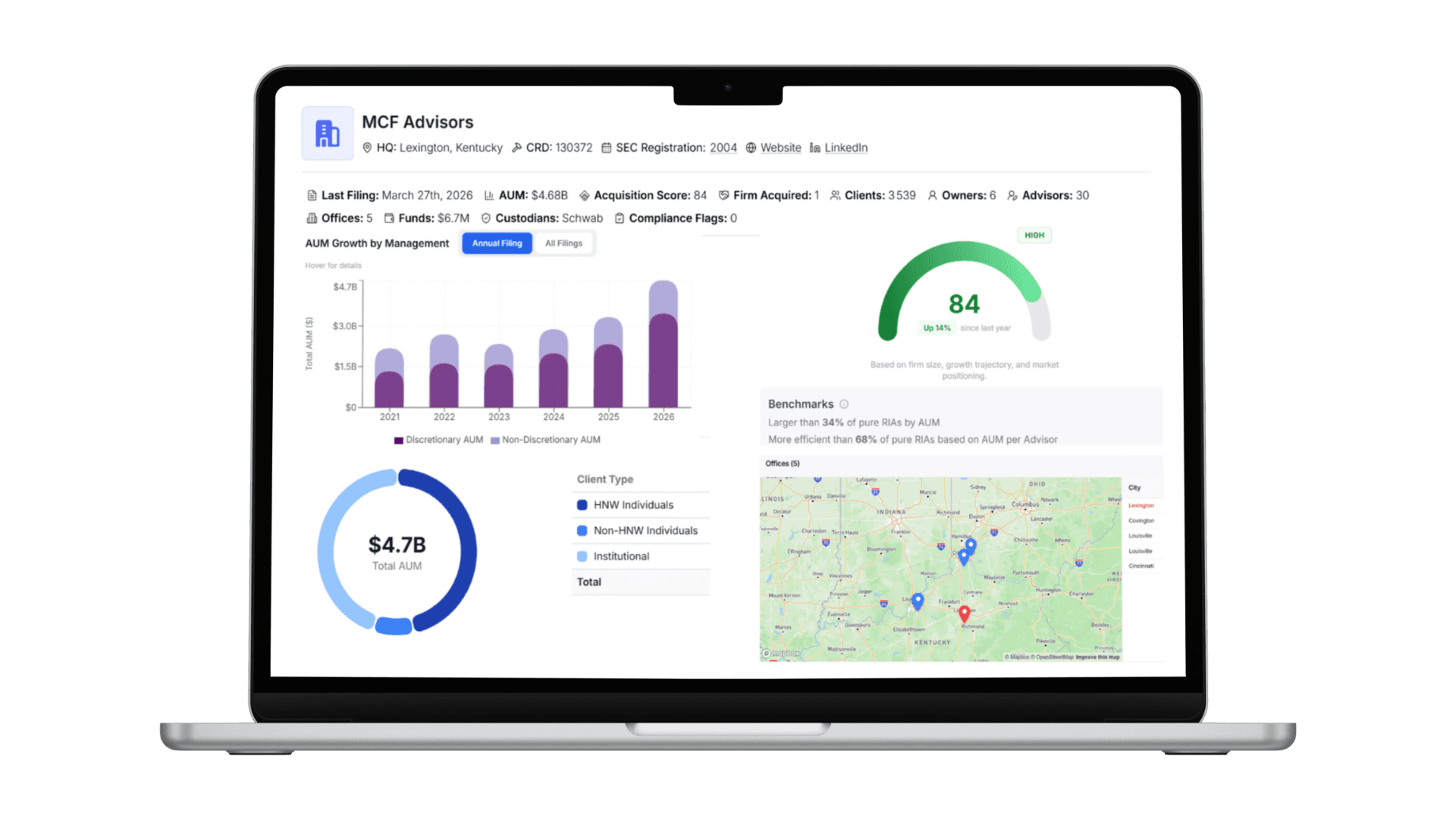
Running a five-metric screen across a regional pipeline of 200+ firms manually requires dozens of hours of ADV research and follow-up. Platforms like RIA Catalyst maintain structured firm-level data — including AUM, advisor demographics, fee trends, custodial relationships, and growth signals — across more than 15,000 SEC-registered RIAs. That infrastructure allows buyers to apply multi-dimensional RIA acquisition screening criteria at the top of the funnel, where it reduces wasted outreach time and surfaces higher-quality targets before they reach a brokered process.
FAQ
If AUM is a flawed metric, why do bankers still organize deals around it?
Because AUM is the most visible, comparable, and defensible metric available at the deal-marketing stage — and bankers are optimizing for competitive processes, not buyer precision. A CIM that leads with AUM reaches the widest buyer universe and maximizes the number of bids. That's rational from the sell-side perspective. From the buy-side perspective, it means every AUM-forward deal has already attracted multiple competitors by the time you see the teaser. That's the structural reason to build a sourcing process that gets ahead of brokered flows.
Can AUM still be useful as a screening input?
Absolutely. AUM is a useful sizing filter, not a quality filter. Using it to bracket the range of deals your team has capacity to evaluate is sensible. Using it as evidence of deal quality is not. The transition from "is this firm a reasonable size for us to evaluate?" to "is this firm a good acquisition?" requires the multi-metric framework. AUM handles the first question. It cannot answer the second.
How do I source the organic growth data for a first-pass screen?
Form ADV Part 1 reports total AUM at the time of filing, which is typically annual. By comparing AUM figures across two or three consecutive filings and adjusting for broad market appreciation, you can construct a rough organic growth estimate. For more precision — and for firms where market-driven changes are hard to separate from organic flows — direct outreach is necessary. Structured firm intelligence platforms that track AUM changes longitudinally make this step significantly faster for large-universe screening.
Does this framework change for PE-backed platform acquisitions vs. independent buyers?
The metrics remain relevant across buyer types, but weights shift. PE-backed platforms often place greater emphasis on revenue quality and organic growth rate because their return models depend on top-line expansion and earnings durability. Independent strategic buyers may weight cultural fit and succession stability more heavily because they are integrating the firm into a longer-duration operating model. The framework is the same; the calibration reflects the buyer's thesis.
Conclusion
AUM became the default RIA acquisition metric because it is visible, comparable, and directly tied to revenue in the simplest fee model. It remains useful as a sizing filter. What it cannot do is distinguish a high-quality acquisition from a large but fragile book, identify organic growth momentum, or surface the succession and revenue risks that drive post-close outcomes. Buyers who treat AUM as a quality signal end up competing for the wrong firms — paying premium prices in crowded processes for deals that disappoint on the metrics that matter. Adding five inputs to the AUM filter costs very little. The alternative — discovering the gaps in diligence — costs significantly more.