Date Published:

In the first week of August 2026, Wealth Enhancement — a platform overseeing more than $159 billion in client assets — announced its acquisition of Miramar Capital, an independent RIA in Northbrook, Illinois managing roughly $592 million. The same week, Mercer Global Advisors added Personal Financial Solutions, a $150 million practice in Manasquan, New Jersey, and Savvy Advisors added two firms totaling about $550 million.
On the surface, the math looks strange. Miramar moves Wealth Enhancement's total assets by less than half a percent. PFS moves Mercer's by a rounding error. Industry data says the big consolidators overwhelmingly target $1 billion to $5 billion sellers — DeVoe's half-year report confirmed it again this cycle. So why do the largest, most sophisticated acquirers in the industry keep writing checks for firms a tenth that size, week after week?
Because tuck-ins are not small versions of platform deals. They are a different product with different economics — and at mega-platform scale, those economics are quietly excellent. Understanding why matters for two audiences: buyers deciding whether sub-$1B M&A is worth the effort, and the thousands of sub-$1B owners wondering what the market really holds for them. This article works through the logic.
The Marginal Cost Advantage
The defining economic fact of a tuck-in at platform scale is that the buyer's infrastructure already exists. Compliance, technology, investment platform, HR, marketing, real estate — all built, all paid for, all running at scale. Absorbing a $600 million practice adds revenue against largely fixed central costs.
Compare the two sides of the same transaction (illustrative):
Factor | Standalone $600M firm | Same firm inside a $150B platform |
|---|---|---|
Compliance function | Dedicated staff and systems | Marginal addition to existing team |
Technology stack | Full licensing and support burden | Incremental seats on platform contracts |
Investment platform | Self-maintained | Plugged into existing research and models |
Management overhead | Full leadership layer | Absorbed into regional structure |
The revenue the firm generates is the same in both columns. The cost to operate it is not. That spread — captured through integration — is the tuck-in's engine, and it exists without modeling any individual expense line: it is the structural consequence of scale.
Integration machinery makes repetition cheap
The second advantage compounds the first. A platform that has integrated dozens of practices has a playbook: repapering timelines, data migration templates, client communication sequences, trained integration staff. Each additional tuck-in reuses that machinery. For a first-time buyer, a $600 million acquisition is a major corporate event. For a serial platform, it is a scheduled workflow. The fixed cost of building the machine has been paid; small deals amortize it further.
What Tuck-Ins Buy Beyond Assets
If tuck-ins were only about marginal economics, platforms would do fewer of them. The strategic payloads are usually the real point.
Geographic infill
This week's examples are textbook. Miramar gives Wealth Enhancement density in the Chicago metro. PFS extends Mercer's coverage on the New Jersey shore. Platforms sell a national service promise; tuck-ins are how the map actually gets filled in, one metro at a time. An office with existing clients, local staff, and a referral network is bought — because building the same presence from zero takes years.
Talent, with a book attached
A $600 million practice typically brings seasoned advisors with capacity. Inside a platform, those advisors receive leads, marketing support, and services their standalone firm could not fund — and their productivity often rises accordingly. In a market where experienced advisors are the binding constraint on growth, tuck-ins function as recruiting with revenue attached.
Client demographics and service fit
Practices are also selected for who their clients are: retirement-stage households needing planning depth, business owners, niche professions. A platform with tax, estate, and trust capabilities buys practices whose clients will consume those services — revenue expansion the standalone firm could never capture.
What This Means for Sub-$1B Owners
The persistent tuck-in bid carries three practical messages for owners below $1 billion.
First, there is a market for your firm — this week's tape proves it at $150 million and at $592 million. The narrative that consolidators only want billion-dollar sellers describes where the most capital concentrates, not where the market stops.
Second, the process is different. Sub-$1B deals are rarely banker-run auctions. They originate in relationships, custodian referrals, and increasingly in data-driven outreach from buyers who identified the firm before it ever considered selling. Owners who wait for a process to find them are choosing the buyer's timing over their own.
Third, fit drives price more than size does. Because the buyer is purchasing infill, talent, and client fit rather than raw scale, the same firm can be worth meaningfully different amounts to different platforms. A practice that fills a geographic hole or feeds an underused service line commands terms a generic bidder would never offer. For sellers, identifying the buyers for whom you are strategic — not just available — is the single highest-leverage act of preparation.
Data Advantage: Finding the Infill Before It's Obvious
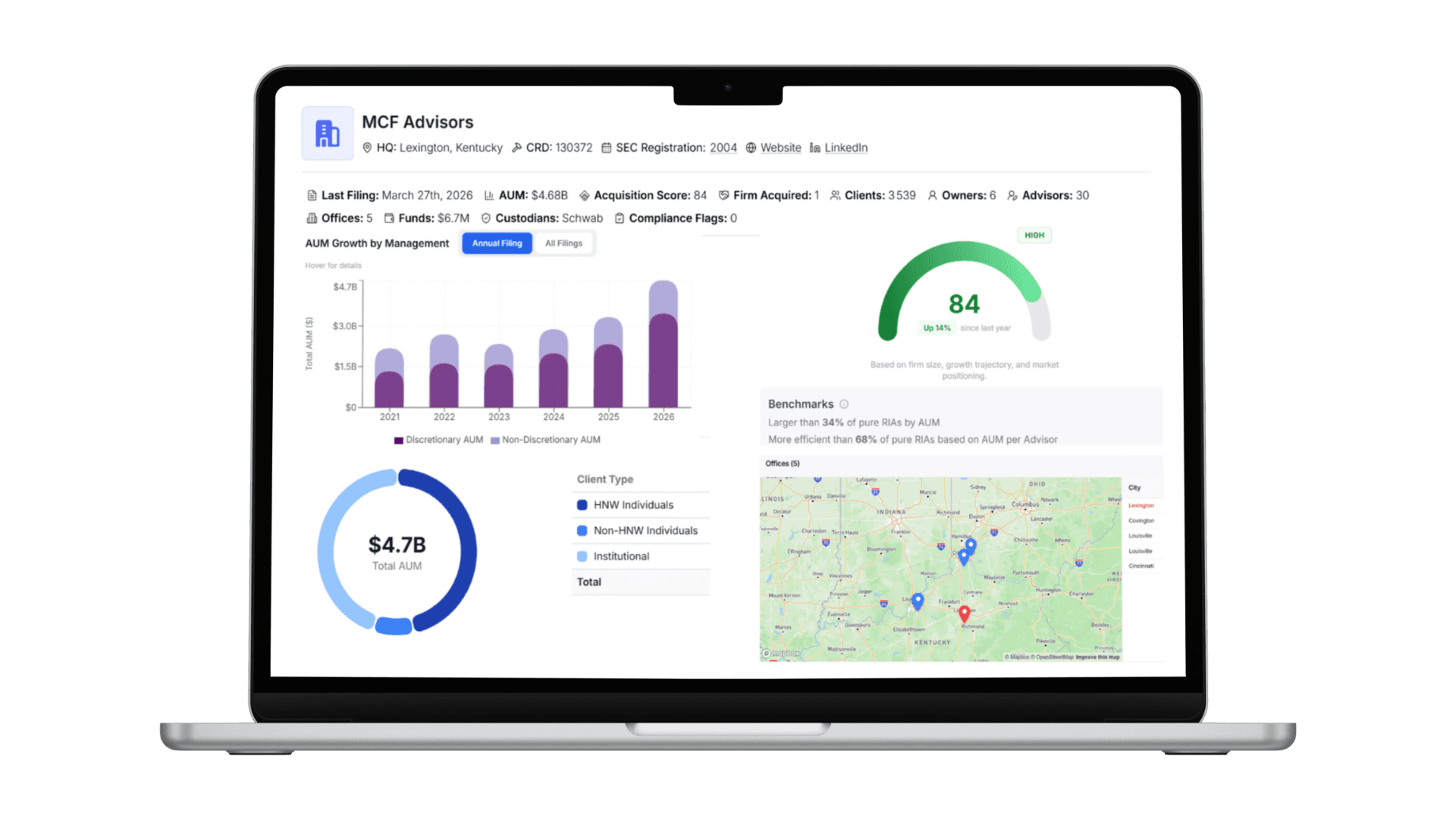
Tuck-in strategy is a mapping problem: which firms, in which metros, with which client profiles, complement an existing footprint. RIA Catalyst structures Form ADV data — AUM, office locations, advisor headcount, growth trajectories, and client composition — across 15,000+ SEC-registered RIAs, letting buyers screen for sub-$1B practices that fit a specific geographic or demographic thesis before any banker is involved. The same lens works for owners: seeing which platforms have gaps your firm fills turns an inbound call from a stranger into a negotiation you anticipated.
FAQ
Why would a $150B platform bother with a $150M practice?
Because the marginal economics are strong and the strategic payload — a metro presence, advisors, client relationships — is bought at a price and integration cost that platform machinery makes trivial. The deal is small; the return on effort is not.
Do sub-$1B sellers get worse terms than $1B+ sellers?
They face fewer simultaneous bidders, which reduces auction pressure. But terms track strategic fit: a practice that solves a specific problem for a specific platform can transact on terms comparable to much larger deals. Preparation and buyer targeting matter more below $1B, not less.
Are tuck-ins integrations or takeovers?
Almost always full integrations. Sub-$1B practices typically adopt the platform's brand, technology, and operations — that is where the economics come from. Owners seeking continued autonomy should be honest with themselves about that trade before starting conversations.
How do platforms find tuck-in targets?
Custodian referral networks, advisor relationships, and increasingly systematic data screening of regulatory filings. The best-run acquirers maintain standing target maps by metro and approach firms years before a transaction.
Is the tuck-in bid cyclical?
Less than the large-deal market. Because tuck-ins are funded by operating economics rather than aggressive leverage, they persist through financing cycles. The steady weekly cadence of sub-$1B deals through every recent market condition supports this.
Conclusion
The week's deal tape answers its own question. Mega-platforms buy sub-$1B firms because at their scale, tuck-ins are close to pure margin with strategy attached: existing infrastructure absorbs the operations, proven machinery absorbs the integration, and the platform gains geography, talent, and client relationships it would otherwise spend years building. For buyers, the lesson is that tuck-in capability — sourcing, playbook, repetition — is a compounding asset worth building deliberately. For sub-$1B owners, the lesson is more personal: the bid for your firm is real and recurring, but it rewards those who understand which buyers need what they have, and who prepare before the phone rings.