Date Published:

For two decades, the custodial referral program was one of the quietest sources of enterprise value in the RIA industry. A firm joined a network, met the service standards, and received a steady flow of qualified prospects it never had to pay to acquire. That flow rarely appeared in a diligence memo as a risk. It appeared as growth.
That assumption is now under pressure. In August 2026, Charles Schwab notified participating advisors that the asset minimum for Schwab Advisor Network referrals would rise from $2 million to $5 million effective January 5, 2027 — a 150% increase in the threshold, and one that came days after the firm took out a full-page Wall Street Journal advertisement, signed by founder Charles Schwab, announcing that it was hiring thousands of additional in-house financial consultants. Schwab framed the change as directing referrals toward each channel's natural clientele. Whatever the framing, the practical effect is that a large band of prospective clients that used to reach independent firms will now be served internally.
For acquirers, this is not primarily a story about one custodian. It is a story about a structural feature of many RIA income statements that has never been stress-tested: growth that depends on a channel the firm does not own, cannot price, and cannot renew. This article sets out how to identify referral dependency in a target, how to quantify its contribution, and how to price it.
Why Channel Dependency Is a Valuation Problem, Not a Marketing Problem
Two firms can report identical AUM, identical growth rates, and identical client counts. If one built its growth through a proprietary engine — centers of influence, professional networks, niche specialization, direct marketing — and the other built it through a custodial network, the two firms carry different risk even though the financials look the same.
The difference is renewal risk. Proprietary channels degrade slowly and predictably. A channel controlled by a third party can change terms in a single memo, with roughly sixteen months of notice, as happened this month. A buyer paying a multiple on current revenue is implicitly paying for the persistence of that revenue and its growth trajectory. If a material share of new client formation runs through a channel whose terms are set elsewhere, the buyer is underwriting a contract it cannot see and cannot influence.
The Three Layers of Exposure
Referral dependency is rarely all-or-nothing. It helps to separate three exposures, because they behave differently after a rule change.
Flow exposure is the share of new clients arriving through the channel in a given year. This is what disappears immediately when a threshold moves.
Stock exposure is the share of existing AUM that originally arrived through the channel. This does not disappear when rules change, but it often carries ongoing fee-sharing obligations that compress the economics of that book relative to organically sourced assets.
Capability exposure is whether the firm has retained the ability to source clients any other way. A firm that has relied on a referral network for a decade may have no functioning business development motion, no marketing infrastructure, and no partner incentives tied to origination. That is the exposure that takes longest and costs most to fix.
Exposure type | What it measures | Behavior after a rule change | Buyer implication |
|---|---|---|---|
Flow | Share of current-year new clients from the channel | Stops at the effective date | Directly reduces forward growth assumptions |
Stock | Share of existing AUM originally sourced from the channel | Persists, often at shared economics | Affects revenue quality, not revenue level |
Capability | Existence of an alternative origination engine | Unchanged by the announcement; revealed by it | Determines cost and time to rebuild growth |
A target with high flow exposure and strong capability elsewhere is a pricing conversation. A target with high flow exposure and no alternative capability is a different business than the one the seller is describing.
Reading Dependency Before You Ask the Question
Sellers rarely volunteer channel dependency, and in a competitive process a buyer may not get a clean answer until well after the indication of interest. There are, however, observable signals available before the first meeting.
Growth Shape
Organic growth built through a broad origination effort tends to be lumpy and correlated with partner activity, hiring, and market cycles. Growth built through a referral program with a fixed asset minimum tends to be unusually smooth and unusually well-clustered around a specific account size band. When a firm's net-new client formation looks like a metronome, the origination mechanism is usually mechanical.
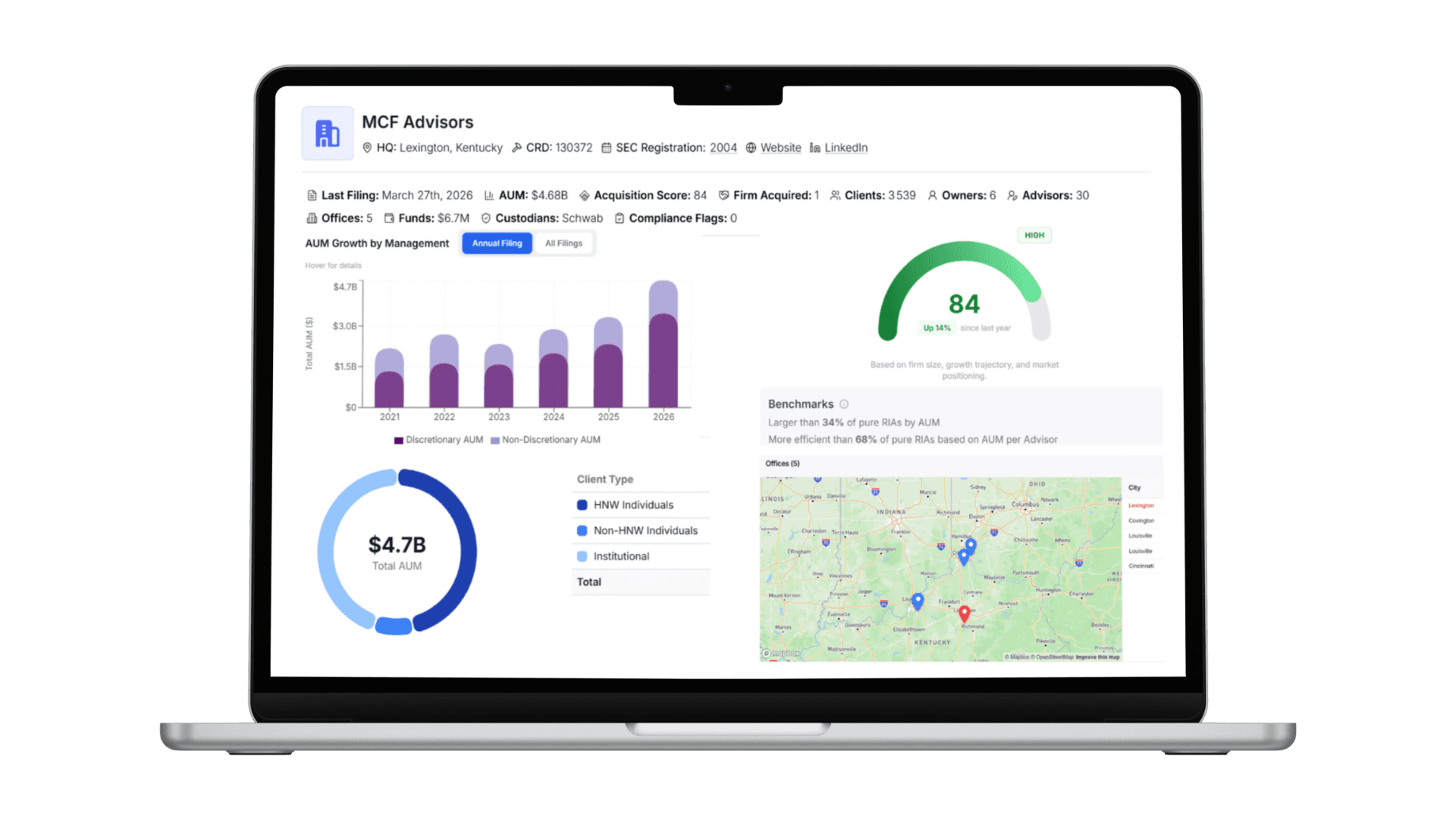
Successive Form ADV filings make this visible. Comparing reported AUM and client counts across filings — and separating market appreciation from net-new flows — produces a growth series that can be inspected for shape, not just level.
Account Size Distribution
Referral programs with minimums create a characteristic distribution: a hard floor at the threshold, a dense band just above it, and a thinner tail. A firm whose relationships cluster tightly just above a well-known industry minimum has probably been fed by a program that uses that minimum. When the minimum moves, the band that fed the firm moves with it.
Custody Concentration
A firm that custodies effectively all of its assets with a single provider is more exposed than one operating a genuine multi-custodian architecture — not only to referral policy, but to pricing, platform, and technology decisions. Custody arrangements are disclosed on Form ADV. Multi-custodian architecture is not automatically better; it carries operational cost. But it changes the negotiating position when the channel owner changes the rules.
Origination Infrastructure
Capability exposure shows up in staffing. A firm with meaningful non-advisory headcount devoted to marketing, client acquisition, or partnerships has an origination engine. A firm with almost none, but strong historical growth, has been receiving its growth from somewhere. Total employee counts and IAR counts are both reported on Form ADV; the gap between them, and how it has evolved, is a rough but useful proxy for whether a firm has invested in anything beyond delivery capacity.
Repricing, Not Rejecting
The correct response to referral dependency is almost never to walk. Firms fed by custodial networks are often excellent operators with high service quality and strong retention — the channel selected for that. The correct response is to move the exposure out of the growth assumption and into the structure.
Separate the Two Halves of the Model
A defensible approach splits the target into a run-rate business and a growth business. The run-rate business — existing relationships, existing revenue, existing retention — is largely unaffected by a referral threshold change. The growth business is where the exposure sits.
Consider a hypothetical firm with $1.2B in AUM and an effective fee rate of 75 basis points, producing roughly $9M in annual revenue (illustrative numbers only). Suppose it has been adding roughly $110M of net-new AUM per year, and roughly 60% of new relationships have historically arrived below a $5M account size. If that band is withdrawn, forward net-new falls toward $45M per year until an alternative engine is built. Over a five-year hold, the difference between those two trajectories is roughly $325M of AUM and, at the same fee rate, roughly $2.4M of annual revenue at exit (illustrative). That gap is not a rounding error in an exit multiple. It is the entire investment thesis for many tuck-in acquisitions.
Structure to the Uncertainty
Where the exposure is material and the seller disagrees with the buyer's read, structure resolves the disagreement more cleanly than argument does. Growth-linked earnouts measured on net-new assets rather than total AUM isolate the variable in dispute. Longer measurement periods — three years rather than one — allow a rebuilt origination engine to demonstrate itself. Retained seller equity aligns the parties on the outcome rather than the forecast.
Underwrite the Rebuild Explicitly
If the thesis requires replacing a lost channel, the plan should exist before close, not after. That means naming the substitute — platform-level marketing, a centralized business development function, professional-network partnerships, a niche specialization — and sizing the investment and the lag. Origination capability typically takes eighteen to thirty-six months to produce reliable flow. A model that assumes the gap closes in year one is not a model; it is a hope.
What This Week's Change Signals About the Next Five Years
The specific threshold matters less than the direction. Custodians, broker-dealers, and asset managers are all repositioning against the same demographic opportunity that made the independent channel attractive in the first place. Schwab's own disclosures make the logic explicit: the $10 million-plus and $25 million-plus segments are now the fastest-growing part of its referral network, so the platform is keeping the smaller households for its in-house advisors and reserving the largest referrals for RIAs. The large platforms are competing for advisor economics and end-client relationships at the same time.
For acquirers, the practical conclusion is that "where does growth come from" should move up the diligence agenda, ahead of several questions that currently sit above it. A firm's ability to originate clients independently is a durable competitive asset. A firm's access to somebody else's origination is a lease with an unknown renewal date.
Data Advantage: Reading Growth Origin Before the First Call
RIA Catalyst structures successive Form ADV filings across 15,000+ SEC-registered RIAs, isolating organic AUM growth from market appreciation and surfacing custody arrangements, IAR counts, total employee counts, and office footprints for every firm. That makes it possible to inspect the shape of a target's growth — its consistency, its clustering, and how much of it is plausibly self-generated — before an outreach call is placed. Buyers who screen on growth origin rather than growth level are the ones who avoid paying an organic-growth multiple for a leased channel.
FAQ
How do I know whether a target participates in a custodial referral program?
Participation is not always disclosed as such, but the components are observable. Custody arrangements appear on Form ADV. Fee-sharing arrangements with a custodian must be disclosed as a conflict of interest in the brochure. Between the custody disclosure, the conflicts language, and the shape of the firm's client size distribution, a reasonably confident inference is usually available before diligence.
Is referral dependency always a discount?
No. It is a discount when the buyer is paying for growth. If the thesis is a tuck-in where the platform supplies all future origination and the target supplies delivery capacity and client relationships, the target's own channel is close to irrelevant — the platform was going to replace it anyway. Dependency matters most in platform acquisitions and in deals underwritten on the target's standalone growth trajectory.
Does multi-custodian architecture protect against this?
Partially. It reduces exposure to any single provider's policy decisions and improves negotiating leverage, but it also raises operational cost and complexity. It is best understood as insurance with a premium rather than as an unambiguous positive. For a firm at scale the premium is usually worth paying; for a firm below a few hundred million in AUM, often not.
What is a reasonable timeline to rebuild origination capability?
Eighteen to thirty-six months from decision to reliable flow, in most cases. Hiring a business development function is fast; building the relationships, content, and reputation that make it productive is not. Buyers should model the lag explicitly rather than assuming a smooth handoff at close.
Should sellers be doing anything differently in light of this?
Sellers who intend to transact within the next three years should be able to demonstrate at least one origination channel they control. That demonstration is worth building before a process starts, not during one, because the evidence a buyer will trust is a multi-year track record rather than a recently announced initiative.
Conclusion
A referral program is a distribution agreement that nobody signed. It produces real growth, but on terms the recipient does not set and cannot renew. This month's threshold change is a reminder that those terms can move, and that they tend to move in the direction of whoever owns the channel.
For acquirers, the discipline is straightforward: separate the growth a target creates from the growth a target receives, price them differently, and structure around the difference. For sellers, the discipline is to build something that survives the memo. In a market where deal volume is at record levels and the pool of quality targets is tightening, firms that can prove they generate their own clients will keep commanding a premium — and the gap between them and the firms that cannot is about to become much easier to see.