Date Published:

Sellers are trained to diligence the acquirer. Look at the deal record, talk to firms that joined two years ago, check whether the integration promises were kept. That is correct and insufficient, because in a private-equity-backed platform the acquirer is not the only party to the deal. Behind it sits a financial sponsor with a fund life, a hold period, and a return target — and that sponsor changes.
August 2026 produced three examples inside four weeks. Vistria agreed to take a majority position in Curi Capital, the $14 billion Chicago-based RIA, with the firm’s existing owners — its employees, prior parent Curi Holdings, and Wealth Partners Capital Group, which had bought a minority position in March — expected to retain stakes alongside the new majority backer. Carlyle replaced Abry Partners as Prime Capital’s backer at a reported $1.8 billion valuation after a roughly three-year hold, as the firm expanded its family office and tax advisory capability. And Carlyle-backed MAI Capital, fresh off its own recapitalization at a valuation exceeding $2.8 billion, closed two acquisitions within days of each other — the $490 million Waypoint Wealth Counsel in Atlanta and the $551 million OG Private Wealth in California.
The pattern is not that PE is arriving in wealth management. It arrived a decade ago. The pattern is that the ownership underneath the consolidators has begun to turn over on a predictable cycle, and most sellers and mid-market buyers still read a platform as though its ownership were permanent.
The Recapitalization Cycle, and Why It Is Predictable
Private capital in wealth management runs to a rhythm. A sponsor invests, the platform acquires for three to five years, growth compounds, and the sponsor sells its position — usually to a larger sponsor, sometimes to a continuation vehicle, occasionally to a strategic buyer. The platform’s name stays the same. Almost everything about its behavior can change.
That new-owner energy is visible in the tape. Vistria’s other wealth platform, the $17 billion Mather Group, completed four acquisitions in the four months immediately after Vistria invested in 2022, then ran a multi-region consolidation. MAI’s burst of deals came right after Carlyle took control. A platform in the first year or two of a new hold behaves very differently from the same platform in year four, and the difference is not strategy drift — it is where the sponsor sits in its cycle.
That behavior maps closely to that position.
Stage of sponsor hold | Typical acquirer behavior | What a seller should expect |
|---|---|---|
Year 1–2 after a new sponsor | Aggressive deployment, expanded pipeline, higher tolerance on price | Fast processes, strong offers, integration capacity still being built |
Year 3–4 | Selective, focused on integrating and proving the thesis | More scrutiny, more structure, slower decisions |
Year 4–5 | Preparing for exit; cosmetic growth prioritized | Deals valued for how they present to the next sponsor |
During a sale process | Effectively frozen on new commitments | Timelines slip without explanation |
Immediately post-recap | Reset mandate, often a new deal thesis | The platform you diligenced is not the platform you are joining |
The last row is the one that costs people money. A seller who spent nine months evaluating a platform under one sponsor and signs under another has diligenced a company that no longer exists in the form they assessed.
The Four Things That Actually Change
The Deal Thesis
A new sponsor buys a platform with a plan. Sometimes that plan is more of the same. Frequently it is a pivot: move up-market, add tax and estate capability, expand a specific region, or build an institutional retirement business. Prime Capital’s expansion into family office and tax advisory alongside its new backer is a visible version of that.
For a seller already in the pipeline, a thesis change can mean the strategic rationale for their deal evaporated. For a competing buyer, it means a platform that ignored your segment for three years may enter it next quarter.
The Cost of Capital
Each sponsor underwrites to its own return requirement. A larger fund with a lower cost of capital can pay more for the same firm; a fund under pressure to show marks may pay more still, but structure it harder. Same platform, same target, different offer — and the difference is not negotiation skill.
Integration Capacity
New sponsors commonly fund technology consolidation, platform migration, and back-office centralization that the prior owner deferred. This is generally good for the enterprise and disruptive for recently acquired firms, who discover that the “you keep your systems” assurance had an implicit expiration date.
Governance and Speed
Investment committee composition changes. Approval thresholds change. A platform that could sign a $500M tuck-in on a partner’s authority may suddenly require full IC approval. Deal velocity is a governance artifact as much as a strategy choice.
How to Diligence a Sponsor, Not Just a Platform
Sellers routinely ask acquirers for references. Almost none ask the questions that determine what the next four years look like.
How long has the current sponsor held this position? A backer in year four is likely preparing an exit. Your deal will be underwritten for how it looks in a sale process, and your integration will happen under the next owner.
Which fund is this, and where is it in its life? A platform bought from a fund’s final vintage carries different pressure than one bought early.
What changed in the deal thesis after the recapitalization? Ask directly. If the answer is vague, the thesis probably changed and nobody wants to say so.
Who has signing authority, and did that change? The person negotiating may no longer be the person deciding.
What is the plan for systems and branding? Ask for the timeline in writing. Prior-owner assurances do not bind a new owner.
What happens to my consideration if the platform recapitalizes during my earnout? This is a drafting question with real money attached. Earnout mechanics tied to platform-level metrics can be distorted by a transaction the seller has no control over.
For a mid-market buyer, the same information is competitive intelligence rather than protective diligence. A newly recapitalized rival with fresh capital is about to get more aggressive in its stated focus areas and less attentive elsewhere. The gaps it leaves are where a smaller buyer wins.
Data Advantage: Watching Platforms Change Shape
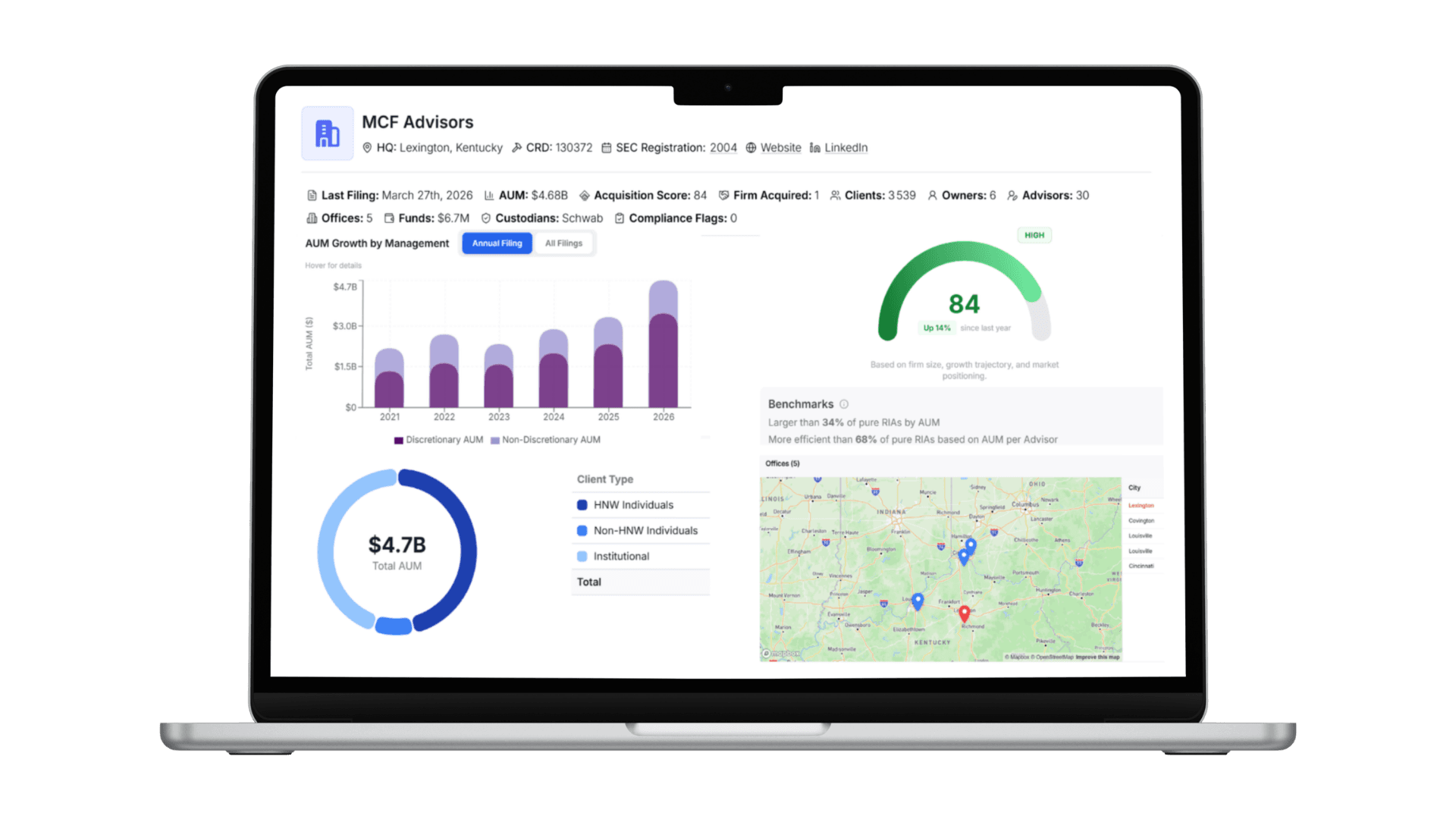
RIA Catalyst tracks Form ADV filings across 15,000+ SEC-registered RIAs, including direct and indirect ownership disclosures, control-person changes, office footprint, and IAR and employee counts. Because those fields update with each filing, ownership turnover at a platform — and the operational changes that follow it, such as consolidating registrations or shifting headcount between offices — becomes visible in the data rather than only in press releases. Sellers can see how long a backer has been in place before entering a process; competing buyers can see which platforms just reset and where they are pointing their capital.
The Seller’s Practical Response
None of this argues against selling to a PE-backed platform. Those platforms pay well, and in a market running at record volume they are where most liquidity lives.
It argues for three specific adjustments.
First, treat sponsor timing as a deal variable. Selling into year one of a new hold generally means a better price and a more focused counterparty than selling into year four.
Second, put the assurances that matter into the documents. Brand retention, systems timelines, reporting lines, and team structure are worth exactly as much as their contractual status. A new sponsor inherits obligations, not intentions.
Third, structure consideration to survive an ownership change. Earnouts keyed to metrics the seller can influence — their own firm’s revenue or client retention — behave far better across a recapitalization than earnouts keyed to platform-level outcomes.
FAQ
Does a recapitalization mean my earnout is at risk?
Not automatically, but it introduces risk that depends entirely on how the earnout was drafted. Provisions tied to the acquired firm’s own performance are relatively resilient. Provisions tied to platform-level results, or payable in platform equity valued at the platform’s discretion, are exposed to decisions the seller cannot influence. Read the change-of-control language before signing, not after.
How can a seller find out where a platform sits in its sponsor’s hold period?
Most recapitalizations are publicly reported in the trade press, and Form ADV ownership disclosures show when institutional owners appear and disappear. Combining the two gives a reasonable estimate of hold duration. Asking the acquirer directly is also legitimate; a platform that will not answer has told you something.
Is a newly recapitalized buyer better or worse to sell to?
Generally better on price and focus, since capital is fresh and the mandate is to deploy. The offsetting risk is integration: a new sponsor often funds platform-wide consolidation that recently acquired firms experience as disruption. Better economics, more operational change.
Do sponsor changes affect the acquired firm’s clients?
Indirectly and usually with a lag. Clients rarely notice an ownership change at the sponsor level. They do notice platform migrations, portal changes, and reporting changes, which are frequently funded by a new owner. The exposure is second-order but it is not zero.
As a smaller buyer, how do I compete with a freshly recapitalized platform?
Not on price in their declared focus areas. The opportunity is in the segments the new thesis de-emphasizes, and in sellers who value autonomy and identity over the highest number. Those sellers exist in meaningful numbers and they are systematically underserved by platforms optimizing for scale.
Conclusion
Consolidator names are stable. The capital behind them is not. A platform’s sponsor determines its cost of capital, its deal thesis, its approval speed, and whether the integration promises made this year survive into the next ownership period.
For sellers, that makes sponsor timing as material as headline price and worth putting into the documents rather than the conversation. For buyers, it makes ownership turnover among rivals a source of usable intelligence — a newly recapitalized competitor tells you where the money is about to go, and where it is about to stop going. Either way, the platform is not the whole counterparty. It is the part with the logo.