Date Published:

Not all AUM is created equal, and nowhere is that clearer than in the ultra-high-net-worth segment. A firm managing $2B for forty ultra-wealthy families is a fundamentally different business from one managing $2B across two thousand mass-affluent households — and a buyer who evaluates the two with the same playbook will misprice both. The UHNW firm looks similar on a screening spreadsheet and behaves nothing like its mass-market counterpart once you understand how it actually operates.
Ultra-high-net-worth RIAs are among the most coveted acquisition targets in wealth management, and for good reason: high revenue per relationship, sticky multi-generational clients, and pricing power that mass-market firms cannot match. But those same characteristics make them harder to acquire well. The relationships are deeply personal, the service model is bespoke, and the risks concentrate in ways that standard diligence can miss.
This article explains what makes UHNW RIAs structurally different, why those differences change how a buyer should evaluate them, and where the specific risks and premiums live. It is written for acquirers who want to target this segment deliberately rather than stumble into it.
What "Ultra-High-Net-Worth" Actually Changes
The UHNW label is not just a bigger version of a wealthy client. It changes the economics, the service model, and the risk profile of the entire firm.
The economics are driven by revenue concentration and depth per relationship. A UHNW firm generates a large share of its revenue from a small number of relationships, each of which is highly profitable and highly demanding. The service model is correspondingly intensive: these clients expect bespoke planning, direct access to senior advisors, and coordination across tax, estate, philanthropy, and often operating businesses or illiquid holdings. And the risk profile is defined by that same concentration — the loss of a single major relationship can move the firm's revenue in a way that would be unthinkable at a mass-market firm.
A buyer who understands this evaluates a UHNW target on entirely different axes than a mass-affluent one: not scale of household count, but depth, durability, and transferability of a small number of exceptional relationships.
Why the Relationships Are Harder to Transfer
The central acquisition risk in UHNW is that the value is embedded in relationships that may not survive a change of ownership. Ultra-wealthy clients choose their advisors with extraordinary care and stay for decades, but that loyalty is personal and earned, not institutional. It does not automatically transfer to a new owner.
Several factors intensify this. UHNW relationships are often multi-generational and interwoven with the family's most sensitive affairs, which raises the bar for trust and makes clients wary of change. They are frequently anchored to a specific senior advisor or the founder personally, which concentrates key-person risk. And because each relationship is so valuable, the departure of even a few clients following an acquisition can materially impair the economics that justified the price.
This is why UHNW acquisitions live or die on retention, and why the structure of the deal — earnouts, transition periods, non-solicits, and the genuine retention of the advisors who hold the relationships — matters even more than in a typical RIA transaction.
The Concentration Problem
Concentration is the defining risk of the segment, and it cuts two ways. Revenue is concentrated in a small number of relationships, and those relationships are often concentrated in a small number of advisors. A firm can look attractively profitable while sitting on exactly the fragility a buyer should fear most.
The difficulty for an acquirer is that the most granular concentration data — how revenue splits across individual clients, or which advisor personally holds which relationships — is not something available from public filings, and a buyer should be cautious about assuming they can quantify it precisely before deep diligence. What is observable from structured data is the shape of the firm: its total AUM relative to a small IAR count, its advisor depth, and its per-relationship scale relative to peers. Those indicators flag a firm as likely concentration-heavy and signal that concentration and retention must become the central focus of diligence, even before the internal detail is available.
Reading Productivity in the UHNW Context
Productivity ratios behave differently in UHNW firms, and misreading them is a common error. A UHNW firm often shows a very high AUM per advisor — but that figure counts only the firm's registered investment adviser representatives. It does not capture the non-IAR professionals a UHNW firm typically employs: tax specialists, estate coordinators, philanthropic advisors, and dedicated client-service staff. A firm can post an impressive AUM-per-advisor number precisely because so much of its team sits outside the IAR count.
To understand the real staffing model, a buyer has to look at AUM per employee, which measures assets against the entire headcount. This is where the service-intensive nature of UHNW reveals itself: the same firm that looks exceptionally lean on AUM per advisor may look far more staffed on AUM per employee, reflecting the deep bench of specialists required to serve ultra-wealthy families. Neither ratio is "good" or "bad" in isolation — the point is that a UHNW firm's staffing model is intentional, and reading only AUM per advisor will badly overstate how lean the business actually is.
Metric | What it captures in a UHNW firm | Interpretation risk |
|---|---|---|
AUM per advisor | Assets per registered IAR only | Can look very high; excludes non-IAR specialists |
AUM per employee | Assets across total headcount | Reveals the true service-intensive staffing model |
Revenue per relationship | Depth and profitability per client | High, but concentrated — durability matters more than size |
Where the Premium Comes From — and When It's Justified
UHNW firms command premium valuations, and the premium is often justified — but only when the characteristics that create it are durable rather than fragile.
The premium is warranted when the firm's revenue is genuinely sticky, when relationships are held by a team rather than a single departing founder, when the client base spans generations in a way that extends the revenue horizon, and when the firm's pricing power reflects real service differentiation rather than legacy relationships that a competitor could poach. In those cases, a buyer is paying for a durable, high-margin book that is hard to replicate.
The premium is a trap when the same headline attractiveness masks concentration in one or two relationships, dependence on a founder who is about to leave, or client loyalty that is personal and non-transferable. A buyer who pays the premium without confirming durability is paying for a business that may partially walk out the door after close. The discipline in UHNW acquisition is separating the firms where the premium reflects durable value from those where it reflects fragility dressed up as quality.
Data Advantage: Identifying and Sizing UHNW Targets
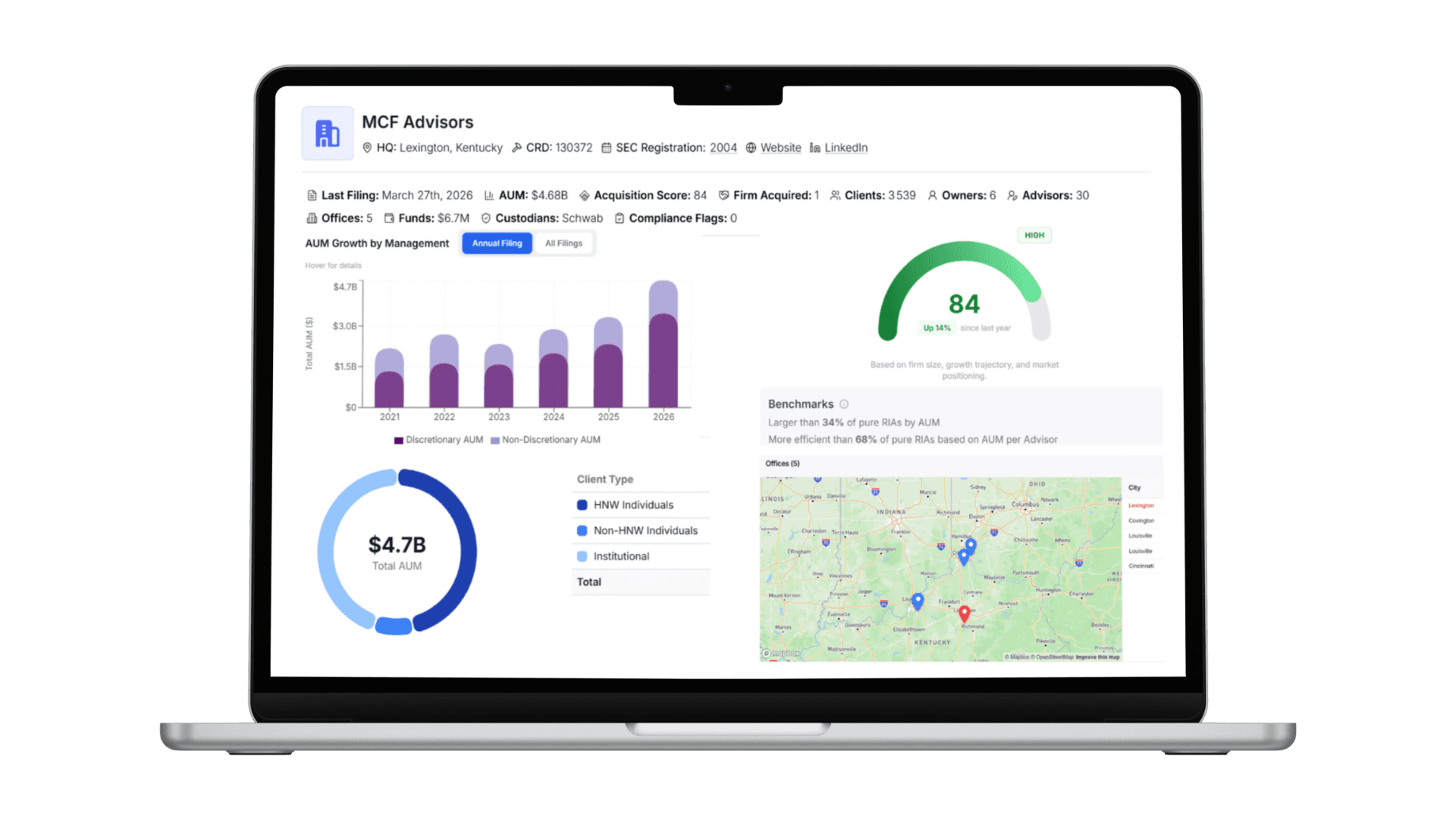
RIA Catalyst tracks AUM, IAR and employee counts, per-relationship scale, and growth trajectory across 15,000+ SEC-registered RIAs, drawing on structured Form ADV data. For buyers targeting the UHNW segment, this makes it possible to identify firms whose profile — high AUM against a small IAR base, deep non-advisor staffing, elevated per-relationship scale — marks them as ultra-high-net-worth specialists, and to prioritize the ones whose structure suggests durable rather than fragile concentration before investing diligence resources.
FAQ
What makes ultra-high-net-worth RIAs different to acquire?
Their economics, service model, and risk profile all differ from mass-market firms. UHNW firms earn a large share of revenue from a small number of deep, demanding relationships served by an intensive, specialist-heavy team. That produces high profitability and pricing power, but also concentration and key-person risk that make retention — not scale — the central acquisition question.
Why is client retention such a big risk in UHNW acquisitions?
Because the value lives in personal, often multi-generational relationships that clients built with specific advisors, not with the institution. That loyalty does not transfer automatically to a new owner, and because each relationship is so valuable, losing even a few after close can impair the economics that justified the price. Deal structure and advisor retention become decisive.
Why can AUM per advisor be misleading for UHNW firms?
Because it counts only registered IARs and excludes the tax, estate, philanthropic, and client-service specialists a UHNW firm typically employs. A UHNW firm can show a very high AUM per advisor precisely because much of its team sits outside the IAR count. AUM per employee, which uses total headcount, reveals the true service-intensive staffing model.
When is a UHNW valuation premium justified?
When the characteristics creating it are durable: sticky revenue, relationships held by a team rather than a departing founder, a multi-generational client base, and pricing power rooted in real service differentiation. The premium becomes a trap when it masks concentration in one or two relationships, founder dependence, or loyalty that is personal and non-transferable.
Can concentration risk be assessed before deep diligence?
Partially. The most granular data — revenue by individual client, or which advisor holds which relationship — is not in public filings and should not be assumed before diligence. But the firm's shape is observable: high AUM against few IARs, advisor depth, and per-relationship scale flag a firm as likely concentration-heavy, signaling that retention and concentration must be the focus of diligence.
Conclusion
Ultra-high-net-worth RIAs are among the most valuable firms in wealth management, and among the easiest to misprice. Their premium is real when it reflects durable, team-held, multi-generational relationships — and a trap when it masks concentration and founder dependence dressed up as quality. Acquiring them well means abandoning the mass-market playbook: reading productivity through both AUM per advisor and AUM per employee, treating retention as the central question rather than an afterthought, and confirming that the value which commands the premium will still be there the morning after close. The buyers who target this segment deliberately, with the right lens, access some of the best businesses in the industry. The ones who apply a generic playbook overpay for fragility.