Date Published:

Transcend Capital Advisors was founded in 2019. Seven years later, in a transaction that closed on July 31, 2026, it joined Arax Investment Partners with more than $3 billion in assets under management, four state footprints, and over 1,000 client relationships. Co-founded by former New York Stock Exchange CEO Duncan Niederauer and a group of partners, the firm went from formation to a scaled exit inside a single market cycle.
A generation ago, that timeline described almost no one. The typical RIA that sold at $3 billion had spent twenty-five or thirty years getting there — a founder's full career compressed into a single liquidity event at the end. Transcend's arc is different in kind, not just speed: a firm built by experienced operators, capitalized and structured for scale from day one, and sold while its founders were still mid-career.
This is not an isolated case. It is the leading edge of a structural change in how RIA enterprise value gets created — and it changes what acquirers underwrite, what fast-build founders should optimize, and how legacy firms should read their own competitive position. This article breaks down the anatomy of the compressed build-to-exit timeline.
The Old Timeline and the New One
The classic RIA lifecycle ran in decades. Found the firm in your thirties, compound clients and referrals through your forties and fifties, confront succession in your sixties, and sell — often reluctantly — as the final act. Enterprise value was a byproduct of a practice, not a design objective.
The compressed model inverts this. The firm is designed as an enterprise from formation: institutional-grade operations, professional management, multi-advisor structure, and often external capital or pedigree founders. The exit is not the end of a career; it is a planned milestone in one.
Dimension | Legacy build (illustrative) | Compressed build (illustrative) |
|---|---|---|
Time to $1B AUM | 15–25 years | 3–5 years |
Growth engine | Referrals, market appreciation | Breakaway teams, sub-acquisitions, recruiting |
Founder profile | Practitioner-advisor | Operator-executive, often with prior exits |
Structure at $1B | Founder-centric | Multi-partner, professionally managed |
Exit trigger | Retirement, succession pressure | Strategic timing, capital partner horizon |
Numbers are illustrative of the two archetypes, not specific firms.
What compresses the timeline
Three inputs recur in fast-build firms. First, breakaway supply: experienced wirehouse and bank teams now move with their books at scale, letting a new RIA acquire decades of client relationships in a single hire. Second, available capital: minority investors and lending platforms fund recruiting packages and sub-acquisitions that were previously self-financed. Third, founder pedigree: operators with prior institutional careers bring networks, credibility, and management capability that shortcut the trust-building a first-time founder spends years on.
What Acquirers Underwrite Differently in a Fast-Build Firm
A $3 billion firm built in seven years and a $3 billion firm built in thirty are not the same asset, even at identical headline AUM. Sophisticated buyers price the differences.
Growth durability versus growth history
The legacy firm's slow compounding demonstrates durability — clients who stayed twenty years will likely stay through a transition. The fast-build firm's growth is more recent and more concentrated in acquired relationships. The underwriting question is whether assets recruited in are as sticky as assets grown organically. Successive Form ADV filings answer much of this: organic growth net of market appreciation, client count trajectory, and advisor retention are all observable over time.
Team-embedded versus founder-embedded relationships
Ironically, fast-build firms often score better here. Because they were assembled from teams rather than grown around one rainmaker, client relationships tend to sit with multiple advisors and a service structure — reducing the single-point-of-failure risk that haunts founder-centric legacy firms.
Infrastructure as an asset, not a project
A firm designed for scale typically arrives with modern custodial arrangements, clean data, and management reporting a buyer can plug into. Integration cost is lower and time-to-synergy shorter. Buyers increasingly pay for this — the market has been repricing capabilities relative to raw assets for several years.
The pedigree premium and its limits
Founder credibility accelerates everything: recruiting, client acquisition, buyer interest. But buyers also test whether the enterprise is separable from the personality. The diligence question is the same one applied to any founder-led firm — does the machine run without its most famous part — asked with higher stakes.
What Fast-Build Founders Should Take From This
For operators building on the compressed timeline, the Transcend arc suggests a checklist of what made the outcome possible: multi-state footprint established early, high-net-worth client focus with planning depth, partnership structure rather than solo ownership, and a growth record legible in public filings. Enterprise value is built into the design, then documented where buyers can verify it.
Timing matters as much as construction. Selling in year seven, into the most active buyer market on record — Echelon Partners counts 262 deals in H1 2026 and a pace toward roughly 500 for the year — captures both firm-specific momentum and market-wide demand. Waiting for year twelve risks discovering that consolidator appetite, financing conditions, or the founder's own energy have moved.
What Legacy Firms Should Take From This
If you run a firm built the old way, the fast-build cohort is your new comparable set. Buyers now benchmark your growth rate, advisor productivity, and infrastructure against firms constructed this decade. A twenty-five-year history is an asset — retention proof, brand depth, referral networks — but it no longer commands a premium by itself. The legacy firms that price best are the ones that can show current-cycle organic growth and next-generation capacity, not just tenure.
Data Advantage: Reading Build Velocity in the Filings
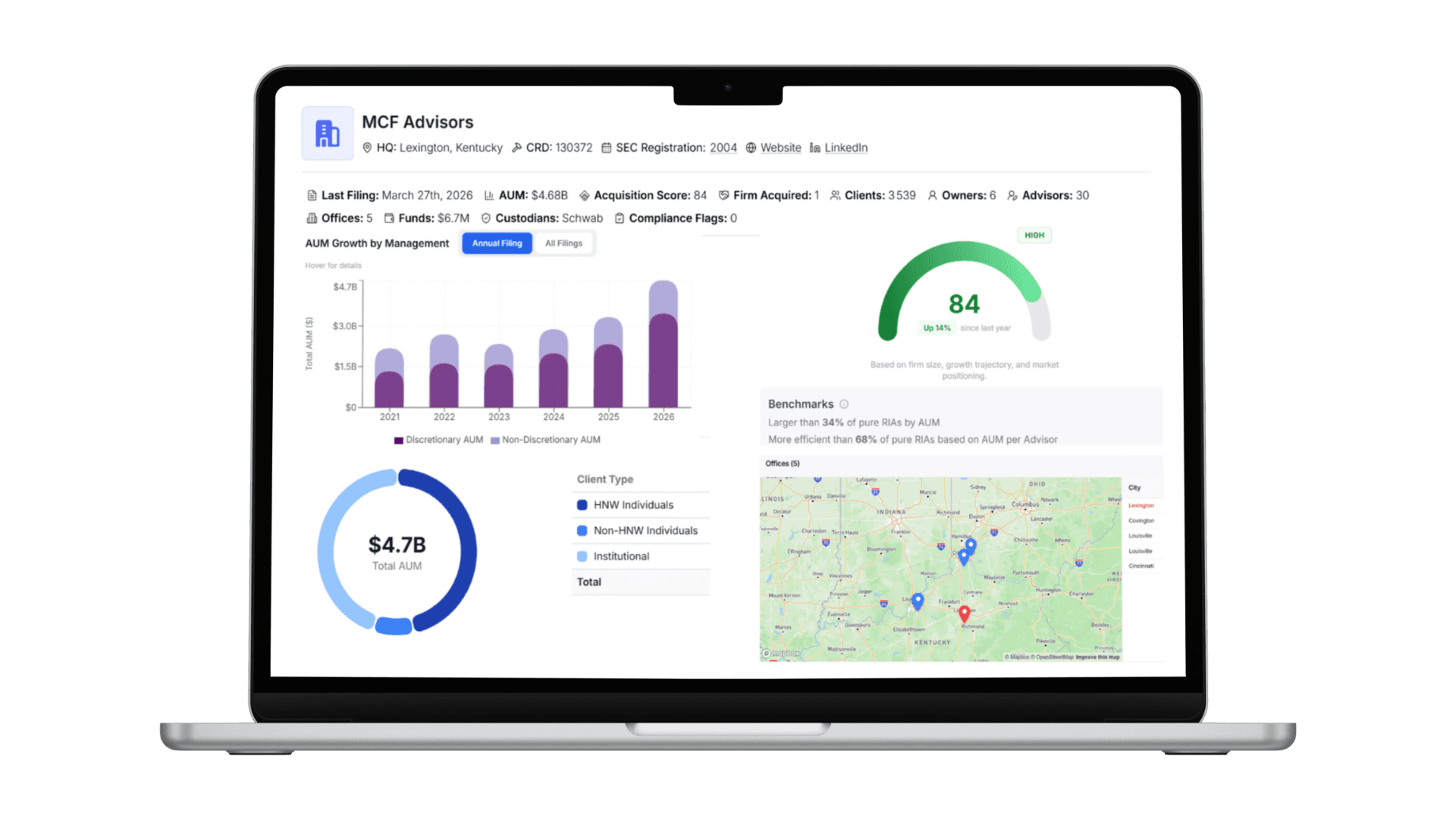
Every RIA's construction speed is public, if you know where to look. RIA Catalyst structures successive Form ADV filings across 15,000+ SEC-registered firms into growth trajectories: AUM change net of estimated market effect, IAR headcount movement, office expansion, and client count evolution. That makes fast-build firms identifiable years before they transact — and lets buyers and sellers alike benchmark any firm's velocity against its true peer cohort rather than against averages.
FAQ
Are fast-build RIAs riskier acquisitions than legacy firms?
Different, not categorically riskier. The risk shifts from key-person concentration (legacy) to growth durability and asset stickiness (fast-build). Diligence weight should shift accordingly — retention data and organic growth decomposition matter more; founder dependence analysis matters somewhat less.
Does a celebrity or institutional founder actually increase firm value?
It accelerates growth and buyer interest, which raises value indirectly. But buyers underwrite the enterprise, not the biography. Pedigree that translated into team depth and client relationships is priced; pedigree that remained a personal brand is discounted.
What is a realistic build-to-exit timeline in 2026?
Firms combining breakaway recruiting with sub-acquisitions have demonstrably reached multi-billion scale in five to eight years. That remains the exception, not the norm — it requires experienced operators, capital access, and a favorable recruiting market, all at once.
Should fast-build founders plan the exit from day one?
Design for it; do not schedule it. Firms structured to be acquirable — clean data, partnership equity, documented growth — keep every option open, including staying independent. Firms that defer structure until a sale process pay for it in price and terms.
How do buyers verify organic growth claims in a fast-build firm?
Primarily through Form ADV time series: AUM changes across filings, netted against market performance, cross-read with client counts and advisor headcount. Recruited AUM, acquired AUM, and true organic flows leave different signatures in the data.
Conclusion
Transcend's seven-year arc from formation to a $3 billion exit is a data point in a larger repricing of time itself in the RIA market. Enterprise value that once took a career to build can now be constructed inside a decade — by operators who treat firm-building as the product, not a byproduct of practicing. For buyers, that means underwriting build quality, not just tenure. For founders on either timeline, it means the same thing it always has, with a shorter fuse: the firms that command premiums are the ones designed, documented, and timed for the market they will actually meet.