Date Published:

Most acquisition screens are built on assets. AUM is the number in the headline, the number in the press release, and the number that determines whether a firm makes it onto a target list. It is also, for the purpose of predicting what a firm will look like in two years, one of the slowest indicators available.
AUM moves for three reasons: market appreciation, net client flows, and advisor movement. The first is noise. The second is meaningful but lagging — clients rarely leave immediately when their advisor does. The third leads both, and it is separately observable.
The context makes this urgent. Advisor recruiting and inter-firm movement are running at multi-year highs, with the industry's largest teams now among the most mobile, and senior executives shifting between custodians and independent broker-dealers as competition for advisor affiliation intensifies. In a market this fluid, a firm's advisor roster is changing faster than its asset base — and the roster is disclosed.
What Headcount Velocity Measures
Every SEC-registered adviser reports the number of investment adviser representatives and the total number of employees on Form ADV, updated at least annually and more often when material changes occur. The absolute figures are of limited interest on their own. The rate of change, and the relationship between the two series, is where the signal is.
Four distinct patterns emerge when those series are tracked across successive filings.
Pattern | IAR count | Total employees | AUM | Typical interpretation |
|---|---|---|---|---|
Scaling | Rising | Rising faster | Rising | Investing in infrastructure ahead of growth; capacity being built |
Loading | Rising | Flat | Rising slowly | Adding advisors without support; capacity strain likely |
Thinning | Falling | Flat or falling | Flat or rising | Departures masked by market appreciation; investigate |
Consolidating | Falling | Falling | Rising | Post-acquisition rationalization or deliberate upmarket shift |
The "thinning" row is the most valuable to a buyer and the least visible in a conventional screen. A firm losing advisors while its AUM holds steady looks healthy on an asset-based screen. It is not healthy. It is a firm where market appreciation is temporarily covering client attrition that has already begun.
Why Departures Lead Asset Losses
When an advisor leaves an RIA, the clients do not follow immediately. Transition friction, account paperwork, custodial changes, and simple inertia mean that the asset consequence of a departure typically shows up over the following four to eight quarters, not in the quarter the advisor leaves.
That lag is the opportunity. A buyer tracking IAR counts sees the departure in the filing. A buyer tracking only AUM sees the consequence a year and a half later, by which point the firm's story has already been rewritten — usually as a market-driven decline rather than an advisor-driven one.
The same lag runs in the other direction. A firm that has recently added several experienced advisors will show elevated IAR count before those advisors' books have fully transitioned. That firm's forward AUM growth is substantially more predictable than its trailing growth suggests, and it is frequently underpriced on trailing metrics.
Building the Screen
Headcount velocity is only useful when normalized, because raw counts favor large firms and raw percentage changes favor small ones.
Normalize Against Firm Size
A net change of two IARs at a twelve-person firm is a 17% shift in advisory capacity. The same change at a hundred-advisor platform is noise. Expressing change as a percentage of prior-period headcount handles this, but percentage changes become unstable below roughly eight IARs, where a single departure produces a dramatic-looking figure. For small firms, absolute change combined with tenure context is more informative than a ratio.
Pair Headcount With Organic Growth
The most informative screen combines two series: change in IAR count, and organic AUM growth net of market appreciation. Isolating organic growth requires comparing successive filings against market performance over the same interval, which removes the single largest source of false signal in asset-based screening.
A firm with rising IARs and rising organic growth is compounding. A firm with rising IARs and flat organic growth is hiring without converting — either the new advisors have not transitioned their books, or the firm is adding capacity it cannot fill. Those two explanations have opposite implications and are distinguished by looking at the next filing.
Watch the IAR-to-Employee Ratio
The relationship between IAR count and total employee count describes how a firm is built. A rising ratio of IARs to total employees means advisors are being added faster than support, which usually precedes a service quality problem. A falling ratio means infrastructure investment, which usually precedes either a growth push or a margin problem, depending on whether the growth arrives.
One caveat matters throughout. The IAR count on Form ADV captures registered representatives only. It excludes non-IAR professionals — tax coordinators, estate planning specialists, client service associates — who may be central to the client relationship without being registered. A firm building a multi-family-office capability may show flat IAR headcount and rising total employees for entirely constructive reasons. Reading the two series together, rather than either alone, avoids that misinterpretation.
Where the Signal Is Most Actionable
Headcount velocity is most useful in three specific situations.
Identifying Firms Under Strain Before They Are In Play
A firm that has lost advisors in consecutive filing periods is under some kind of pressure — succession, compensation, culture, or strategy. That firm is more likely to consider a transaction in the next twenty-four months than a stable peer, and considerably more likely to consider one before it runs a process. A watch-list built on consecutive-period IAR decline surfaces those firms while the conversation is still bilateral.
Validating a Target's Growth Story
Sellers present growth. Headcount data tests whether that growth came from client acquisition or from advisor recruitment, which are very different things to buy. A firm whose AUM growth is fully explained by advisor additions has bought its growth, and the buyer will need to keep buying it. A firm whose AUM growth outpaced its headcount growth has genuine operating leverage.
Monitoring the Buy Side
The same data works in reverse. A platform's acquired affiliates continue to file. Tracking IAR counts at those affiliates in the two years after close shows whether a given acquirer retains advisors or loses them. For a seller evaluating buyers, and for a competing buyer evaluating a rival's integration capability, that record is public and rarely examined.
Data Advantage: Turning Filing Changes Into a Watch List
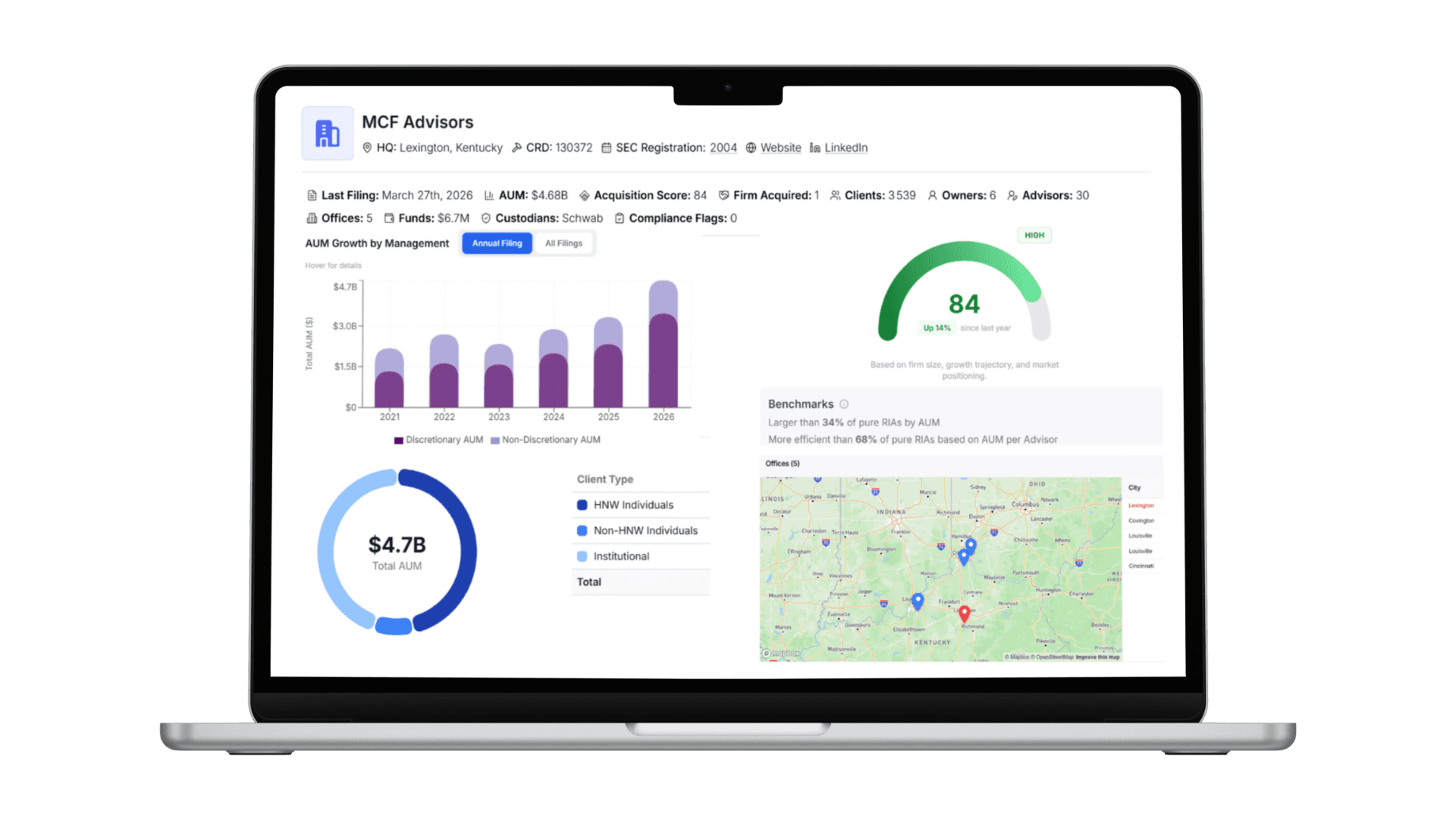
RIA Catalyst tracks IAR counts, total employee counts, office footprints, and organic AUM growth across 15,000+ SEC-registered RIAs, comparing successive Form ADV filings so that changes surface as a time series rather than as isolated snapshots. Because the platform separates organic growth from market appreciation, headcount movement can be read against real client flows rather than against index performance. Buyers using it can build standing screens — consecutive-period IAR decline, headcount growth outpacing organic growth, affiliate retention after close — that flag firms months before those changes become visible in reported assets.
FAQ
How often is IAR headcount updated on Form ADV?
Advisers file an annual updating amendment within ninety days of fiscal year end, and other-than-annual amendments when certain information becomes materially inaccurate. In practice, headcount is refreshed at least annually for every registered firm, with more frequent updates at firms undergoing significant change. That cadence is slower than real time but considerably faster than the point at which advisor movement becomes visible in reported assets.
Does a falling IAR count always indicate a problem?
No. Retirements, a deliberate move upmarket, or the consolidation of registrations after an acquisition all reduce IAR counts for benign reasons. The distinguishing test is what happens to organic growth and total employees at the same time. A decline accompanied by stable organic growth and stable support headcount is usually structural. A decline accompanied by weakening organic flows is usually attrition.
Can this identify which specific advisors left?
Individual representative registrations are publicly searchable, so movements can often be reconstructed at the individual level. For screening purposes, however, the aggregate change is usually sufficient — the objective is to identify firms worth a closer look, not to build a roster.
How does advisor recruitment affect the reading?
A firm that recruits aggressively will show rising IAR counts before the associated assets arrive, creating a temporary period where headcount growth outpaces AUM growth. This is a positive signal misread as a negative one on ratio-based screens. Checking whether office count and total employees are also rising helps distinguish genuine recruitment from a registration artifact.
Is this useful for firms below $500 million in AUM?
Yes, though with more care. Percentage-based measures become volatile at small headcounts, so absolute changes and multi-period trends are more reliable than single-period ratios. At the smallest firms, the departure of one of three advisors is a material event that no asset-based screen will detect for a year.
Conclusion
Assets tell you what a firm has accumulated. Advisor headcount tells you what it is currently capable of, and which direction that capability is moving. In a market where advisor mobility is running at a multi-year high, the second question is the more predictive one.
The data is public, updated at least annually, and consistently underused — largely because it requires comparing filings across time rather than reading any single filing carefully. Buyers willing to do that comparison get a twelve to eighteen month head start on a change that everyone else will eventually see in the AUM line.