Date Published:

The wealth management trade press spent this week describing something new: an AI arms race inside the RIA sector. Firms are no longer debating whether to adopt AI tooling — they are racing to deploy it across meeting preparation, client communication, portfolio operations, and compliance workflows. The same week, Wells Fargo rolled out an AI assistant to its advisor force, a signal that the largest distribution channels consider AI-augmented advisors the new baseline.
For RIA dealmakers, this is not a technology story. It is an underwriting story.
Every durable shift in how advisory firms operate eventually shows up in how they are bought and sold. Custody consolidation did. Fee compression did. The move from commission to fee-only did. AI adoption is following the same path, and faster: it changes the economics of serving a client, the scalability of a team, the risk profile of a compliance program, and the durability of a firm's growth — all of which are things buyers price.
This article examines how AI capability is entering RIA M&A: what buyers should actually evaluate (and what is noise), how AI changes integration math, where the new risks sit, and why the gap between AI-forward and AI-passive firms will become a valuation gap before most sellers realize it.
From Back Office to Deal Term: Why AI Entered the M&A Conversation
Three forces pushed AI from an operations topic to a transaction topic.
The economics are now measurable
Early AI deployments in advisory firms were experiments. In 2026, the use cases are concrete: automated meeting notes and follow-ups, drafting of planning documents, prospect research, service-tier triage, operational reconciliation. Firms deploying these tools serve more households per professional without degrading service. Anything that changes output per professional changes what a buyer is underwriting.
Buyers are building platform-level AI theses
Large acquirers are no longer evaluating targets in isolation. A platform that has invested in a centralized AI stack values a target differently depending on whether the target's data, processes, and team can plug into that stack. Clean data architecture and documented workflows now function the way clean books always have — as integration accelerants.
The talent dimension flipped
For years, technology diligence meant checking which vendors a firm licensed. The differentiator now is whether the team actually uses the tooling — adoption depth, not license count. A firm whose advisors work AI-augmented workflows daily is operationally different from a firm that bought the same licenses and ignored them.
What Buyers Should Evaluate — and What Is Noise
AI capability is easy to claim and hard to verify. A practical diligence frame separates three layers.
Layer | What it includes | Signal value |
|---|---|---|
Tooling | Licensed AI products, vendor stack | Low — anyone can buy licenses |
Adoption | Share of team using tools daily, workflows redesigned around them | High — hard to fake, shows up in output |
Governance | Written AI-use policies, data controls, review procedures | High — predicts regulatory resilience |
Tooling is table stakes
A vendor list tells a buyer almost nothing. AI products are available to every firm at similar prices; owning them creates no moat.
Adoption is where the value sits
The questions that matter: which workflows changed? How many hours per advisor per week moved from administration to client-facing work? Can the firm show capacity gains — more households served per professional, faster onboarding, shorter meeting-to-deliverable cycles? Firms with real adoption can answer with specifics. Firms with shelfware answer with vendor names.
Governance predicts survivability
AI use in a regulated business without written policies is a liability dressed as an asset. Buyers should look for documented AI-use policies, client-data handling rules, output review procedures, and disclosure practices. A firm using AI aggressively without governance may carry more risk than a firm using none at all.
How AI Changes Integration Math
Compatibility is the new migration
Traditional integration risk centered on custodial repapering and CRM migration. AI adds a layer: whether the target's data hygiene and process documentation allow the buyer's AI stack to work from day one. A firm with structured, consistent client data integrates into an AI-forward platform in months; a firm with tribal knowledge and inconsistent records can take years to reach the same state.
Capacity gains can be underwritten — carefully
An acquirer with a proven AI operations layer may realistically expect to increase a target's service capacity post-close. That is a genuine synergy, but it should be underwritten the way revenue synergies always should be: conservatively, with evidence from prior integrations rather than vendor marketing.
Culture determines whether the synergy lands
AI-driven capacity gains require advisors willing to change how they work. Diligence should include conversations about how the target's team responded to past technology changes. A team that resisted a CRM rollout will resist an AI rollout — and the modeled synergy quietly disappears.
The New Risk Map
AI creates diligence questions that did not exist three years ago.
Data exposure: has client data been entered into consumer-grade AI tools without enterprise controls? That is now a standard question, and uncomfortable answers are common.
Output liability: were client-facing documents — plans, letters, marketing — generated with AI and inadequately reviewed? Errors compound silently until they surface as complaints.
Regulatory posture: examiners increasingly ask how firms supervise AI-assisted work. A target with no answer imports regulatory risk into the buyer's program.
Key-person concentration, new form: in some firms, one operations person built and maintains the entire AI workflow layer. If that person leaves at close, the capability the buyer priced walks out the door.
None of these risks argues against buying AI-forward firms. They argue for treating AI capability like any other underwritten asset: verified, documented, and stress-tested rather than taken on faith.
The Coming Valuation Gap
Markets price differentiation, and AI adoption is becoming measurable differentiation. Two firms with identical AUM and identical headcount no longer look identical when one serves 30% more households per professional with the same service quality (illustrative numbers only). Over the next several filing cycles, that difference will show up where buyers can see it: in organic growth rates, in headcount efficiency, in the capacity to absorb acquired clients without proportional hiring.
Sellers should draw the obvious conclusion. AI capability built in 2026 will be priced in 2027 and 2028 exits. The window where adoption is a differentiator — rather than a requirement — is the window where it earns a premium.
Buyers should draw the mirror-image conclusion: the fundamentals that signal AI-readiness — growing output per professional, stable teams, clean data — are visible in public filings before any diligence conversation starts.
Data Advantage: Finding Operational Leverage Before the First Call
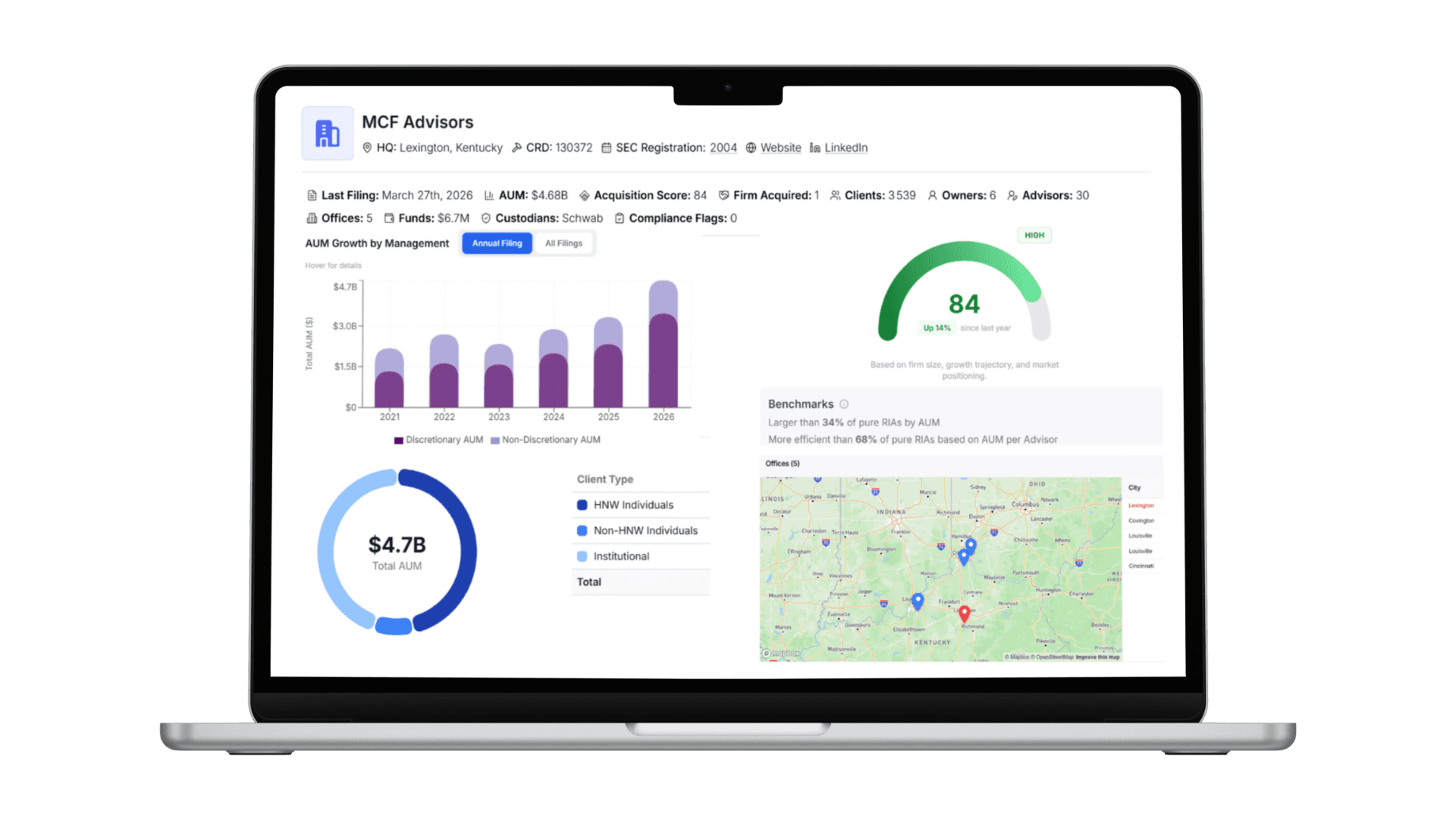
AI adoption itself is not disclosed in regulatory filings — but its effects are. RIA Catalyst tracks AUM per advisor and AUM per employee across 15,000+ SEC-registered RIAs, computed from Form ADV data (the advisor ratio uses registered IARs only, which excludes non-IAR professional staff — a nuance that matters when comparing planning-heavy or family-office models). Firms whose efficiency ratios are improving faster than their peer cohort are, increasingly often, firms that changed how they operate. Buyers use those trends to build target lists of operationally leveraged firms before competitors notice — and to ask sharper questions when diligence begins.
FAQ
Does AI adoption actually increase an RIA's sale price in 2026?
Directly, rarely — buyers do not pay a line-item premium for software. Indirectly, yes: verified adoption shows up as higher output per professional, stronger organic growth, and lower integration friction, all of which buyers underwrite. The premium attaches to the results, not the tools.
How should a buyer verify a target's AI claims?
Look past the vendor list. Ask which workflows were redesigned, request before/after metrics on service capacity, interview non-partner staff about daily tool use, and review written AI governance policies. Adoption depth and governance are hard to fake; tool ownership is trivial to fake.
What are the biggest AI-related red flags in RIA diligence?
Client data entered into consumer AI tools without controls, AI-generated client deliverables without review procedures, no written AI-use policy, and a single employee holding the entire workflow layer. Each is manageable if identified — and expensive if discovered post-close.
Should small RIAs invest in AI before selling?
If the exit is more than a year away, adoption that produces measurable capacity gains will likely pay for itself in both operating results and buyer perception. Days before a process, no — buyers discount capabilities acquired for the deal rather than embedded in operations.
Will AI-passive firms become unsellable?
No — the H1 2026 market absorbed firms of every operational profile. But the spread is widening: AI-passive firms will increasingly be priced as integration projects rather than growth assets, while operationally leveraged firms attract the competitive processes. Passivity will cost a multiple turn before it costs a buyer pool.
Conclusion
The AI arms race the trade press described this week is real, but the M&A implication is bigger than the technology story. AI adoption is becoming one of the few genuinely new sources of differentiation in a market where 167 first-half deals and a valuation plateau have made averages meaningless. For buyers, the mandate is to underwrite adoption rather than tooling — and to find the operationally leveraged firms before their efficiency shows up in everyone's screens. For sellers, the mandate is simpler: the capability you build now is the multiple you defend later. In both cases, the firms that treat AI as an operating discipline rather than a purchase will be the ones the market rewards.