Date Published:

Most first-time RIA acquirers close their first deal through sheer determination. The second and third deals expose every process gap the first one papered over. The mistakes first-time RIA acquirers make rarely show up at signing. They compound quietly during integration, eroding the value the deal was supposed to create.
The core problem is treating M&A as a transaction rather than a capability. A single successful close doesn't make an RIA acquisition strategy. Building a repeatable program requires defined sourcing, a disciplined thesis, early diligence on retention risk, deal terms that match real-world outcomes, and integration planning that begins well before the ink dries. The five mistakes below represent the failure modes I see most often in PE-backed platforms and independent aggregators running their first few deals. Each one is preventable with the right operating cadence.
Mistake #1: Treating Sourcing Like a One-Off Search
Symptoms
The team only sources actively when leadership says "go find a deal"
Pipeline consists of 3-5 names from personal networks or a single broker relationship
No CRM or tracking system for RIA deal sourcing conversations
Months of silence between outreach bursts, then a scramble when a "hot" opportunity surfaces
Why It Happens and the Downstream Impact
First-time acquirers often assume sourcing is something you turn on when you're ready to buy. In practice, the best acquisition targets rarely come to market through formal channels. Advisors considering a transition often take 12-18 months to warm up to the idea of selling. If you aren't maintaining consistent contact during that window, you'll only see deals that have already been shopped to multiple buyers, which drives up pricing and compresses your ability to negotiate favorable RIA LOI terms.
Fix: Build a Repeatable Sourcing Engine
Define your universe. Identify the total addressable market of RIA firms matching your thesis (geography, AUM band, custodian, client demographics).
Systematize outreach. Use a CRM to track every firm, contact, and conversation stage. Assign owners for each relationship.
Set a monthly cadence. Schedule a minimum number of new outreach touches and follow-ups per month, regardless of whether you're actively pursuing a deal.
Diversify channels. Broker relationships, direct outreach to advisors, custodian referral networks, and industry conferences should all feed your pipeline.
Mistake #2: Having a Vague RIA Acquisition Thesis
Symptoms
The team evaluates every inbound opportunity, regardless of fit
Internal stakeholders disagree on what "good" looks like after reviewing the same target
Screening calls take 45+ minutes because there's no pre-defined checklist
Post-close, the acquired firm feels like an outlier compared to the rest of the portfolio
Why It Happens and the Downstream Impact
Early acquirers often keep their criteria broad because they're afraid of missing opportunities. The result is the opposite of what they intend: without a clear RIA target profile, every deal requires a custom evaluation framework, which slows decision-making and increases the risk of thesis drift. Over time, a portfolio of mismatched acquisitions becomes nearly impossible to operate efficiently.
Fix: Define Your Target Profile and Non-Negotiables
Write a one-page acquisition thesis. Include AUM range, revenue size, client demographics, geography, fee structure, and advisor age/succession timeline.
Separate "must-haves" from "nice-to-haves." Non-negotiables might include minimum revenue per client, a specific custodian, or a maximum advisor age. Everything else is flexible.
Create a scoring rubric. Rate each opportunity against your thesis on a 1-5 scale across 8-10 dimensions. Only advance deals scoring above your threshold into diligence.
Data advantage: avoiding preventable mistakes
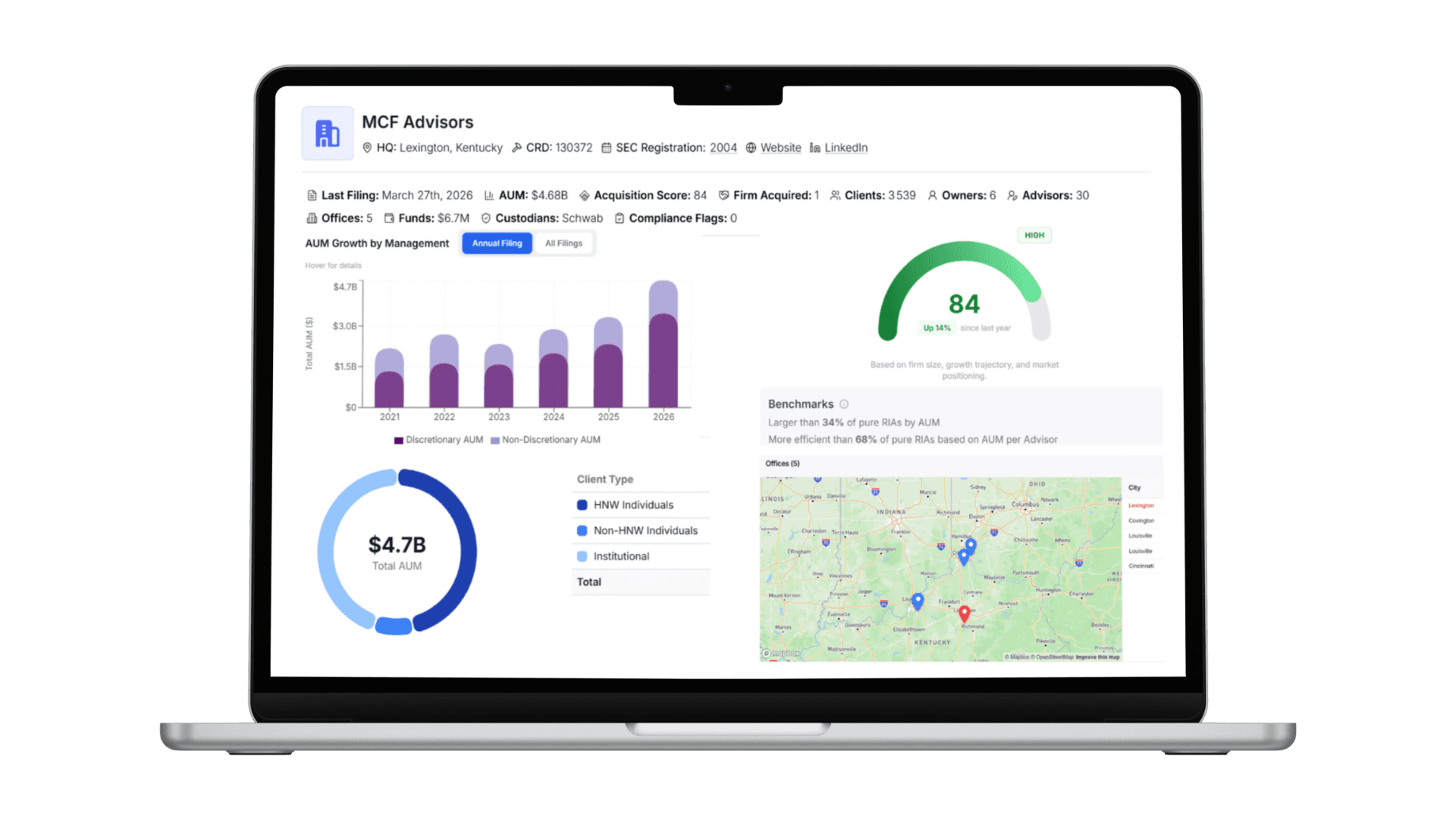
Thesis discipline depends on reliable firm-level data. Platforms like RIA Catalyst provide structured intelligence on RIA firms, including AUM, advisor demographics, custodian relationships, and growth trends. Having access to this kind of data layer lets corporate development teams screen targets against their thesis before the first phone call, rather than relying on broker teasers or self-reported information. The difference between a data-informed pipeline and a relationship-only pipeline often shows up as 40-60% less time spent on deals that never close.
Mistake #3: Underestimating Retention and RIA Succession Risk
Symptoms
Due diligence focuses primarily on financials and compliance, with minimal attention to client concentration or advisor dependency
The team doesn't interview key employees or top clients before signing
Post-close attrition exceeds projections by 15%+ within the first year
The selling advisor's "transition period" is vaguely defined or unenforced
Why It Happens and the Downstream Impact
Financial diligence is comfortable because the numbers are concrete. RIA client retention risk and RIA succession risk are harder to quantify, so they get deferred or hand-waved. The problem is that in a typical RIA acquisition, 70-80% of the enterprise value walks out the door every night. If the lead advisor's relationships aren't transferable, or if key associates leave within six months, the revenue you modeled simply won't materialize.
Fix: Diligence the "People and Client" Layer Early
Build a dedicated section into your RIA due diligence checklist for human capital and client risk:
Client concentration analysis. Flag any firm where the top 10% of clients represent more than 30% of revenue. Model attrition scenarios at 10%, 20%, and 30% loss rates.
Advisor dependency mapping. Identify which advisor manages each client relationship. If one person controls more than 60% of AUM, the succession plan needs to be ironclad, or the deal structure needs to reflect that risk.
Key person interviews. Meet with at least the top 2-3 non-owner employees before LOI. Gauge their intent to stay and their relationship with the owner.
Transition terms. Require a minimum 12-month transition period with defined client introduction milestones, not just "availability for calls."
Mistake #4: Over-Focusing on Headline Valuation and Under-Focusing on Terms
Symptoms
Internal conversations center on "What multiple are we paying?" rather than "What's our total risk-adjusted cost?"
Deal structures are mostly cash-at-close with minimal contingent consideration
The team hasn't modeled downside scenarios tied to retention or revenue run-rate
Post-close, the acquirer absorbs losses that should have been shared with the seller
Why It Happens and the Downstream Impact
Headline multiples are easy to compare and easy to communicate to a board or investment committee. But a 7x deal with 100% cash at close carries fundamentally different risk than a 7x deal with 40% in an RIA earnout structure tied to client retention over three years. First-time acquirers often concede on structure to "win" the deal, then realize twelve months later that they overpaid on a risk-adjusted basis.
Fix: Align Structure to Risk
Default to blended structures. Cash at close, a seller note or rollover equity, and an earnout tied to measurable outcomes (revenue retention, client retention, or advisor transition milestones).
Model three scenarios. Base case, downside (15-20% revenue attrition), and severe downside (30%+ attrition). Make sure your structure protects returns in the downside case.
Negotiate employment and non-solicit terms as deal terms, not afterthoughts. The selling advisor's post-close employment agreement, non-compete, and non-solicitation provisions directly affect the value of your earnout.
Use covenants that match your integration plan. If you need the seller to introduce clients to a new advisor within 90 days, write that into the agreement with measurable triggers.
Mistake #5: Starting RIA Integration Planning After Close
Symptoms
The first 30 days post-close are consumed by "figuring out" technology migration, branding, and client communication
Key employees learn about operational changes through rumor rather than a structured plan
Client communication goes out late, is inconsistent, or creates confusion about the new relationship
RIA M&A integration costs exceed budget because nothing was scoped in advance
Why It Happens and the Downstream Impact
Integration feels like a "post-close problem" because the deal team is focused on getting to signing. In reality, every week of disorganized integration increases the probability of client and employee attrition. An RIA post-close integration that stumbles in the first 30 days can take six months to recover from, if it recovers at all.
Fix: Pre-Close Integration Plan with 30/60/90-Day Execution
Appoint an integration lead before LOI. This person (not the deal lead) owns the integration workstream from diligence through Day 90.
Build the RIA integration plan during diligence. By the time you sign, you should have a detailed playbook covering technology migration, client communication templates, branding decisions, compliance filings, and employee onboarding.
Day 1 readiness checklist. On close day, every employee should know their reporting structure, every client should have received a personalized communication, and every system should have a migration timeline.
30/60/90-day milestones. Define specific, measurable targets for each phase: client introductions complete by Day 30, technology migration by Day 60, first post-close performance review by Day 90.
A Simple "First-Time Acquirer" Operating Cadence
Weekly Pipeline Review Agenda (30 Minutes)
Review pipeline by stage: initial outreach, screening, diligence, LOI, closing
Flag any deal that has been in the same stage for more than 3 weeks
Assign next actions for top 5 active opportunities
Identify new sourcing targets to backfill the top of the funnel
Monthly Thesis Review (60 Minutes)
Review deals screened in the past 30 days against the acquisition thesis scorecard
Discuss any pattern of "near misses" that might suggest thesis refinement
Update market intelligence using platforms like RIA Catalyst or comparable data sources to validate assumptions about target firm demographics and trends
Adjust non-negotiables only with documented rationale
Post-Close Retrospectives (What to Capture and Standardize)
Conduct a structured retrospective at Day 90 and Day 365 for every closed deal
Document deviations between projected and actual client retention, revenue, and integration costs
Identify process improvements and feed them back into the diligence checklist, integration playbook, and deal-structuring templates
Archive lessons learned in a shared knowledge base accessible to the full deal team
FAQ
How many deals should a first-time RIA acquirer target in year one?
Most first-time acquirers overestimate their capacity. One to two completed deals in the first year is a realistic target, assuming you're building the operating cadence simultaneously. Prioritize quality of process over volume. A single well-executed acquisition with a documented playbook creates more long-term value than three rushed deals with ad hoc integration.
What is the biggest risk in RIA acquisitions that first-time buyers overlook?
Client and advisor attrition after close. Financial and compliance diligence get the most attention, but the "people layer" drives the majority of post-close value realization. If the selling advisor disengages early or key associates leave, revenue can decline 20-30% within twelve months, regardless of how clean the financials looked at signing.
How should first-time acquirers think about RIA earnout structures?
Earnouts should tie directly to the risks you identified in diligence. If client concentration is high, tie a portion of consideration to retention of top-20 client relationships over 24 months. If advisor dependency is the primary risk, tie earnout milestones to client transition benchmarks. Avoid earnouts based solely on revenue growth, since growth-based earnouts can create misaligned incentives where the seller prioritizes new business over transitioning existing clients.
When should integration planning start in an RIA acquisition?
During diligence, not after close. The integration lead should be involved in the process no later than the LOI stage. By signing, you should have a complete Day 1 readiness plan covering client communications, technology migration timelines, employee onboarding, and compliance filings. Waiting until after close to begin planning is the single most common driver of avoidable integration cost overruns.
How do you build an RIA deal sourcing pipeline from scratch?
Start with your target universe. Define the total addressable market by geography, AUM band, custodian, and advisor demographics. Use structured data sources (such as RIA Catalyst for firm-level intelligence) to build an initial list, then layer in broker relationships, custodian referral programs, and direct outreach. Commit to a minimum number of new contacts per month and track every interaction in a CRM. Consistency matters more than volume in the first six months.
Conclusion
The five RIA acquisition mistakes outlined here share a common root cause: treating M&A as a series of discrete transactions rather than a repeatable operating capability. The mistakes first-time RIA acquirers make, from reactive sourcing and vague thesis definition to neglected retention risk, under-structured deal terms, and post-close integration scrambles, are all preventable with the right systems. Build a sourcing engine that runs continuously. Define and enforce a clear acquisition thesis. Diligence the people and client layer with the same rigor you apply to financials. Structure terms that protect your downside. Plan integration before you close. The operating cadence described above (weekly pipeline reviews, monthly thesis checks, and post-close retrospectives) turns these five fixes into a durable program, one that improves with every deal.