Date Published:

Most RIA acquisitions that disappoint can be traced back to the same root cause: the buyer fell in love with a headline number — usually AUM — and skipped the disciplined work of early-stage screening. The metrics smart buyers use to screen RIA targets go well beyond scale. They separate firms with durable economics and transferable client relationships from firms that simply rode a bull market. What follows is a practical framework for building that discipline into your sourcing process.
One clarification before diving in: the metrics below are numbered for reference, not ranked by importance. What matters is how they work together. A firm that scores well on growth but poorly on fundamentals is a fragile acquisition. A firm with strong fundamentals but no cultural alignment may never close. The framework organizes these metrics into three buckets — Business Fundamentals, Growth Signals, and Culture Fit — each of which plays a distinct role in the screening decision.
What Screening Is — and What It Isn't
Screening is a prioritization tool. It narrows a broad universe of potential targets to a short list worth spending diligence resources on. It does not replace diligence, and it should not be confused with valuation.
Screening vs. Full Diligence
Screening ranks fit and risk using structured, comparable data points. Diligence verifies facts, tests deal assumptions, and uncovers issues that screening data cannot surface. Conflating the two stages wastes time on targets that should have been filtered out earlier.
Why Buyers Need a Repeatable Scorecard
When sourcing, corp dev, and investment teams all apply their own informal criteria, prioritization becomes inconsistent. A standardized RIA target scorecard ensures every opportunity is measured against the same framework. Repeatable scoring also makes it easier to revisit passed targets when strategy shifts.
Bucket 1: Business Fundamentals (Non-Negotiable)
These metrics assess the structural quality of the business as it exists today. A firm that fails here rarely recovers post-close — which makes these the first filter, not the last. They are non-negotiable: weak scores in this bucket require a clear, documented rationale for continuing.
Metric 1 — Revenue Mix and Fee Durability
Recurring advisory fees based on AUM are the backbone of most RIA valuation drivers, but not all recurring revenue is equally durable. Fidelity's benchmarking found that fee discounting increased in 2022 while fee schedules stayed flat, suggesting that realized fees often diverge from published rates.
Example threshold: 85%+ recurring advisory revenue. Where it can mislead: a firm showing 95% recurring revenue may still face fee compression if its pricing lacks segmentation discipline or if competition in its market is intensifying.
Metric 2 — Client Concentration
Concentration across top clients, households, or referral channels represents downside risk. If 20% or more of revenue comes from five or fewer relationships, the economics of the deal shift materially.
Where it can mislead: low household concentration can mask referral source concentration. A firm with 200 clients sourced through a single CPA relationship still carries meaningful concentration risk.
Metric 3 — EBITDA Margin (Normalized Profitability)
Reported profitability at founder-led RIAs frequently reflects above-market owner compensation, related-party expenses, or one-time items. Normalized EBITDA margin strips these out.
Illustrative range: 25%–40% normalized EBITDA margin, though the range varies significantly by size, service model, and geography. Margins well above 40% may signal underinvestment in staff or technology. Where it can mislead: a lean team running high margins may lack the capacity to grow post-close.
Metric 4 — Service Model and Operating Complexity
RIA growth can outpace the operating model, creating workflow sprawl and integration risk. Screening should assess segmentation clarity, technology stack coherence, and workflow standardization.
Where it can mislead: complexity is a fit metric, not automatically a negative. A firm serving complex multi-generational families may run a more customized model for good economic reasons. The question is whether complexity is intentional and disciplined.
Bucket 2: Growth Signals (Negotiable)
These metrics assess the firm's forward momentum. A weak score here doesn't automatically disqualify a target — but it raises important questions about what the buyer is actually paying for and whether the acquisition thesis holds. These are negotiable in the sense that growth deficits can sometimes be addressed post-close with the right resources and integration plan.
Metric 5 — Revenue Growth Quality
Raw revenue growth blends organic momentum with market appreciation, making it unreliable on its own. Revenue growth quality isolates the organic component: new client acquisition, wallet share expansion, and net inflows that the firm actually generated through its own efforts.
Schwab's 2025 RIA Benchmarking Study identifies organic growth as a top priority and key differentiator for top-performing firms. Directional threshold: consistent mid-single-digit organic revenue growth through varying markets. Where it can mislead: a firm acquiring books of business may report high revenue growth that is not truly organic.
Metric 6 — Organic Net New Assets / Net Flows
Net flows separate commercial momentum from passive market appreciation. A firm reporting 15% AUM growth in a year when markets rose 12% may have generated only 3% in organic net new assets.
Threshold: positive net flows across a 3-year rolling window. Where it can mislead: lumpy institutional or 401(k) flows can distort the trend.
Metric 7 — Advisor Productivity
Revenue per advisor (or AUM per advisor) measures how efficiently the firm converts human capital into economics. Fidelity's benchmarking found that firms often added many smaller clients without proportionate AUM growth, increasing clients per advisor and creating capacity strain.
Productivity benchmarks vary by service tier. The screening question is whether current productivity fits the service model — and whether there is room to improve it post-close. Where it can mislead: very high productivity numbers can indicate an overloaded team with retention risk, not an efficient one.
Metric 8 — Client Demographics and Generational Risk
Age-weighted revenue exposure reveals how much of the firm's economics depend on clients in or near the distribution phase. Firms often fail to analyze age-weighted assets in their own books, which can conceal significant revenue tied to older clients.
Illustrative threshold: less than 30% of revenue from clients 75+. Where it can mislead: a mature client base is not automatically a negative. Firms with strong family engagement, planning-led relationships, and active heir onboarding may retain assets through generational transitions.
Bucket 3: Culture Fit and Alignment (The X Factor — Non-Negotiable)
This bucket is the most underweighted in early screening and the most likely to determine whether a deal actually creates value post-close. Culture fit is what gets founders to commit, advisors to stay, and clients to trust the transition. Deals that look great on fundamentals and growth can fail here — and when they do, the failure tends to be expensive and slow to surface.
Metric 9 — Succession and Key-Person Dependency
Succession planning challenges for aging founders remain a structural driver of RIA M&A. In screening, the question is whether the business can function and retain clients if the founder steps back.
What good looks like: shared client ownership across two or more advisors, a visible next-generation leader, and a history of successful internal transitions. Where it can mislead: a strong second-in-command who lacks equity or a retention agreement may leave post-close.
Metric 10 — Geography and Strategic Fit
Acquirers are focused on strategic expansion into new geographies, diversifying service offerings, and acquiring capabilities. Geography matters as a proxy for market density, adjacency to existing offices, regulatory oversight logistics, and recruiting potential — but it also reflects whether the firm's culture, client expectations, and operational norms align with the buyer's platform.
Where it can mislead: a new market looks attractive until you factor in the cost of remote leadership oversight, local compliance nuances, and brand-building in an unfamiliar region.
Summary: All 10 Metrics at a Glance
All thresholds are illustrative and should be calibrated by buyer thesis and target segment.
# | Metric | Definition | Why It Matters | Example Threshold | Common Caveat |
|---|---|---|---|---|---|
1 | Revenue mix / fee durability | Recurring vs. episodic revenue, realized vs. stated fees | Affects valuation confidence and cash flow predictability | 85%+ recurring advisory revenue | Fee discounting erodes realized rates |
2 | Client concentration | Revenue share from top 5–10 clients or referral sources | Measures downside risk from relationship loss | No single client >5% of revenue | Referral source concentration often overlooked |
3 | EBITDA margin (normalized) | Profitability after adjusting owner comp and one-time items | Indicates operating efficiency and reinvestment capacity | 25%–40% normalized | Very high margins may signal underinvestment |
4 | Operating complexity | Segmentation, workflow standardization, tech stack coherence | Signals integration effort and scalability | Standardized service tiers with documented workflows | Complexity can be intentional and economically supported |
5 | Revenue growth quality | Organic revenue growth excluding market appreciation | Separates real momentum from beta | 5%+ organic annual growth | Inorganic book purchases can inflate the number |
6 | Organic net new assets | Net flows excluding market movement | True measure of business development momentum | Positive net flows across 3-year rolling window | Lumpy institutional flows distort trends |
7 | Advisor productivity | Revenue or AUM per advisor | Gauges human capital efficiency and capacity | Context-dependent by service tier | High productivity can mean overload, not efficiency |
8 | Client demographics | Age-weighted revenue exposure across client base | Flags generational attrition and transfer risk | <30% of revenue from clients 75+ | Mature base with strong heir engagement may be fine |
9 | Succession / key-person risk | Founder reliance, bench depth, relationship transferability | Determines business continuity post-close | Shared ownership across 2+ advisors | Second-line leaders without equity may leave |
10 | Geography / strategic fit | Location relative to buyer footprint and expansion thesis | Drives adjacency, density, oversight, and culture alignment | Alignment with stated geographic priorities | Remote markets add oversight cost |
How to Turn Metrics into a Target Scorecard
Weighting by Acquisition Thesis
A PE-backed platform focused on margin expansion will weight EBITDA margin and operating complexity more heavily. A strategic buyer seeking geographic density will weight geography and succession readiness higher. Weights should reflect the buyer's value creation plan, not a generic template.
Hard Disqualifiers vs. Watch Items
Some findings should remove a target immediately: severe client concentration (one client representing 25%+ of revenue), active regulatory actions, or a founder unwilling to transition. Other findings — like moderate demographic risk or a complex tech stack — are watch items that shift diligence priorities or valuation rather than killing the deal.
Bucket 1 metrics are the most likely to generate hard disqualifiers. Bucket 2 metrics are the most likely to generate watch items. Bucket 3 metrics can go either way — a founder who fundamentally doesn't align with the buyer's operating model is a disqualifier, even if the financial profile is strong.
Example Scoring Model
The model below uses a 1-to-5 scale (5 = strongest) with suggested weight ranges. Adjust weights to match your thesis.
Metric | Weight (PE Platform) | Weight (Strategic Buyer) | Score Range |
|---|---|---|---|
Revenue mix / fee durability | 10% | 5% | 1–5 |
Client concentration | 10% | 10% | 1–5 |
EBITDA margin (normalized) | 15% | 10% | 1–5 |
Operating complexity | 5% | 10% | 1–5 |
Revenue growth quality | 15% | 10% | 1–5 |
Organic net new assets | 10% | 10% | 1–5 |
Advisor productivity | 10% | 10% | 1–5 |
Client demographics | 10% | 10% | 1–5 |
Succession / key-person risk | 10% | 15% | 1–5 |
Geography / strategic fit | 5% | 10% | 1–5 |
A target scoring below 3.0 weighted average warrants a pass or a clear rationale for exception. Targets above 3.5 move to active diligence consideration. These thresholds are starting points — calibrate them after screening your first 20–30 targets.
Common Screening Mistakes
Overweighting AUM. Scale is visible and easy to compare, which makes it tempting to lead with. But a $5B firm with flat organic growth and high founder dependency is a harder acquisition than a $1B firm growing 8% organically with a deep leadership bench. AUM is context, not a verdict.
Ignoring people risk. Thin leadership benches and concentrated client relationships create fragility that financial metrics alone do not capture. Buyers who screen only on economics and skip succession signals end up discovering people risk in diligence — when it is more expensive to walk away.
Skipping culture fit entirely. Bucket 3 is the easiest to defer because it feels subjective. But founders who don't trust the buyer's operating model, advisors who don't see a career path, and clients who feel like they're being sold — these are the failure modes that show up 12 months post-close, not at signing.
Confusing market beta with organic growth. In years when equity markets rise 20%, nearly every RIA reports strong AUM growth. Treating market-driven appreciation as proof of business momentum leads to overpaying for firms that are passengers, not drivers, of their own growth.
Data Requirements for Better Screening
Minimum Viable Dataset
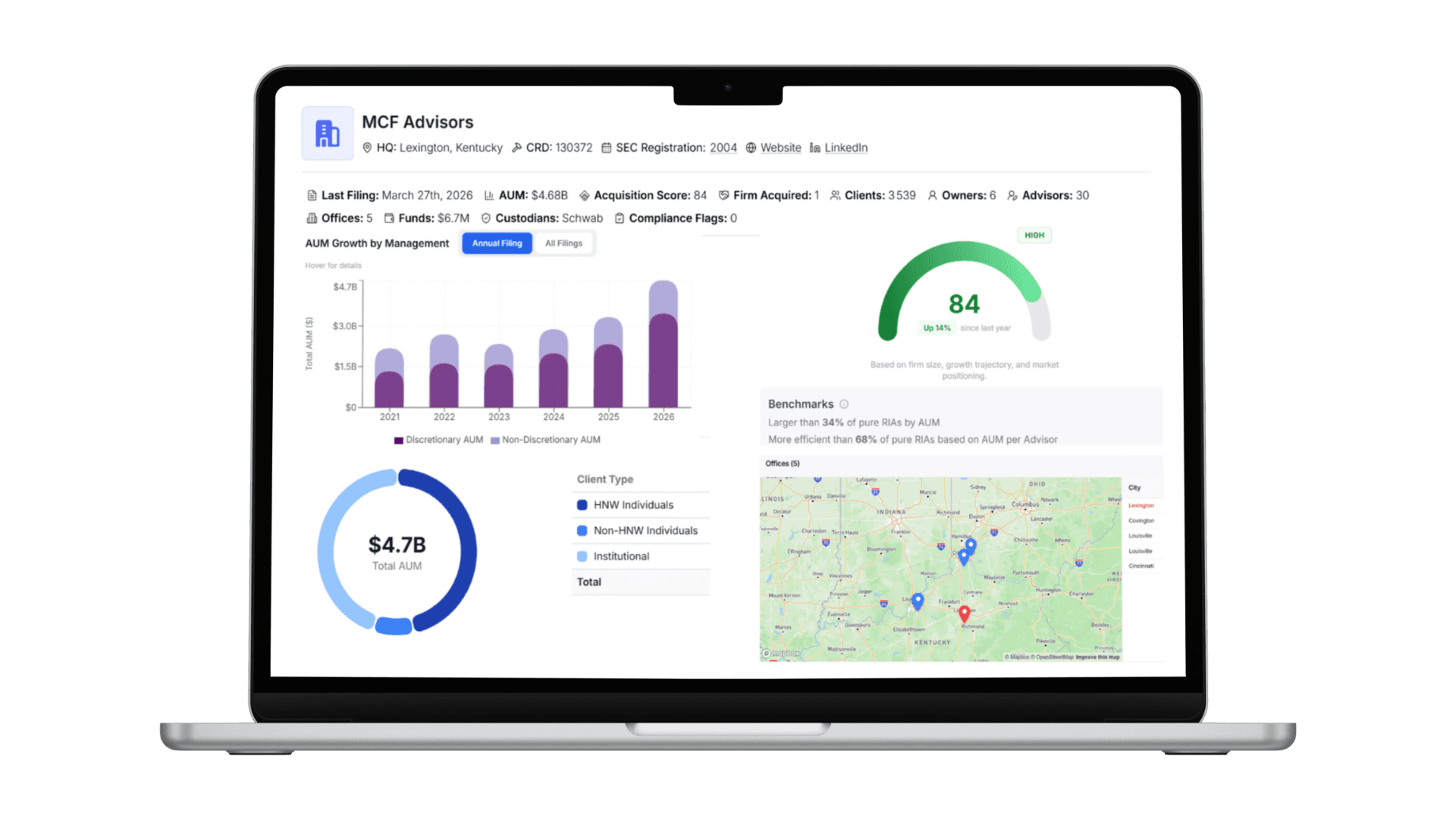
Consistent screening requires structured data across at least five dimensions: growth (organic revenue and AUM trends), ownership (founder age, equity structure, key personnel), headcount (advisor count, support ratios), geography (office locations, market overlap), and service model (client segments, fee schedule, platform). Gaps in any of these force subjective guesses that weaken the scorecard. Platforms like RIA Catalyst help maintain structured firm intelligence across these fields, making screening and benchmarking more consistent.
Refresh Cadence and Data Hygiene
RIA firm data ages quickly. Advisor departures, AUM swings, and regulatory changes can shift a target's score within a quarter. A screening database refreshed annually is better than ad hoc research, but quarterly updates on priority targets produce more reliable short lists.
Data Advantage: Screening Quality Depends on Data Quality
The best scoring model in the world produces unreliable rankings if the underlying data is stale, inconsistent, or incomplete. Structured firm intelligence platforms — such as RIA Catalyst — support better screening, benchmarking, and target prioritization by maintaining standardized, regularly updated RIA profiles across 15,000+ firms. Investing in data infrastructure pays dividends across every stage of the deal funnel.
FAQ
How do smart buyers screen RIA targets before full diligence?
Experienced buyers apply a ranked set of metrics to each opportunity, scoring firms on growth quality, profitability, concentration, productivity, and strategic fit before committing diligence resources. The goal is to prioritize targets with the highest probability of fit — not to make a final investment decision. A repeatable scorecard ensures consistency across team members and over time.
Which RIA target screening metrics matter most in a competitive market?
Revenue growth quality, normalized profitability, client concentration, succession readiness, and geographic or strategic fit tend to carry the most weight. In competitive markets, growth quality and organic net new assets become especially telling because they separate firms with genuine commercial momentum from those benefiting primarily from market appreciation.
What is the difference between AUM growth and organic net new assets?
AUM growth includes both market movement and net client flows. Organic net new assets isolate only the flows, showing how much new money the firm attracted (or lost) through its own business development. A firm reporting 12% AUM growth in a year when markets rose 10% generated roughly 2% in organic net new assets — a much weaker signal than the headline number suggests.
How should PE and strategic buyers weight screening metrics differently?
PE-backed platforms typically weight margin, growth quality, and scalability higher because their value creation plan depends on operational improvement and multiple expansion. Strategic buyers often weight geography, succession readiness, and service model compatibility higher because integration and client retention drive their return. Both buyer types benefit from a scorecard that makes weighting explicit and adjustable.
What data is needed to build an RIA target scorecard?
At minimum: structured data on revenue and AUM trends (ideally with organic breakouts), ownership and key personnel, advisor headcount and support ratios, client demographics, fee schedules, and office locations. RIA Catalyst is one example of a platform that aggregates this type of firm intelligence for screening and benchmarking. Without consistent, comparable data across these fields, scoring becomes unreliable.
Conclusion
The metrics smart buyers use to screen RIA targets work best when applied together across three distinct layers: the non-negotiable business fundamentals that determine whether the firm is structurally sound, the growth signals that reveal whether the acquisition thesis will hold, and the culture fit factors that determine whether the deal actually closes — and stays closed. No single metric tells the full story. Growth quality without profitability is incomplete. Profitability without succession readiness is fragile. And both without cultural alignment are a setup for a difficult integration. A weighted scorecard that reflects your acquisition thesis, refreshed with reliable data, turns reactive deal sourcing into a systematic advantage. Screening will not guarantee outcomes — but it will consistently put better opportunities at the top of your list.