Date Published:

The deal tallies that made headlines this month — 167 RIA transactions in the first half of 2026, a record — count firms and practices that were bought and sold. What they capture far less well is a parallel channel moving client assets in the same period: advisor teams changing platforms through recruitment, without any firm being acquired at all.
The distinction is easy to blur, because both channels involve the same aggregators and produce similar headlines. When OneDigital added the $1.8 billion Rosenthal Wealth Management practice — moving it off Cetera's broker-dealer platform — that was an acquisition, and it will appear in the deal counts. When Wealth Enhancement acquired the $993 million WealthShield and Madison Oaks practices, the same is true. But in the very same weeks, other teams moved by pure recruitment: Ameriprise brought over a Raymond James practice managing more than $270 million; RBC recruited a team in Fargo; independent broker-dealers traded advisors back and forth. None of those recruitment moves shows up in RIA M&A statistics — and collectively, that uncounted channel is large.
For growth-minded platforms, the lift-out — recruiting an intact advisor team with its client relationships — has matured from an opportunistic tactic into a systematic acquisition channel that competes directly with M&A for the same strategic outcome: more advisors, more assets, more markets. And for anyone tracking consolidation, ignoring the lift-out market means undercounting the real pace of asset movement.
This article compares the two channels — when a lift-out beats an acquisition, when it does not, what each costs and risks — and examines what the growth of team-level movement means for buyers, for the firms losing teams, and for how the industry should read deal statistics.
Two Channels, One Objective
Acquisitions and lift-outs are alternative answers to the same question: how do we add productive advisors and their client relationships?
Dimension | Firm acquisition | Team lift-out |
|---|---|---|
What transfers | Entity, brand, contracts, full team, ADV history | Advisors, client relationships (subject to consent) |
Upfront capital | Purchase price at closing | Transition packages, guarantees, forgivable notes |
Client transfer | Assignment/consent process, typically high retention | Clients must actively follow; retention varies more |
Legal surface | Reps and warranties, entity diligence | Protocol membership, non-solicit and restrictive covenants |
Speed | Months (LOI to close, then integration) | Weeks to months; integration is onboarding |
What does NOT transfer | — | Entity liabilities, legacy compliance history, brand |
The structural trade is clean: an acquisition buys certainty and completeness (the whole firm, its history, its client base under contract) at a higher upfront price; a lift-out buys selectivity (exactly the team you want, none of the entity baggage) at the cost of client-transfer risk and legal exposure.
When the Lift-Out Wins
When the asset is the team, not the firm
Some of the most productive advisor teams in the country sit inside broker-dealers and wirehouses that cannot be bought at all, or inside firms that are not for sale. When Ameriprise recruits a practice away from Raymond James, or RBC lifts a team out of a competitor, the asset was reachable only through recruitment — there was no entity to acquire. For buyers whose thesis is talent density rather than platform scale, the lift-out is often the only channel to the asset they actually want.
When entity risk is the deal-killer
Acquirers walk away from otherwise attractive firms because of what the entity carries: disciplinary history, legacy client contracts, litigation exposure. A lift-out surgically separates the productive asset (the team) from the problematic wrapper (the entity). What the buyer gives up is the contractual client base — which is why lift-outs of teams with strong, portable client relationships are the premium version of the play.
When the buyer is building in a new market
Entering a metro through acquisition means paying for an entire firm to get a local presence. Recruiting an established local team achieves the same geographic goal with less capital and full selectivity over who joins. Mature platforms that run steady team recruitment alongside an acquisition program choose between the two channels market by market.
When the Acquisition Wins
When client relationships are institutional, not personal
Lift-outs move clients one consent at a time; acquisitions move books under negotiated transition terms with the selling firm's cooperation. Where client relationships attach to the firm — institutional mandates, retirement plans, multigenerational family relationships served by multiple team members — an acquisition transfers them far more reliably.
When succession is part of the value
A lift-out takes producers; it does not solve the acquired team's long-term ownership question — they are employees or partners of the new platform on negotiated terms. An acquisition can underwrite the whole arc: founder liquidity, next-generation equity, staff continuity. Sellers with genuine enterprises — not just books — are better served by, and better priced in, the M&A channel.
When brand and infrastructure carry value
Some firms are worth more than the sum of their advisors: a differentiated niche, a referral engine, specialized capability. Lift-outs cannot capture any of that. Acquisitions can.
The Risk Ledger: What Each Channel Can Cost You
The lift-out's risks concentrate in two places. Client transfer: every client must choose to move, and projections built on an advisor's confidence rather than evidence of relationship strength routinely disappoint. Legal exposure: restrictive covenants, non-solicits, and (for firms outside the Broker Protocol) raiding claims can turn a recruitment into litigation. The diligence a serious acquirer runs on a team — client tenure, relationship depth, covenant landscape — should approach what it would run on a firm.
The acquisition's risks are the familiar ones: overpaying for assets that then attrite, cultural mismatch surfacing after close, and integration consuming more capacity than modeled. In a market where buyers themselves say prices have peaked, the cost of these mistakes is no longer forgiven by multiple expansion.
One risk is shared and rising: the war for teams cuts both ways. A platform that grows by lift-out is vulnerable to lift-out. Retention economics — equity participation, career paths for second-chair advisors, service infrastructure — are now defensive investments for every acquirer, whichever channel they grow through.
What Team Movement Means for Reading the Market
Deal counts understate consolidation. Assets are consolidating onto large platforms through two doors, and only one is counted. A quarter where announced deals flatten can still be a quarter of aggressive asset consolidation via recruitment — which is exactly what the current market looks like: record M&A and heavy team movement simultaneously.
For sellers, the recruitment market is also a pricing signal. The packages platforms pay to recruit a large team put an implicit price on advisor-attached assets — a useful sanity check for founders weighing what their firm's relationships are worth inside a sale.
For the firms losing teams — IBDs and platforms alike — each departure is a reminder that in wealth management, the assets ride the elevator. Retention is not an HR topic; it is balance-sheet defense.
Data Advantage: Tracking Where the Advisors Actually Are
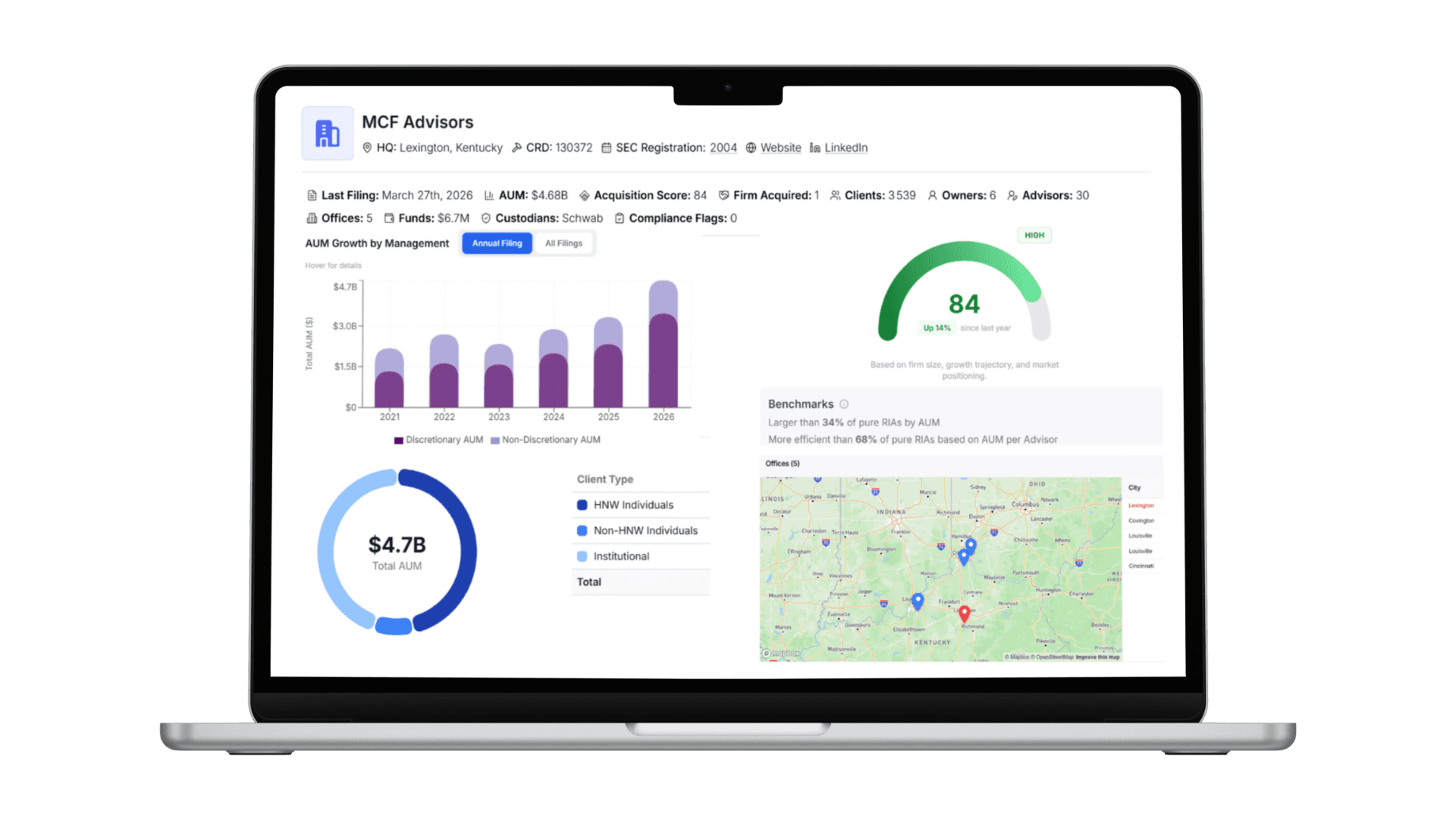
Team movement leaves a data trail. RIA Catalyst tracks advisor headcount, office locations, and AUM across 15,000+ SEC-registered RIAs from successive regulatory filings — so a firm adding IARs and offices faster than its peer cohort, or bleeding them quarter over quarter, is visible before the trade press writes it up. Acquirers use those movements two ways: to identify platforms winning the talent war (and study how), and to spot firms losing teams — which are often the next motivated sellers. In a market consolidating through two channels at once, headcount flow is as informative as deal flow.
FAQ
What is a team lift-out in wealth management?
Recruiting an intact advisor team — typically with transition compensation — from another firm, without acquiring the firm itself. Clients are invited to follow the advisors to the new platform, subject to their consent and to any restrictive covenants binding the team.
Is a lift-out cheaper than an acquisition?
Usually in upfront capital, not always in total cost. Transition packages, guarantees, and ramp-up support for a large team can approach meaningful fractions of what an acquisition would cost — and the buyer bears client-transfer risk that an acquisition largely prices in. The honest comparison is cost per retained client asset, not headline outlay.
Why did team moves accelerate in 2025–2026?
Platform capital chasing growth, advisor mobility normalized by remote-era client habits, and the math of a flat-valuation M&A market: when acquisitions stop getting cheaper, recruitment becomes the marginal growth channel. Large IBD-affiliated teams seeking equity and independence supply the other side of the trade.
Do lift-outs show up in RIA M&A statistics?
Generally no. Deal trackers count firm transactions; pure recruitment moves are recorded, if at all, as advisor-move news. That is why published deal counts — even record ones like H1 2026's 167 — understate the true pace of asset consolidation onto large platforms.
How should an acquirer choose between the two channels?
Start from the asset: if the value is the entity — brand, contracts, succession, infrastructure — acquire it. If the value is a specific team and its portable relationships, recruit it. Mature platforms run both channels against the same market map and let each target's structure decide.
Conclusion
The record H1 2026 deal count tells only part of the consolidation story; the rest moved through recruitment, in teams that never appear in a deal tracker. Lift-outs and acquisitions are no longer separate disciplines — they are competing channels in a single market for advisors and the assets attached to them, and the most sophisticated growers now underwrite both with the same rigor. For buyers, the mandate is channel-agnostic clarity: know the universe, know which firms hold the teams, and know which structure fits each target. For everyone else, the lesson is simpler. In this industry, the durable unit of value is the advisor-client relationship — and it moves.