Date Published:

It's buyer type. Understanding strategic buyers vs. financial buyers in RIA M&A determines everything downstream: how diligence unfolds, what the deal structure looks like, how the firm operates post-close, and whether the founder actually achieves their goals. A strategic acquirer optimizing for distribution scale will run a fundamentally different process than a PE sponsor underwriting to a five-year hold period. Yet many sellers enter a process without a clear framework for evaluating which buyer archetype fits their situation.
The result is often a mismatch between headline terms and real-world outcomes. This guide breaks down the structural differences between RIA M&A buyer types, maps each archetype's incentives and constraints, and provides a practical decision framework for sponsors, corporate development teams, and sell-side advisors navigating live processes.
Definitions: What "Strategic" and "Financial" Mean in RIA M&A
The labels "strategic" and "financial" are shorthand for two distinct acquisition philosophies. A strategic buyer acquires an RIA to integrate it into an existing business, capturing operating synergies or expanding capabilities. A financial buyer acquires an RIA primarily as a standalone (or platform) investment, optimizing for risk-adjusted returns over a defined hold period.
Common Strategic Buyer Profiles
Strategic buyers in RIA M&A include consolidation platforms (e.g., Focus Financial, CI Financial), registered investment advisory firms pursuing tuck-in acquisitions, banks and trust companies expanding wealth management divisions, and asset managers seeking distribution. Each of these profiles brings an existing infrastructure, a defined RIA platform acquisition strategy, and a clear thesis about where the target fits within their operating model.
Common Financial Buyer Profiles
Financial buyers encompass private equity sponsors (both traditional and independent), family offices making direct investments, and search funds or holding companies targeting wealth management. Private equity RIA acquisitions have surged over the past decade, with PE-backed deals representing a significant share of total RIA transaction volume. These buyers typically operate through a platform-plus-add-on model, building scale through sequential acquisitions rather than organic integration.
What Each Buyer Optimizes For
Strategic Buyers: Synergies, Operating Leverage, Distribution, Capability Expansion
Strategic acquirers underwrite to a combined entity. Their models assume cost takeout (compliance, technology, back-office), revenue synergies (cross-selling, referral networks), and operating leverage that wouldn't exist for the target on a standalone basis. The core question a strategic buyer answers: "How does this firm make our existing business more valuable?"
Valuation premiums from strategic buyers often reflect projected synergies, not just the target's standalone cash flows. A bank acquiring an RIA to retain depositor assets or an asset manager buying distribution capacity will assign value to revenue streams that don't yet exist.
Financial Buyers: Risk-Adjusted Cash Flows, Scalability, Multiple Expansion, Exit Options
Financial buyers underwrite to the target's standalone (or lightly enhanced) economics. Their return models depend on entry multiple, leverage, margin improvement, organic growth, and exit multiple. The core question: "Can we generate a 3x to 5x return on equity over a four-to-six-year hold?"
Financial buyers tend to be more disciplined about downside protection, which shows up in structure (earnouts, rollover equity requirements, working capital adjustments) rather than headline multiples.
How Buyer Type Changes the RIA Deal Process
Sourcing Channels and Relationship Dynamics
Strategic buyers often source deals through existing industry relationships, referral networks, and proprietary outreach. Many have dedicated corporate development teams running continuous pipelines. Financial buyers rely more heavily on investment banks, broker-dealers, and data-driven sourcing. Structured market intelligence platforms (like RIA Catalyst) can accelerate both approaches by providing firmographic data, AUM trends, and ownership structures that inform targeting and prioritization.
Diligence Focus Areas
Strategic buyers dig deepest into operational compatibility: technology stack, custodial relationships, investment philosophy alignment, compliance history, and cultural fit. They're stress-testing integration risk.
Financial buyers focus on revenue quality and durability: client concentration, fee compression trends, advisor demographics, contract structures, and margin trajectory. They're stress-testing the cash flow model. Both buyer types care about retention, but they measure it differently. Strategic buyers worry about advisor attrition during integration. Financial buyers worry about client revenue decay post-close.
Speed, Certainty, and Governance
Strategic buyers with balance sheet capacity can often move quickly, with fewer approval layers. A well-capitalized platform might move from LOI to close in 60 to 90 days. PE sponsors typically require investment committee approval, which adds process steps and can extend timelines to 90 to 120 days (or longer for first-time platform investments). Independent sponsors face additional complexity, since they must secure committed capital alongside the deal.
Valuation and Structure: Where Differences Show Up
RIA Valuation Drivers
Regardless of buyer type, the same core RIA valuation drivers apply: recurring revenue quality, organic growth rate, client retention, EBITDA margins, client and advisor concentration, and AUM composition (fee-based vs. commission). Where buyers diverge is in how they weight these factors. A strategic buyer may discount concentration risk if they plan to cross-sell additional services. A financial buyer may penalize the same concentration heavily, since they lack the offsetting revenue base.
Valuation Driver | Strategic Buyer Weighting | Financial Buyer Weighting |
Recurring revenue % | High | Very High |
Organic growth rate | Moderate | High |
Client retention (3-year) | High | Very High |
EBITDA margin | Moderate (synergy-adjusted) | Very High |
Client concentration (top 10%) | Moderate (can diversify) | High (penalized) |
Advisor concentration | Very High (retention risk) | High |
Tech/custodial compatibility | Very High | Low to Moderate |
Geographic overlap | High | Low |
Fee structure (basis points vs. flat) | Moderate | High |
Structure Tools
Strategic buyers more frequently offer all-cash or cash-plus-stock deals with employment agreements. Financial buyers lean on rollover equity (typically 20% to 40% of proceeds), earnouts tied to AUM or revenue retention, and seller notes. Rollover equity is a defining feature of PE-backed transactions, since it aligns seller incentives with the second-bite thesis.
"Headline Price" vs. "Real Economics"
A 10x revenue multiple with a 30% earnout, 25% rollover, and a two-year employment agreement with non-competes carries very different risk-adjusted economics than an 8x multiple paid in full at close. Sellers and their advisors should model total expected value across scenarios (base, upside, downside) rather than anchoring on the headline number. The real economics depend on earnout achievability, rollover liquidity timeline, and integration burden.
Post-Close Integration and Operating Model Implications
Brand, Tech Stack, Service Model, Compliance, and Investment Platform
Strategic buyers typically integrate the target onto their existing platform. Depending on the acquirer, the target firm may retain its brand (common among aggregator models) or be fully absorbed. Technology migration, compliance framework adoption, and investment platform changes are common within 6 to 18 months post-close.
Financial buyers generally preserve the target's operating model, at least initially. The PE playbook prioritizes margin improvement through shared services and procurement leverage rather than full-stack integration. Brand continuity, advisor autonomy, and client-facing service models tend to remain intact during the hold period.
Advisor and Client Retention Risk by Buyer Type
Integration-heavy strategic acquisitions carry higher near-term attrition risk, particularly if technology changes disrupt advisor workflows or client reporting. Financial buyers face a different retention dynamic: advisors may leave if they perceive the PE sponsor as extractive or short-term oriented. Both risks are manageable with thoughtful transition planning, but they require different mitigation strategies.
Which Buyer Type Is the Best Fit? A Framework
Comparison Table: Strategic vs. Financial Buyers Across Key Criteria
Criteria | Strategic Buyer | Financial Buyer |
Primary objective | Integration synergies, capability expansion | Risk-adjusted financial return (3x to 5x) |
Typical hold period | Indefinite (permanent capital) | 4 to 7 years |
Valuation approach | Synergy-adjusted, often revenue-based | Standalone DCF, EBITDA-based |
Deal structure | Cash-heavy, employment agreements | Rollover equity, earnouts, seller notes |
Diligence emphasis | Operational/cultural compatibility | Revenue quality, margin durability |
Post-close integration | Moderate to high (platform migration) | Low to moderate (shared services) |
Brand retention | Varies (often absorbed over time) | Typically preserved during hold |
Advisor autonomy | Lower (platform standardization) | Higher (operating model continuity) |
Speed to close | 60 to 90 days (if balance sheet funded) | 90 to 120+ days (IC/capital sourcing) |
Certainty of close | Higher (fewer financing contingencies) | Moderate (dependent on capital commitment) |
Second liquidity event | Unlikely | Yes (rollover equity at exit) |
Best fit for seller | Seeking full exit, operational support | Seeking growth capital, second bite |
Decision Tree: Choosing the Right Buyer Type
Step 1: Define your primary goal. If the seller wants a clean, full exit with minimal post-close obligations, strategic buyers are the natural starting point. If the seller wants to retain meaningful equity upside and operational control, financial buyers warrant priority.
Step 2: Assess operational readiness. Firms with strong standalone margins (above 30% EBITDA), clean financials, and low concentration are well-positioned for financial buyers. Firms that need operational infrastructure, compliance support, or technology investment may benefit from a strategic acquirer's platform.
Step 3: Evaluate cultural and succession fit. If the founding advisor is retiring within 12 to 24 months, a strategic buyer with a built-in successor bench reduces transition risk. If the founder plans to stay for five or more years, a PE sponsor offering autonomy and growth capital may be a better match.
Step 4: Model the real economics. Run scenario analysis on total expected proceeds across buyer types, accounting for earnout probability, rollover liquidity timelines, tax treatment, and integration costs.
Step 5: Pressure-test with market data. Use benchmarking data (firmographics, comparable transactions, growth rates) to validate assumptions about where the firm sits relative to recent deal activity.
Common Mismatches and How to Avoid Them
The most frequent mismatch: a seller optimizing for headline valuation who accepts a PE-backed offer without fully modeling the rollover and earnout terms. The second most common: a seller who values autonomy accepting a strategic deal that requires full platform migration within 12 months. Both mismatches stem from insufficient upfront diligence on buyer incentives and post-close operating models.
Data Advantage: Benchmarking Buyer Fit
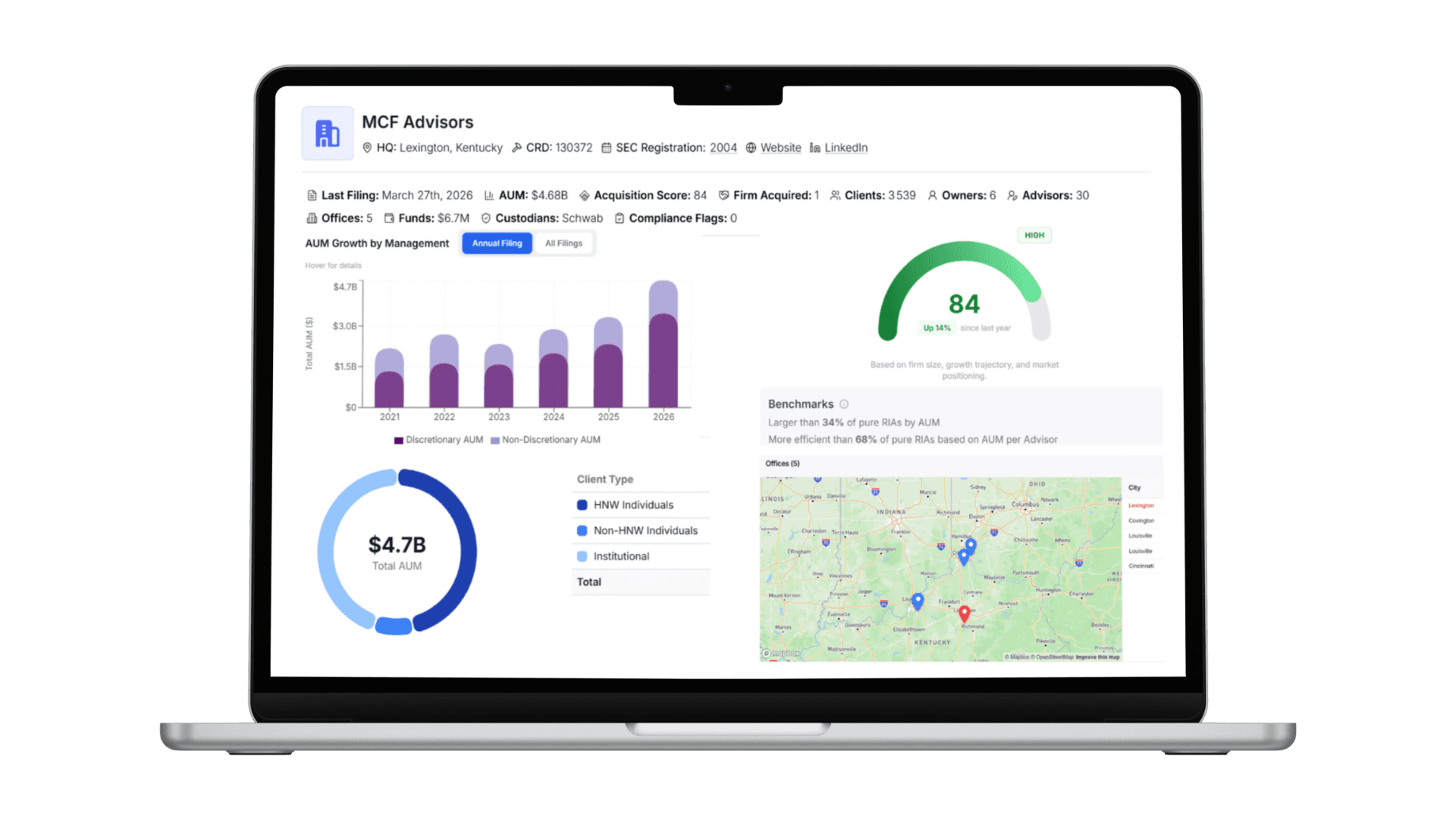
Selecting the right buyer type requires more than intuition. Structured market intelligence, including firmographic data, AUM segmentation, geographic coverage, and advisor demographics, enables precise buyer targeting and realistic benchmarking. Platforms like RIA Catalyst provide the underlying data infrastructure for market mapping, comparable analysis, and pipeline management, giving sponsors and corporate development teams a measurable edge in identifying and prioritizing acquisition targets that match their thesis.
Why Buyer-Type Strategy Depends on Accurate Market Intelligence
Running an effective RIA deal process requires knowing who is actively acquiring, what they're paying, and how their post-close models perform. Without structured data on the buyer landscape, sellers and their advisors are left relying on anecdotal deal flow and relationship-driven sourcing. Market intelligence tools (RIA Catalyst among them) allow participants to benchmark target firms against the broader market, identify buyer-type concentration in specific segments, and track deal activity by geography, AUM band, and buyer archetype. The result is a more informed process that produces better outcomes for all parties.
FAQ
How do strategic buyers and financial buyers differ in RIA valuation multiples?
Strategic buyers may pay a premium (often 1x to 3x revenue turns above financial buyers) when they can model significant synergies. Financial buyers anchor to standalone EBITDA multiples, typically in the 8x to 15x range for quality RIAs, depending on size, growth, and margin profile. The gap narrows for larger, higher-margin firms where standalone economics are already strong.
What does rollover equity mean in a PE-backed RIA acquisition?
Rollover equity requires the seller to reinvest a portion of their proceeds (commonly 20% to 40%) into the acquiring entity. The intent is to align incentives and give the seller exposure to a "second bite," meaning a future liquidity event when the PE sponsor exits. Sellers should evaluate rollover terms carefully, including governance rights, distribution policies, and expected hold period.
How long does the typical RIA M&A deal process take by buyer type?
Strategic acquisitions with balance sheet funding typically close in 60 to 90 days from signed LOI. PE-backed transactions average 90 to 120 days, with variability depending on investment committee timelines, financing arrangements, and regulatory approvals. Independent sponsor transactions can take longer if capital must be raised concurrently.
What are the biggest post-close risks in RIA acquisitions?
Advisor attrition and client revenue decay are the primary post-close risks across both buyer types. Strategic buyers face integration risk (technology migration, compliance framework changes). Financial buyers face governance and cultural risk if the operating model shifts too aggressively toward margin optimization. Both risks are quantifiable and manageable with proper transition planning.
How can sellers evaluate whether a strategic or financial buyer is the better fit?
Start with a clear articulation of goals (full exit vs. growth capital vs. succession), then model the real economics of representative offers across both buyer types. Benchmark the firm's profile against recent comparable transactions using structured data, and pressure-test assumptions about post-close operating model, timeline, and advisor retention.
Conclusion
The distinction between strategic buyers vs. financial buyers in RIA M&A is not academic. It shapes every dimension of the transaction, from valuation mechanics and deal structure to post-close integration and long-term outcomes. Strategic buyers offer platform resources and often higher certainty of close, while financial buyers offer autonomy, second-bite economics, and growth capital. The right answer depends on the seller's goals, the firm's operating profile, and the specific terms on the table. Use the comparison framework and decision tree above to evaluate buyer fit systematically. Ground the analysis in real market data, run scenario models on total expected value, and avoid the common trap of optimizing for headline price at the expense of real economics.