Date Published:

Two facts landed in the same report this week, and they point in opposite directions.
First: the RIA industry announced 167 transactions in the first half of 2026, according to DeVoe & Company's Q2 RIA M&A Deal Book — 13% above the prior high set in 2025, and the strongest first half on record. Deal activity has now increased for seven consecutive quarters.
Second: not a single one of the large consolidators DeVoe surveyed expects sale prices to rise over the next six months. 82% expect valuations to hold flat. 18% expect them to decline — up from 7% a year ago.
A market setting volume records while its most active buyers call a price ceiling is not a contradiction. It is a phase change. The 2020–2024 pattern — rising volume pulling valuations upward — has given way to something more mature: abundant deal flow, disciplined pricing, and a widening gap between what average firms and exceptional firms command.
This article covers what the H1 2026 numbers actually say, why volume and price are decoupling, and what a flat-price environment changes for buyers and sellers making decisions in the second half of the year.
The Numbers: Seventh Consecutive Quarter of Growth
The headline figures from DeVoe's Q2 2026 Deal Book:
Period | Transactions | Change |
|---|---|---|
Q1 2026 | 93 | +24% vs. Q1 2025; tied for most active quarter ever |
Q2 2026 | 74 | +1 deal vs. Q2 2025 |
H1 2026 total | 167 | +13% vs. prior first-half record (2025) |
Two details beneath the headline matter more than the total.
Large sellers are transacting at a record pace
Firms with over $5 billion in AUM announced 30 transactions in the first half of 2026 — just six shy of last year's record full-year total. The upper end of the market is not waiting for better pricing. Sophisticated sellers with the most banker attention and the best information are choosing to transact now.
Momentum is flattening, not reversing
Q1 tied the all-time quarterly record; Q2 grew by a single deal year over year. The market is still growing, but the growth rate is compressing. Combined with buyer sentiment on pricing, the picture is a market reaching cruising altitude rather than one still climbing.
Why Volume and Price Are Decoupling
For most of the past five years, record volume and rising valuations moved together. Three forces explain why they are now separating.
Seller supply keeps expanding
Founder demographics have not changed: a large share of RIA founders are approaching transition age, and the economics of scale — technology costs, compliance burden, talent competition — keep pushing sub-scale firms toward partners. More supply relieves pressure on buyers to bid up scarce assets.
Buyer capital is abundant but more disciplined
PE-backed platforms still have capital to deploy, and new entrants keep arriving. But the cost of that capital is no longer trivial, and several platforms are now on their second or third owner. Underwriting has shifted from "win the asset" to "defend the model." When buyers believe prices have peaked — as 100% of DeVoe's surveyed consolidators now do — auction dynamics lose their upward spiral.
Integration capacity is a real constraint
Seven quarters of rising volume means most active acquirers are digesting multiple recent deals. Integration bandwidth — leadership attention, technology migration, client communication — has become the binding constraint at several platforms. Buyers constrained on integration pay for fit, not for volume.
What a Plateau Is Not
A valuation plateau is not a correction, and reading it as one leads to bad decisions on both sides.
Deal volume is at an all-time high. Buyer demand, measured by transactions actually closed, has never been stronger. What has stopped is the automatic multiple expansion that let sellers assume next year's price would beat this year's. Prices are consolidating at historically elevated levels — the market is repricing risk and differentiation, not repricing the asset class.
The practical consequence: dispersion. In a rising market, mediocre firms get pulled up with the tide. In a flat market, the gap between what a fast-growing, well-run firm commands and what an average firm commands widens. Averages hide this; process reveals it.
What Flat Valuations Change for Buyers
Discipline stops being a handicap
For several years, disciplined underwriters lost auctions to momentum bidders. A price ceiling flips that: when nobody expects to be bailed out by multiple expansion, overpaying is permanent. The buyers who modeled organic growth honestly — separating market appreciation from true net flows — are no longer competing against irrational math.
Differentiation shifts from price to everything else
When most credible buyers converge on similar pricing, sellers choose on other dimensions: deal structure, autonomy, integration record, cultural fit, and speed of execution. Buyers who can demonstrate — with evidence — what happens to a firm after close now hold the advantage that a higher headline number used to buy.
Sourcing advantage compounds
In a flat-price market, the excess return comes from buying the right firm, not from timing the cycle. That pushes the competitive frontier toward identification: seeing the strong firm before it hires a banker, building the relationship before the process starts, and benchmarking it against the full universe rather than the visible-for-sale inventory.
What Flat Valuations Change for Sellers
Waiting no longer earns a premium by default
From 2020 to 2024, delay was often rewarded: the market repriced upward while founders deliberated. DeVoe's survey says the most informed buyers no longer expect that. A founder who waits two more years is betting that their firm's own growth — not the market — will create the additional value.
Growth becomes the only lever that moves price
In a flat-multiple environment, enterprise value grows only as fast as the underlying firm. The sellers who command premiums in H2 2026 will be the ones who can document organic growth net of market appreciation, client additions, and next-generation talent — the fundamentals that make a buyer underwrite above the average.
The large-seller signal is worth weighing
The firms with the best advisors — the $5B+ sellers transacting at a record pace — are choosing to transact at today's prices. That is not proof that prices have peaked. But sellers should notice which cohort is acting and which cohort is waiting.
Data Advantage: Reading the Market Beneath the Averages
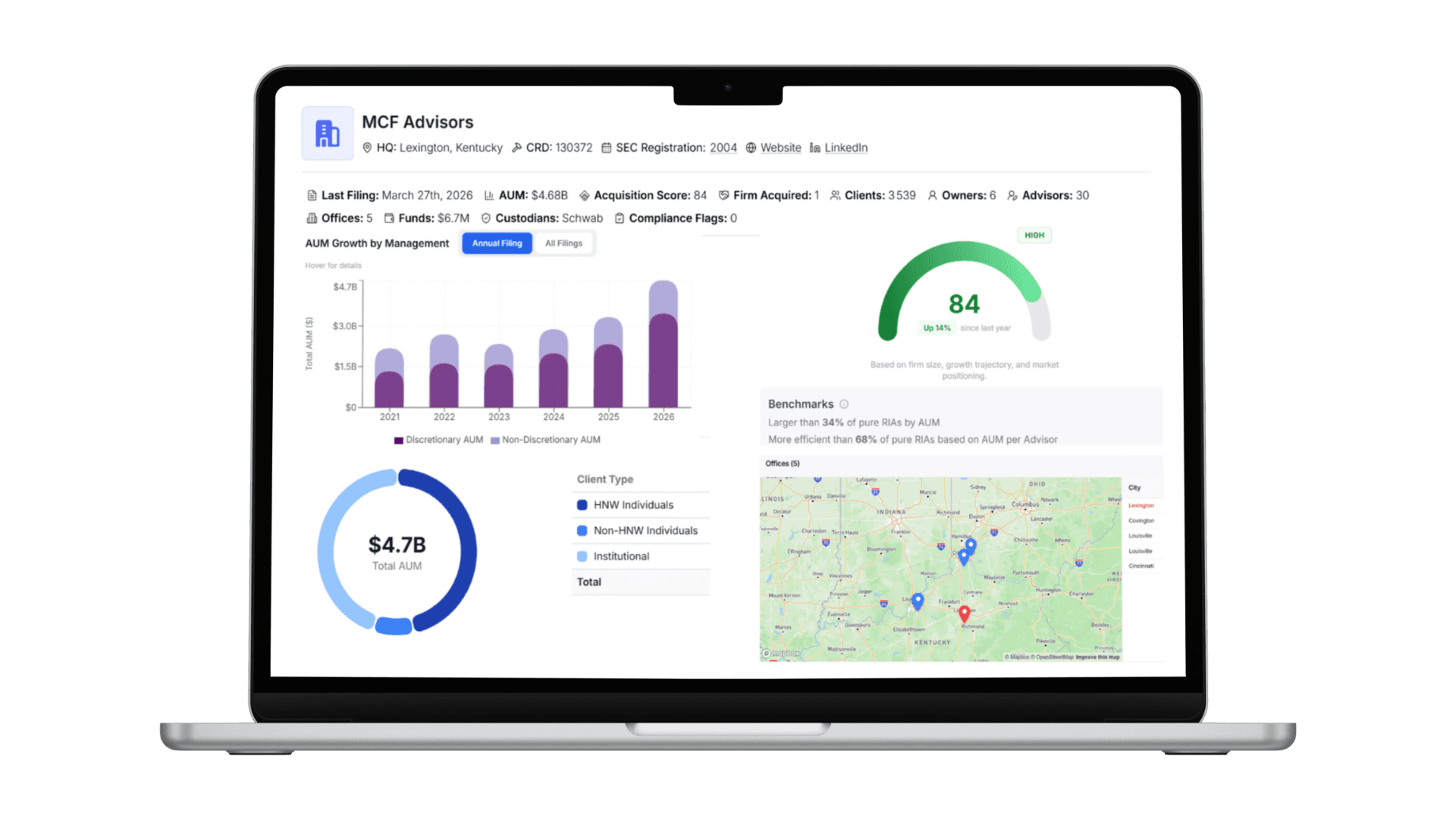
Headline deal counts and average multiples describe the market; they do not describe any individual firm. RIA Catalyst tracks AUM growth, net-new client flows, advisor headcount, and office footprint across 15,000+ SEC-registered RIAs — computed from successive Form ADV filings rather than self-reported claims. In a flat-price market where dispersion between average and exceptional firms is widening, buyers use that filing-level view to identify which firms are actually compounding — and to benchmark a live target against its true peer set before agreeing on price.
FAQ
Did RIA valuations fall in the first half of 2026?
No. Reported pricing remained at historically elevated levels. What changed is expectations: DeVoe's Q2 2026 survey found 82% of consolidators expect flat valuations over the next six months and 18% expect declines — and none expect increases. That is a plateau in sentiment, not a decline in observed prices.
Is a record deal count compatible with flat prices?
Yes. Volume records reflect seller supply and buyer capacity; price reflects competition at the margin. When supply expands as fast as demand, volume rises while price stabilizes. H1 2026 — 167 deals with flat price expectations — is what that equilibrium looks like.
Should sellers rush to market before the end of 2026?
Speed alone is not a strategy. The honest takeaway from the DeVoe data is that market timing no longer adds value by default, so the decision should rest on firm-specific readiness: growth trajectory, team stability, and whether the founder's objectives are defined. A well-prepared process in a flat market beats a rushed process in any market.
Which firms will still command premium pricing?
Firms with documented organic growth (net of market appreciation), expanding client bases, credible next-generation leadership, and clean regulatory histories. Dispersion widens in flat markets: the premium for demonstrable quality increases even as the average holds still.
What does the record pace of $5B+ deals signal?
Thirty transactions by $5B+ firms in one half-year — near last year's full-year record — signals that the most sophisticated, best-advised sellers see current conditions as favorable. It also signals that the buyer universe for large firms (and the capital behind it) remains deep.
Conclusion
H1 2026 delivered a rare combination: record volume and a declared price ceiling. The market is not cooling — it is maturing. For buyers, the era of winning through aggressive pricing is ending; the advantage moves to underwriting discipline, integration credibility, and seeing the right firms early. For sellers, the message is equally clear: the market will no longer do the work of growing your valuation. Your firm has to. In H2 2026, both sides win the same way — by knowing exactly where a firm stands against its real peer universe before the negotiation starts.