Date Published:

Every RIA deal starts with a multiple. The number gets tossed around in teasers, whispered at conferences, and anchored in LOIs before the buyer has opened a single financial statement. The problem? A headline multiple tells you almost nothing on its own. The debate over revenue multiple vs EBITDA multiple for RIAs is really a proxy for a deeper set of questions about growth, profitability, and risk.
Sophisticated buyers know that multiples are shorthand, not substance. A revenue multiple compresses assumptions about scale and fee durability into one figure. An EBITDA multiple compresses assumptions about operating leverage, margin sustainability, and reinvestment discipline into another. Neither captures the full picture. Both can mislead if applied without context. The goal of this guide is to give acquirers a practical framework for choosing which lens to lead with, when to switch, and how to avoid the valuation traps that catch less disciplined buyers.
Quick definitions (and why both exist in RIA M&A)
Both multiples persist because they answer different questions at different stages of diligence. Understanding what each one measures (and what it ignores) prevents misplaced confidence in a single number.
Revenue multiple: what it captures and what it ignores
An RIA revenue multiple expresses enterprise value as a ratio of trailing or run-rate revenue. It is one of the simplest valuation methods, easy to compute, and easy to compare across firms. Revenue captures scale, fee levels, and top-line trajectory.
What it ignores: cost structure, margin, owner economics, and how much of that revenue converts to cash flow. Two firms with identical revenue can have wildly different profitability. The revenue multiple treats them as equivalent.
EBITDA multiple: what it captures and what it ignores
An RIA EBITDA multiple expresses enterprise value as a ratio of earnings before interest, taxes, depreciation, and amortization. It proxies operating cash flow, which is what a buyer actually services debt against and what drives returns.
What it ignores: reinvestment needs, capital intensity, and one-time distortions. EBITDA is sensitive to normalization choices, especially owner compensation, staffing decisions, and expense classification. Without a clean quality-of-earnings (QoE) analysis, the EBITDA number itself may be unreliable.
When revenue multiples are useful (and when they're dangerous)
Revenue multiples work best as triage tools. They become dangerous when buyers treat them as terminal valuation metrics without understanding the margin and risk embedded beneath the top line.
Early-stage diligence and market comps
In the first pass of screening, financials are often incomplete or inconsistently reported. Revenue is typically the most available and comparable data point. Using the RIA revenue multiple for initial ranking and market comps is sensible, as long as the buyer treats it as a filter, not a conclusion.
High-growth / reinvesting RIAs
When a firm is actively hiring advisors, building technology, or expanding into new markets, current EBITDA gets depressed by growth spend. Revenue multiples can be temporarily more informative because they capture the scale being built, even if today's margins look thin. The risk: assuming growth spend is truly temporary rather than a permanent feature of the business model.
Margin volatility and accounting noise
Owner compensation, timing of bonuses, expense classification, and related-party transactions can make pre-QoE EBITDA unreliable. If you are comparing several targets in parallel and none have been through normalization, revenue provides a steadier (if blunter) basis for ranking.
When EBITDA multiples are the right focus
Once you have clean financials and a credible normalization, the RIA EBITDA multiple becomes the sharper lens. It connects directly to what buyers are actually underwriting: sustainable earnings power.
Cash-flow underwriting and debt capacity
Lenders size acquisition debt against EBITDA, not revenue. Leverage ratios, debt service coverage, and covenant headroom all flow from an EBITDA figure. If you are financing the deal, EBITDA is the number that determines how much you can borrow and at what terms.
Mature RIAs with stable margins
For firms with a predictable cost structure, low advisor turnover, and consistent RIA profit margin, EBITDA is a cleaner comparator across targets. Margin stability reduces the risk that today's earnings are an anomaly.
Integration and synergy planning
Valuing a target on EBITDA forces explicit assumptions about cost takeout, platform migration, and growth spending. Revenue multiples let synergy assumptions stay vague. EBITDA-based underwriting demands that every line item earns its place in the pro forma.
Normalized EBITDA for RIAs (practical adjustment checklist)
Normalized EBITDA for RIAs represents sustainable, go-forward operating earnings that a third-party owner would expect. The normalization process removes anomalies, non-recurring items, and owner-specific economics to produce a comparable view.
Owner compensation normalization
Founders often pay themselves well above or below market. Normalize by replacing actual owner comp with the cost of hiring a market-rate replacement for the roles the owner fills (lead advisor, CEO, CIO, or some combination). Role clarity matters: a founder who is also the lead advisor on 60% of AUM creates a very different normalization than one who is purely a manager.
One-time and non-recurring add-backs
Common RIA add-backs include litigation and settlement costs, one-time recruiting or signing bonuses, office relocation or buildout, technology migration expenses, severance, and unusual consulting engagements. Each add-back should be documented with evidence that the expense does not repeat under new ownership.
Run-rate vs trailing EBITDA
Trailing twelve-month (TTM) EBITDA reflects what happened. Run-rate EBITDA reflects what the business looks like today, adjusted for recent hires, pricing changes, or client mix shifts. If a firm added three advisors in the last quarter, TTM EBITDA carries their full onboarding cost but only a fraction of their revenue contribution. Run-rate adjustments correct for that timing mismatch, but require defensible assumptions.
What buyers will not add back
Recurring costs do not qualify as add-backs, even if they feel discretionary. Ongoing recruiting and training, persistent compliance and regulatory expenses, steady-state technology spend, and normal annual bonuses are part of running the business. Buyers who inflate EBITDA by stripping out recurring costs end up overpaying.
The bridge: how revenue turns into EBITDA (and why it matters)
The mechanical relationship is simple: EBITDA = Revenue × EBITDA Margin. A 2.5x revenue multiple on a 40% margin firm implies a 6.25x EBITDA multiple. The same 2.5x revenue multiple on a 25% margin firm implies a 10x EBITDA multiple. EBITDA margins directly affect what a revenue multiple actually means, and ignoring the margin bridge leads to mispricing.
Margin drivers (pricing, service model, staffing, tech, compliance)
RIA profit margin varies widely based on operating model. Fee schedule and pricing power, advisor-to-client ratios, use of planning technology, compliance infrastructure, and office footprint all shape the cost structure. A firm charging 80 bps with a lean tech-enabled model will look very different from one charging 60 bps with a high-touch, staff-heavy approach, even at the same AUM.
Revenue quality and retention risk
Fee mix (AUM-based vs. fixed planning fees vs. performance fees), client concentration, and advisor portability all affect how durable revenue is post-close. A firm where the top three clients represent 30% of revenue carries retention risk that should compress the multiple or increase structural protections.
Capacity constraints and growth costs
Growth often requires headcount additions, technology investment, and infrastructure spending that compress near-term EBITDA. Buyers need to separate temporary growth investment from structural margin pressure. The distinction determines whether current EBITDA understates or accurately represents earning power.
Worked example (hypothetical)
RIA A vs RIA B: same revenue, different EBITDA
Metric | RIA A | RIA B |
Revenue | $5M | $5M |
Reported EBITDA | $2.0M | $1.0M |
Owner comp (actual) | $300K | $800K |
Market replacement comp | $400K | $400K |
One-time legal costs | $0 | $150K |
Normalized EBITDA | $1.9M | $1.55M |
Normalized margin | 38% | 31% |
RIA A has a lean cost structure and market-rate owner comp. RIA B has above-market owner comp and a one-time legal expense that inflates the add-back, but normalized EBITDA still trails by $350K.
Implied valuation under revenue multiple
Applying a 2.5x revenue multiple to both: $5M × 2.5 = $12.5M for each. The revenue multiple treats these firms as identical.
Implied valuation under EBITDA multiple
Applying an 8x EBITDA multiple to normalized EBITDA: RIA A = $1.9M × 8 = $15.2M. RIA B = $1.55M × 8 = $12.4M. The $2.8M valuation gap reflects the margin and normalization differences that the revenue multiple hid entirely.
What changes in the LOI terms to protect downside
For RIA B, where margin is thinner and revenue quality may carry more risk, buyers often adjust deal structure: a larger earnout component tied to revenue retention, holdbacks linked to client transition milestones, and tighter representations around key client relationships. The revenue multiple suggested parity. The EBITDA multiple, and the diligence behind it, revealed why parity was not warranted.
Revenue multiple vs EBITDA multiple: comparison across key criteria
Criteria | Revenue Multiple | EBITDA Multiple |
Data required | Minimal (top-line revenue) | Detailed P&L, normalization |
Ease of computation | High | Moderate to low |
Sensitivity to growth | Captures scale trajectory | Depressed by reinvestment |
Sensitivity to margin | Ignores margin entirely | Directly reflects margin |
Sensitivity to retention risk | Does not distinguish | Reflected via margin durability |
Manipulability | Low (revenue is harder to inflate) | Higher (add-backs can be subjective) |
Comparability across firms | Good for screening | Better once normalized |
Relevance to debt sizing | None | Direct input to leverage ratios |
Useful stage of diligence | Triage and early screening | LOI through close |
Integration planning value | Low | High (forces cost assumptions) |
Risk of overpaying | Higher if margins are low | Lower if normalization is disciplined |
What buyers should focus on (a decision framework)
The right "headline multiple" depends on where you are in diligence and how much confidence you have in the underlying numbers.
5-7 underwriting questions to answer before picking a "headline multiple"
Is revenue primarily AUM-based, and what is the fee schedule trajectory?
What is client concentration, and how portable are relationships?
Has owner compensation been normalized to market replacement cost?
Are there material add-backs, and would a third party agree they are non-recurring?
Is the current margin representative, or is it distorted by growth investment or cost deferrals?
What does the advisor staffing model look like, and where is the firm on its capacity curve?
Has the firm been through a QoE, or are you working with management-prepared financials?
If you can answer questions 3 through 7 with confidence, lead with the EBITDA multiple. If not, use the revenue multiple as a placeholder and invest in normalization before setting terms.
A simple scorecard for revenue quality + margin durability
Score each factor 1 (weak) to 3 (strong) to standardize internal investment committee discussions:
Fee stability: recurring AUM-based fees vs. project or performance fees
Client concentration: top-10 client revenue share
Advisor retention: tenure and non-compete enforceability
Margin consistency: trailing 3-year EBITDA margin variance
Growth cost clarity: ability to separate temporary investment from structural spend
A total score above 12 (out of 15) suggests the EBITDA multiple is reliable. Below 9, lean on revenue multiples and widen structural protections.
Data advantage: better comps, faster underwriting
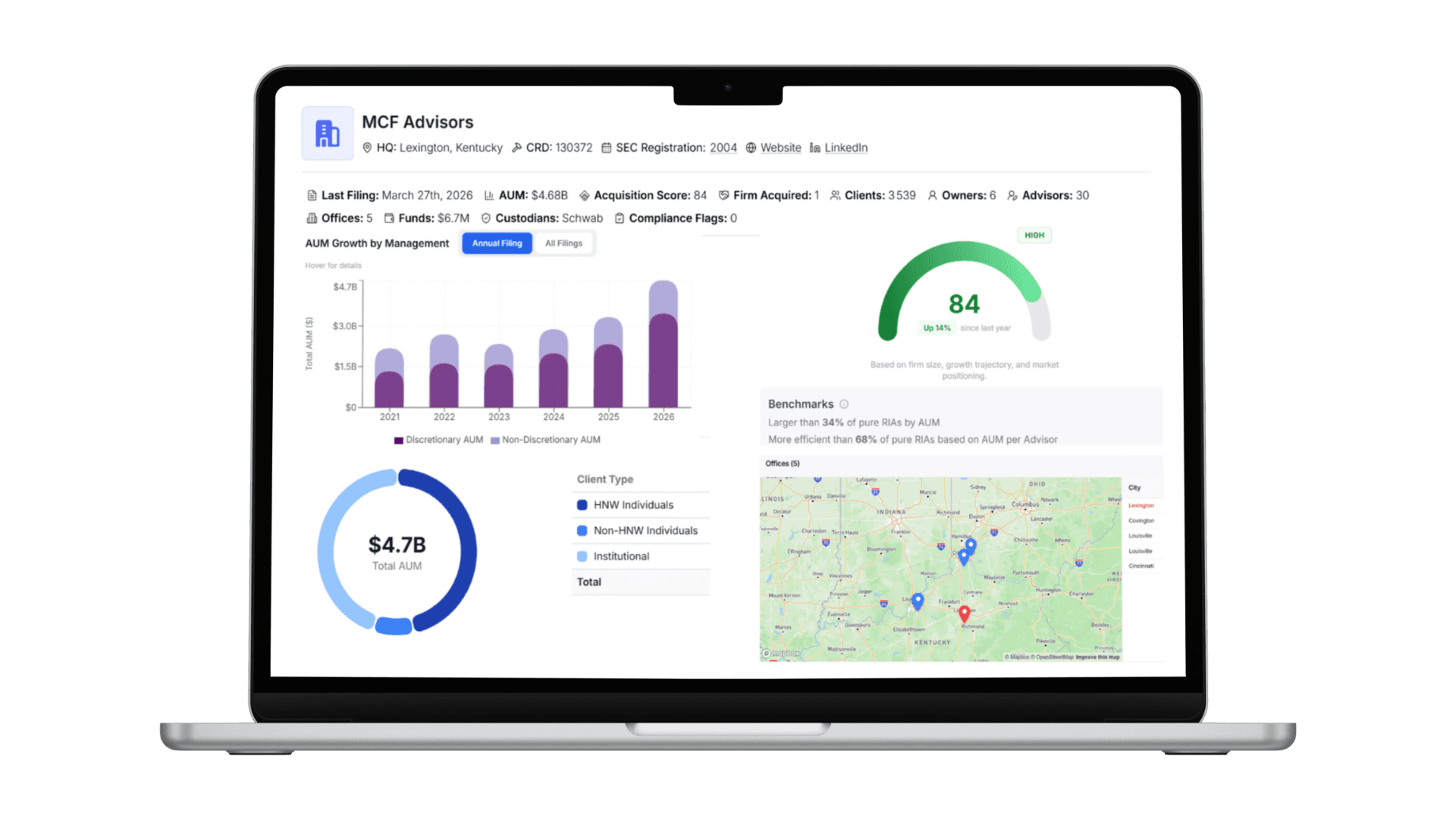
Multiple selection improves with consistent peer benchmarking and clean firm-level intelligence. Attributes like AUM, advisor headcount, client mix, geography, and ownership signals determine whether a comp set is meaningful or misleading. Platforms like RIA Catalyst help maintain structured RIA firm intelligence for comps, market mapping, and pipeline diligence, anchored in public disclosures like Form ADV via the SEC's IAPD system. The SEC also publishes downloadable adviser data files that provide a foundation for structured analysis, though raw filings require meaningful processing to become actionable.
FAQ
What is a good revenue multiple vs EBITDA multiple for RIAs?
Ranges vary by growth rate, profitability, size, and business model. RIA valuation drivers include attrition, fee structure, EBITDA margins, and risk concentration. Quoting a single "market multiple" without specifying these inputs is misleading. Buyers should build cohort-specific comp sets rather than relying on headline averages.
How is normalized EBITDA for RIAs calculated in diligence?
Start with reported EBITDA. Adjust owner compensation to market replacement cost. Add back documented, genuinely non-recurring expenses. Subtract any understated costs (deferred maintenance, below-market vendor contracts). The result should reflect what a third-party owner would earn on a go-forward basis. A formal QoE analysis typically documents each adjustment with supporting evidence.
Why do two RIAs with the same revenue sell for different prices?
Margin, retention risk, client mix, and growth reinvestment explain most of the gap. A firm with 40% EBITDA margins, low client concentration, and sticky AUM-based fees commands a premium over one with 25% margins and key-person risk, even at the same top line.
When should a buyer switch from revenue multiple to EBITDA multiple?
The trigger is diligence maturity. Once you have clean, normalized financials (ideally through a QoE), a credible retention assessment, and clarity on growth spending, lead with the EBITDA multiple. Continuing to anchor on revenue past that point leaves margin risk unaddressed.
What add-backs are most likely to be challenged in an RIA deal?
Owner compensation adjustments draw the most scrutiny, especially when the founder is also the primary relationship manager. Related-party rent (office space owned by the founder) and "one-time" expenses that appear in multiple years are frequent points of negotiation. Buyers should pressure-test every add-back with the question: does this cost disappear under new ownership, or does it just change form?
Conclusion
The revenue multiple vs EBITDA multiple for RIAs debate is not about choosing one and discarding the other. Both lenses serve a purpose at different points in the deal process. Revenue multiples are useful for early screening and for firms where growth investment temporarily compresses earnings. EBITDA multiples become the right focus once normalization, retention risk, and margin durability are understood. The most disciplined buyers use revenue multiples to build the pipeline, then switch to EBITDA multiples to price the deal. Keeping both frameworks in view, with explicit assumptions behind each, is the best protection against overpaying for a headline number that hides the economics underneath.