Date Published:

In the first week of August 2026, Arax Investment Partners closed its seventh acquisition of the year — Transcend Capital Advisors, a multi-state RIA with more than $3 billion in assets under management. The same week, industry data from DeVoe & Company confirmed that the most active consolidators, including Hightower, Beacon Pointe, and Savant Wealth Management, each logged eight transactions in the first half of the year alone.
Read those numbers from the seller's side of the table. If your buyer closes a deal roughly every month, you are not their defining transaction. You are one entry in a pipeline — and the quality of your outcome depends on how well that pipeline is run.
Most diligence advice flows one direction: buyers scrutinizing sellers. But in a market pacing toward roughly 500 deals this year, according to Echelon Partners' latest deal report, the more neglected discipline is the reverse. Sellers routinely spend months preparing their own firm for scrutiny and less than a week evaluating the acquirer whose equity, integration model, and culture will define the next decade of their professional life.
This article lays out a reverse diligence framework: what to examine in a serial acquirer's track record, capital structure, and integration history — and the specific questions that separate a well-run acquisition machine from a growth story held together by announcements.
Why Buyer Velocity Is a Seller Risk
Deal velocity is usually presented as a strength. Seven closings in seven months signals capital access, process maturity, and board conviction. All true. But velocity also creates three specific risks that accrue to sellers, not buyers.
Integration capacity is finite
Every acquisition consumes integration resources: technology migration, repapering, compliance consolidation, client communication, staff onboarding. A buyer doing two deals a year can put senior people on each one. A buyer doing eight deals in six months is triaging. The question is not whether your integration will be planned — it is whether it will be staffed, and by whom, when three other closings land in the same quarter.
Your equity story depends on their next twenty deals
Most consolidator transactions include an equity component. That equity's value is a function of deals the buyer has not yet done — future acquisitions, future leverage, a future liquidity event. When you accept equity in a serial acquirer, you are effectively investing in their M&A discipline. A buyer who overpays for the next ten firms dilutes the value of your rollover. A buyer who stalls stops the multiple-expansion story your payout depends on.
Culture compounds — in both directions
A firm that has absorbed thirty practices has a culture shaped by absorption. That can mean a refined playbook and realistic promises. It can also mean standardization that leaves little room for the autonomy you were told you would keep. The difference is observable — but only if you look before signing.
The Reverse Diligence Framework
Reverse diligence is not adversarial. Sophisticated acquirers respect sellers who run a real process on them, because it signals the seller understands what they are agreeing to. The framework has four pillars.
1. Track record: announced versus closed versus retained
Announcements are marketing. Closings are operations. Retention is truth.
Build a simple ledger of the buyer's transactions over the past three years: what was announced, what actually closed, and — where discoverable — what happened to the acquired firm's advisors and assets afterward. Form ADV filings make much of this public. A pattern of advisors departing twelve to twenty-four months post-close is the single most important red flag in the dataset, because it usually means the integration promises did not survive contact with reality.
2. Reference calls with prior sellers
Ask the buyer for introductions to three founders who sold to them — then independently find two they did not offer. The unofficial references matter more. Useful questions:
Question | What the answer reveals |
|---|---|
What surprised you after close? | Gap between pitch and execution |
How long did technology migration actually take? | Integration capacity and honesty of timelines |
Did your service model change for clients? | Whether "nothing changes" was real |
Would you do the deal again at the same terms? | The only summary metric that matters |
Who do you call when something breaks? | Whether post-close support is a person or a queue |
3. Capital structure and hold-period math
Serial acquirers are almost always backed by institutional capital, and that capital has a clock. Understand where the buyer's sponsor is in its fund life. A sponsor in year two of a hold behaves differently from a sponsor preparing an exit: pricing discipline, integration investment, and appetite for long earnouts all shift. You do not need inside information — sponsor entry dates are public, and the implications are arithmetic.
Also map the leverage. A heavily levered platform in a higher-rate environment has less room to absorb a slow quarter, and cost pressure eventually reaches the acquired firms.
4. Integration model: integrated, federated, or undecided
Consolidators sit on a spectrum. Fully integrated platforms migrate every firm onto one brand, one custodian relationship, one technology stack. Federated models leave brands and operations largely intact and centralize only capital and compliance. Both can work. The dangerous buyer is the one that has not decided — or says "federated" in the pitch while its last six integrations were forced migrations.
The test is behavioral, not verbal: look at what happened to the brands, ADV filings, and office footprints of the firms they bought two years ago.
What This Week's Market Data Adds
The concentration numbers sharpen the argument. DeVoe's H1 data shows the largest acquirers overwhelmingly targeting sellers between $1 billion and $5 billion in assets. If your firm sits in that band, you will likely have multiple bidders — which means reverse diligence is not just protective, it is a selection tool. When three serial acquirers offer comparable headline numbers, the differentiator is everything this framework surfaces: retention history, integration staffing, sponsor timeline, and the honesty gap between announcements and outcomes.
If your firm sits below the band, the discipline matters differently: fewer bidders means less negotiating leverage, which makes the quality of the single buyer across the table proportionally more important.
Data Advantage: Seeing the Buyer's Footprint Before the First Call
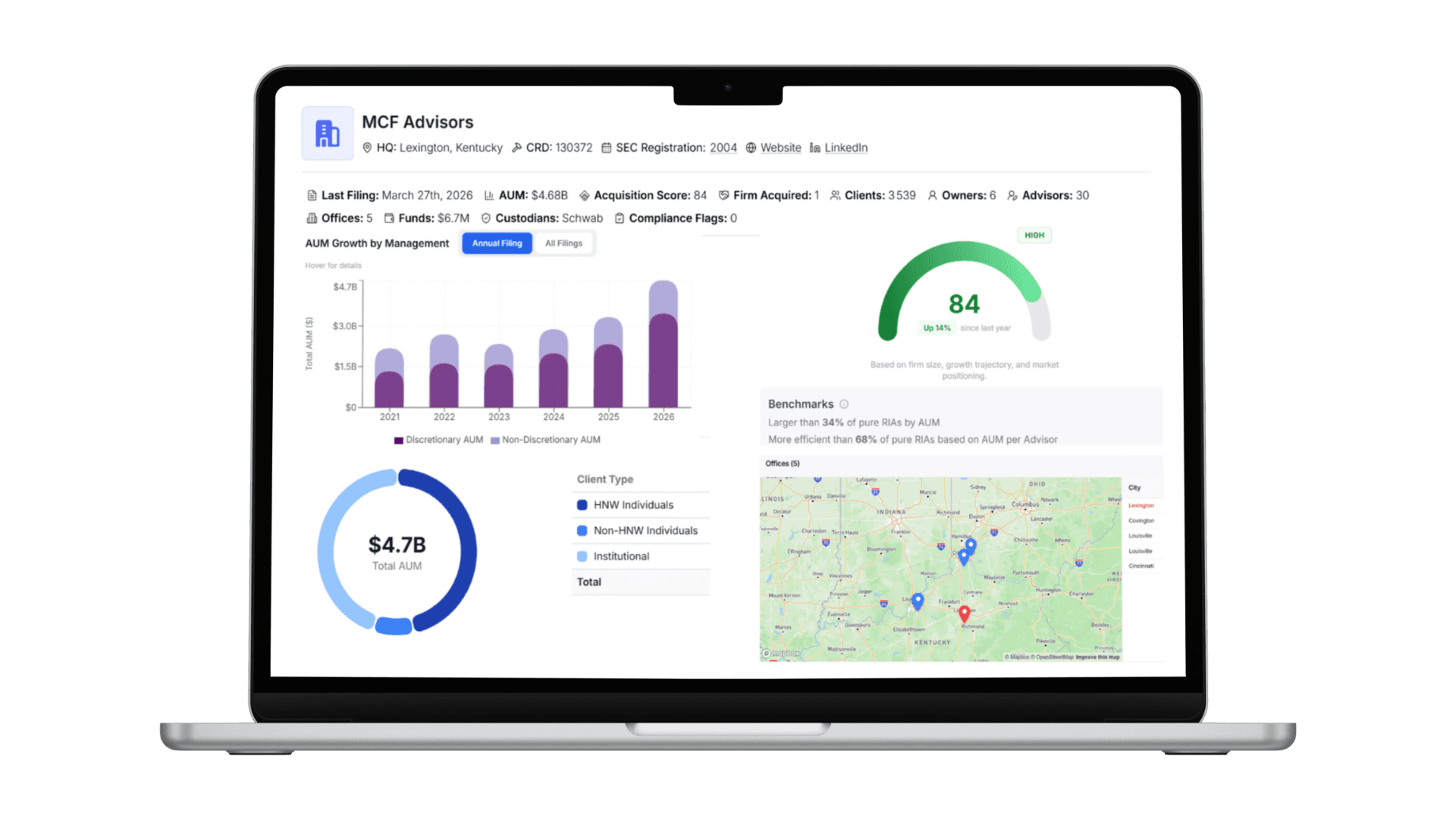
RIA Catalyst tracks acquisition activity, advisor headcount changes, office locations, and regulatory filings across 15,000+ SEC-registered RIAs. For sellers, that same dataset works in reverse: a buyer's acquired firms can be monitored through successive Form ADV filings — IAR counts, office consolidations, AUM trajectories — turning integration claims into observable history. A consolidator's true retention record is written in its filings long before it comes up in a pitch meeting.
FAQ
How long should reverse diligence take?
Four to eight weeks, run in parallel with the buyer's diligence on you. Most of the work — filings review, reference calls, sponsor research — requires no cooperation from the buyer and can start before an LOI.
Is it appropriate to ask a buyer for seller references?
Yes, and the reaction is itself diagnostic. Established acquirers expect the request and have references ready. Hesitation or curated-only access tells you something the references themselves might not.
What if the buyer's equity is the majority of my consideration?
Then reverse diligence is effectively investment diligence, and it deserves the same rigor you would apply to any illiquid, concentrated position. Understand the sponsor, the leverage, the path to liquidity, and the dilution mechanics of future deals before you weight the paper.
Does a fast-closing buyer signal strength or risk?
Both. Speed usually reflects process maturity and committed capital — real advantages. The risk is not the speed of your closing but the crowding of the integration calendar after it. Ask directly how many integrations will be running concurrently with yours.
Can smaller firms below $1B run this process?
Yes, and they arguably need it more. With fewer bidders competing, the cost of choosing a weak buyer is higher, and the leverage to renegotiate later is lower.
Conclusion
The 2026 market rewards prepared sellers. Buyers are closing at a record pace, capital is abundant, and the deal machinery is more professional than it has ever been. But machinery is exactly the point: when your buyer is a system, you need to inspect the system, not the salesperson. A ledger of closed deals, five honest reference calls, a sponsor timeline, and two years of the buyer's own Form ADV history will tell you more than any management presentation. The firms that get the best outcomes this cycle will be the ones that diligence their buyer as seriously as their buyer diligences them.