Date Published:

The best RIA acquisition targets are rarely for sale. They are not in broker databases. They are not responding to unsolicited emails from buyers they have never met. When they do decide to explore a transition, they move quickly — often reaching a shortlist of buyers within weeks before signing. By the time most acquirers learn a firm is available, the proprietary access window has already closed.
This is the structural reality of off-market RIA acquisition sourcing. The firms that create the most value post-close are typically the ones with the least urgency to transact. They have pricing power, stable organic growth, and a client base that isn't going anywhere. When they eventually decide to explore options, they choose buyers they already know — people who took the time to build a relationship before any deal was on the table.
Sourcing off-market RIA acquisition targets is not about knowing the right people. It is about building an infrastructure that identifies the right firms early, monitors the signals that predict a transition, and places the right person in front of the right founder at the right moment. This guide covers how to build that system.
Why Off-Market Deals Are Different — and Better
Price, Terms, and Process Advantages of Proprietary Access
The financial case for off-market sourcing is direct. When a seller engages an M&A advisor, the banker's job is to maximize competition — broadening the buyer universe, running structured bid processes, and anchoring price expectations at the high end of the range. That process is rational from the seller's perspective. From the buyer's perspective, it means arriving at a deal where price is the primary differentiator, diligence timelines are compressed, and terms have already been shaped by competing offers.
Proprietary access changes all of that. When a buyer has built a genuine relationship before a formal process begins, several things shift: conversations happen before pricing is anchored by a banker, the buyer can present their platform and culture rather than just their offer, diligence can be paced appropriately, and deal structure can be negotiated with a seller who is choosing a partner rather than running an auction. The result is typically a lower entry multiple, better terms, and a more cooperative integration — because the relationship that enabled the deal also supports the post-close transition.
What most sellers don't realize is that broker incentives don't always point in their direction. Many intermediaries have worked with the same buyer universe for years and no longer have visibility into the full market — their network has narrowed to a familiar group of repeat buyers. Some buyers go further, paying brokers a separate fee to keep the process group deliberately small, reducing competition and preserving their pricing leverage. Sellers who rely exclusively on a broker to run a competitive process may be operating in a smaller market than they think.
The conflict extends to advisor and team transitions. When advisors move from one firm to another, brokers are frequently paid a referral fee by the receiving firm — meaning the broker is economically incentivized to direct advisors toward whichever buyer pays the highest referral rate, not necessarily the best fit for the advisor or their clients. At the time of writing, some large platforms are paying referral fees of approximately 16% of trailing twelve-month revenue to attract incoming teams — significantly above a market rate that typically runs between 7% and 10%. Sellers who sense that a broker is steering them toward specific buyers should treat that as a signal to ask direct questions about fee arrangements — and to consider whether independent outreach to a broader buyer universe would produce a more competitive outcome.
Why Brokered Processes Systematically Disadvantage Buyers
A brokered RIA deal is, by design, a competitive process optimized for the seller. By the time a CIM hits a buyer's inbox, the firm has been positioned by professionals whose compensation depends on maximizing price. Diligence requests are standardized across all bidders. Management presentations are choreographed. The seller's advisors have already identified the valuation tension points and prepared responses.
None of this is improper — it is simply the function of a well-run sell-side process. But it creates a structural disadvantage for buyers who rely on brokered deal flow. They see curated information, compete against the full market, and negotiate from a position where the seller holds most of the informational and process advantages. Over time, serial acquirers who depend on brokered flow end up paying market price for market-quality deals — which is a reasonable outcome only if you have no capability to do better.
The 12–18 Month Window: Understanding When Sellers Decide
The Pre-Contemplation Phase and Why Most Buyers Miss It
Most RIA founders who eventually sell begin contemplating the idea 12 to 18 months before they take any formal action. During that pre-contemplation phase, they are not looking for buyers — they are processing a decision that touches their identity, their team, their clients, and their legacy. They are talking informally with trusted advisors, occasionally doing mental math on what a transition might look like, and paying attention to how the firms around them are handling similar decisions.
This is the window in which proprietary relationships are built. A buyer who is present and credible during this period can shape how a founder thinks about transition — what kind of buyer makes sense, what a good outcome looks like, what questions to ask. A buyer who appears at the LOI stage is, by contrast, a stranger making an offer. The founder may still transact, but the relationship dynamic is entirely different.
Most buyers miss the pre-contemplation window for a simple reason: they are not monitoring the right signals at the right frequency. They source reactively — responding to broker teasers, following up on referrals, activating networks when they are ready to buy. By the time they move, the pre-contemplation window has already passed for the firms they most want to acquire.
What Triggers a Founder to Start Thinking About a Transition
Understanding what causes a founder to enter the pre-contemplation phase is the foundation of proactive sourcing. The triggers are rarely dramatic. They tend to be accumulative — a combination of personal, operational, and market factors that gradually shift the calculus.
Common triggers include: approaching a personal age milestone (late 50s or early 60s is a common inflection point), a health event affecting the founder or a close peer, a competitor sale at a valuation that reframes what the founder's firm might be worth, increasing regulatory complexity that makes independent operation feel less appealing, or the arrival of a well-capitalized acquirer in the local market that accelerates awareness of options.
Buyers who monitor for these signals — and who maintain relationships with founders in the relevant demographic — consistently gain access to transition conversations before the formal process begins.
The Four Sourcing Channels — and How to Rank Them
Direct Outreach (Data-Driven Targeting)
Direct outreach to RIA founders — without an intermediary — is the highest-quality sourcing channel available to a disciplined buyer. It is also the hardest to execute at scale, because it requires identifying the right firms, prioritizing the ones most likely to be receptive, and delivering outreach that is specific enough to earn a response from a busy professional who has no particular reason to take the meeting.
Done well, direct outreach produces relationships that no banker can replicate. The buyer demonstrates market knowledge, shows they have done their homework on the firm, and opens a conversation that is genuinely about the founder's situation rather than a transaction. Done poorly — mass emails, generic scripts, pressure-oriented messaging — it permanently closes the door with the exact founders you most want to reach.
The quality of direct outreach is determined almost entirely by the quality of the targeting behind it. Buyers who can identify high-productivity firms in their target geography, stratify them by succession proximity and owner age, and personalize outreach based on specific firm characteristics will consistently outperform buyers who work from generic lists.
Custodian and COI Referral Networks
Custodian referral programs and centers-of-influence (COI) networks — accountants, attorneys, consultants who work with RIA founders — are a high-signal source for off-market deal flow. These relationships sit close to the decision: a custodian's relationship manager often knows months in advance that a firm is exploring options, and a founder's CPA is typically one of the first people consulted when a transition is being considered.
Building these networks requires consistent investment. Custodians care about protecting client assets; they will refer to buyers they trust to handle transitions carefully. COIs refer to buyers who have demonstrated professionalism in past deals. Neither relationship can be manufactured quickly — they are built through repeated positive interactions over time. But once established, they produce a consistent flow of pre-market opportunities that are qualitatively different from broker teasers.
Industry Conferences and Community Presence
Physical presence at industry conferences and association events where RIA founders gather is one of the most underrated sourcing channels. Not because deals are discussed at conferences — they rarely are — but because trust is built there. A founder who has met you three times at IMPACT or the Barron's conference, who has heard you speak or participated in a discussion you facilitated, perceives you differently than a name on a letter of intent.
Community presence signals longevity and commitment to the industry, which matters to founders who are considering entrusting their clients to a new organization. It is not a fast channel — the relationship ROI on conference attendance compounds over 18–36 months. But for buyers building a long-term sourcing engine, it is a foundational investment.
Broker Relationships (When and How to Use Them)
Broker relationships are not a proprietary sourcing channel — by definition, any buyer with a broker relationship can access the same deals. But they are a reality of the RIA M&A market, and dismissing them entirely leaves real deal flow on the table.
The strategic question is sequencing. Buyers who use brokers as their primary sourcing channel will pay market price for market-quality deals, consistently. Buyers who use brokers as a supplementary channel — to access deals that fall below or outside their primary target profile — can capture opportunistic value while preserving their proprietary sourcing capacity for the highest-priority targets. The key discipline is not allowing brokered deal volume to crowd out the relationship investment required to build genuine off-market flow.
Sourcing Channel Comparison
Channel | Signal Quality | Scalability | Time to Relationship | Competition Level |
|---|---|---|---|---|
Direct outreach (data-driven) | High — firm-specific and targeted | Medium — requires data infrastructure | 6–18 months | Low if reached pre-contemplation |
Custodian / COI referrals | Very high — pre-qualified, trusted | Low — relationship-constrained | 12–36 months | Low to medium |
Industry conferences | Medium — broad but trust-building | Low — time and presence intensive | 18–36 months | Medium |
Broker / intermediary | Low — fully brokered, marketed | High — passive inbound | Days to weeks | Very high |
Building a Data-Driven Outreach Infrastructure
Market Mapping and Universe Definition
The first step in building a proprietary sourcing engine is defining the total addressable market — the universe of RIA firms that match the acquisition thesis before any prioritization. This means segmenting by AUM band, geography, advisor demographics, fee model, custodial relationship, and service model.
Market mapping at scale requires current, structured data. Form ADV filings are the authoritative public source for RIA firm data — they report AUM, advisor headcount, ownership structure, custodial relationships, and compliance history on an annual or amended basis. Working from raw ADV data is feasible but time-intensive; the value of a structured data platform is in the aggregation and continuous updating of that underlying intelligence.
The output of market mapping is a defined universe — typically 200 to 500 firms for a regionally focused buyer — that represents the full set of firms worth monitoring and eventually approaching.
Signal-Based Prioritization: Which Firms to Contact First
Not all firms in the target universe are equally ready for outreach. Signal-based prioritization ranks the universe by readiness indicators that predict which founders are most likely to be in or near the pre-contemplation phase.
Key prioritization signals include: founder age between 57 and 67, which represents the realistic succession planning horizon; firm AUM that has grown primarily through market appreciation rather than organic flows, suggesting a business that may be plateauing; recent advisor departures visible in updated ADV filings; and a lack of junior partner equity, which indicates no internal succession solution is in development.
Secondary signals include: conference attendance patterns shifting toward industry leadership topics rather than investment management content; website or LinkedIn updates that suggest the founder is building a public legacy narrative; and custodian conversations indicating the firm has been asking about transition support resources.
Firms that score highest on these signals move to the active outreach queue. Firms that are in the target universe but show no near-term succession signals go on a monitoring list with quarterly review triggers.
CRM and Pipeline Hygiene
A sourcing engine without a CRM is a relationship without a memory. Every firm in the target universe, every outreach touch, every conversation and follow-up should be tracked in a structured system. This is not optional at scale — without it, the team cannot coordinate outreach across multiple relationship managers, cannot identify which firms have been contacted and when, and cannot detect when a firm that was dormant six months ago has just entered the active contemplation phase.
Pipeline hygiene also means regular universe refresh. ADV filings update annually at minimum; firm AUM, advisor headcount, and ownership structure change continuously. A target list built eighteen months ago will contain firms that have since sold, merged, or changed ownership. Removing stale entries and adding newly qualifying firms is a quarterly discipline, not a one-time exercise.
The Off-Market Outreach Sequence
A structured outreach sequence prevents the two most common failures: reaching out too early with the wrong message, or waiting so long that a banker gets there first.
Touch 1 — Market insight share (Month 1): Send a brief, personalized note sharing a relevant data point or market observation specific to the founder's firm or geography. No transaction language. The goal is to demonstrate that you know the market and have done your homework on their firm specifically.
Touch 2 — Conference or community connection (Month 2–3): If possible, connect in person at a shared industry event. If not, engage with the founder's LinkedIn content or professional writing with a substantive comment. Visibility without pressure.
Touch 3 — Platform introduction (Month 4–6): Share a brief summary of your platform's value proposition — not as a pitch, but as context. "Here is what we have built and why advisors in your market have found it compelling." Keep it short. Offer a 20-minute conversation with no agenda beyond getting to know each other's perspectives.
Touch 4 — Relationship check-in (Month 9–12): A brief note acknowledging a firm milestone, market development, or regulatory change relevant to their situation. Demonstrates ongoing attention without manufacturing urgency.
Touch 5 — Direct conversation trigger (Month 12–18): When a prioritization signal strengthens — a new ADV showing advisor departure, a conference interaction that signals the founder is actively thinking about next steps — move to a direct, frank conversation. "We have been building a relationship with you for the right reasons, and I want to make sure you know what a partnership with us would look like before you have any other conversations."
The sequence is a framework, not a script. The timing and tone adapt to what you learn about each founder through the relationship. What does not adapt is the discipline of maintaining consistent presence across the 12–18 month pre-sale window.
Common Sourcing Mistakes That Kill Proprietary Access
Leading with transaction language. The fastest way to close a pre-contemplation founder is to open with a conversation about deal multiples or acquisition interest. It reframes the relationship as transactional before trust has been established. First contact should never mention a deal.
Inconsistent outreach cadence. A burst of activity when the team is "in sourcing mode" followed by months of silence signals to founders that they are on a list, not in a relationship. Proprietary access requires consistent, light-touch presence over time.
Over-relying on a single channel. Buyers who source exclusively through custodian referrals or exclusively through conferences leave significant segments of the target market unreached. A functioning sourcing engine uses multiple channels with different time horizons operating simultaneously.
Failing to update the universe. A target list that isn't refreshed at least quarterly will contain firms that have already sold and will miss firms that have recently entered the succession horizon. Stale data produces wasted outreach and missed opportunities.
Treating all signals equally. Not every ADV data point or behavioral signal carries the same weight. Founder age above 62 with no junior equity is a high-conviction signal. A conference appearance is a low-conviction signal. Outreach priority should reflect that difference.
Neglecting the post-conversation follow-through. A productive first conversation that isn't followed up within two weeks is a relationship that cools. The post-meeting cadence is as important as the initial outreach sequence.
Data advantage: signal-based sourcing at scale
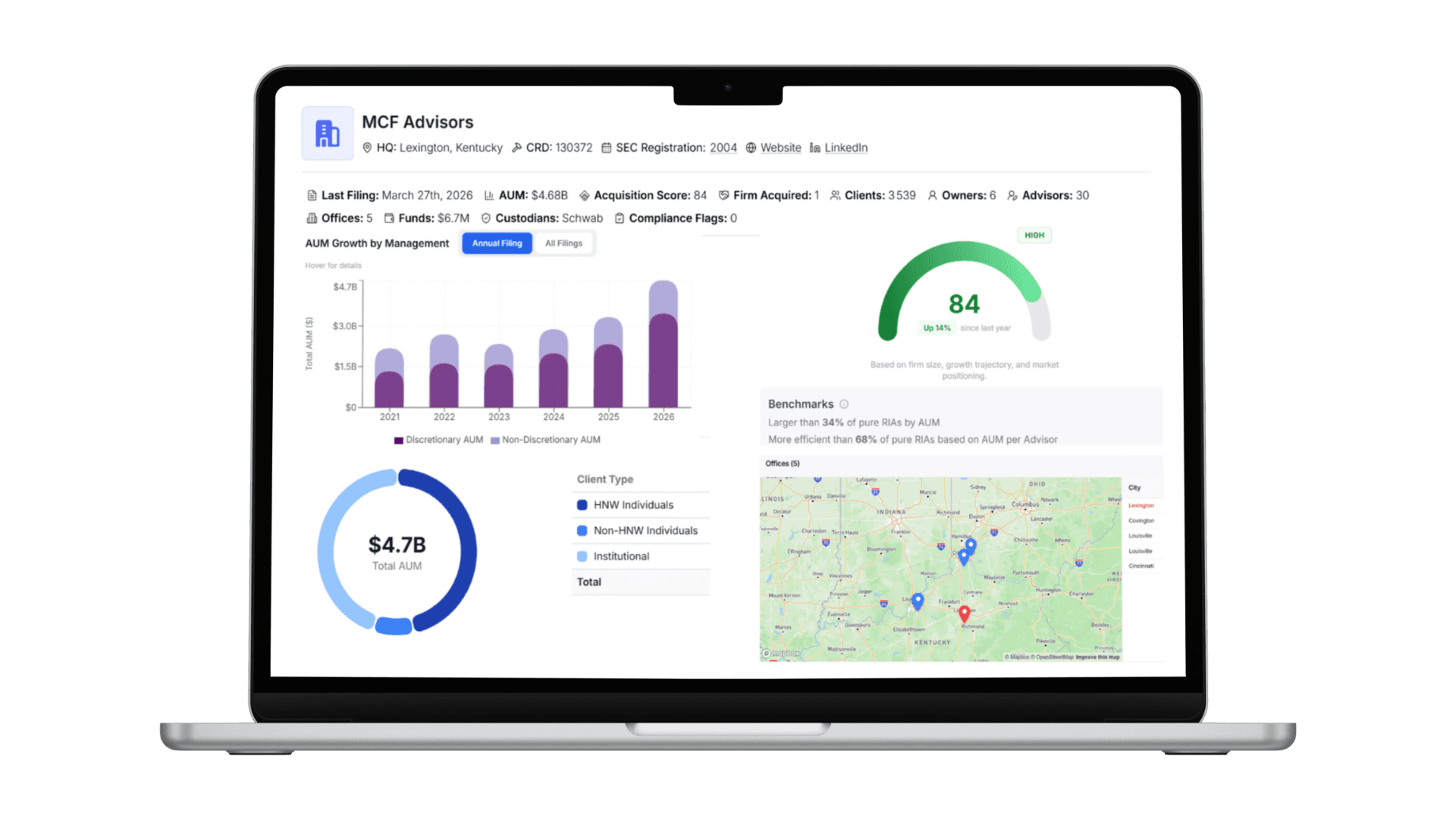
Running a signal-based prioritization model across a universe of 200–500 firms — and maintaining it as that universe changes — requires a data layer that tracks firm-level intelligence continuously. RIA Catalyst maintains structured data across 15,000+ SEC-registered RIAs, including AUM history, advisor demographics, custodial relationships, and growth trends. That infrastructure enables buyers to apply a systematic prioritization model at the top of the sourcing funnel — identifying which founders are most likely approaching a transition 12 to 18 months before a formal process begins, rather than discovering them in a broker teaser.
FAQ
How many off-market RIA targets should be in an active outreach sequence at any given time?
For a team closing 2–4 deals per year, an active outreach sequence of 40–80 firms provides enough coverage to generate consistent relationship-building activity without spreading outreach too thin to be meaningful. Quality of engagement matters more than list size: 20 genuine relationships with high-priority founders produce more proprietary deal flow than 200 names in a spreadsheet with no consistent contact cadence.
How do I identify which RIA founders are approaching a transition without direct conversations?
Form ADV filings provide several indirect signals: founder age (listed in Part 2 bios or estimable from career histories), advisor headcount changes year-over-year, AUM growth decomposition, and ownership structure disclosures. Structured data platforms that aggregate and track these inputs across the full RIA universe — such as RIA Catalyst — allow buyers to run signal-based prioritization models across thousands of firms simultaneously, surfacing the highest-priority targets for active outreach without requiring a direct conversation first.
What is the right tone for a first outreach to an RIA founder I've never met?
Specific, professional, and non-transactional. The message should reference something concrete about the founder's firm — a market trend relevant to their geography, a data point about their client segment, or a genuine observation about their growth trajectory. It should not mention acquisition, deal interest, or valuation. The goal of the first touch is to be remembered as a credible, knowledgeable market participant — not as a buyer looking for a deal.
How long does it take to build a functioning off-market sourcing engine?
Six to twelve months to build the infrastructure (market map, CRM, outreach sequence, custodian relationships). Twelve to eighteen months before the first genuinely proprietary conversations begin producing deal-ready opportunities. Three years before the engine is self-reinforcing — where founders are referring other founders, custodians are calling proactively, and the platform's reputation in the target market does some of the sourcing work independently. The firms that invest in this infrastructure consistently access better deals at better terms than those that rely on brokered flow.
Conclusion
Sourcing off-market RIA acquisition targets is a capability, not a tactic. It requires a defined market universe, a prioritization model grounded in succession signals, a multi-channel outreach infrastructure, and the discipline to maintain consistent presence across the 12–18 months before a founder is ready to have a formal conversation. None of those components can be assembled quickly. All of them compound over time. The buyers who consistently access the best deals at the best terms are not the ones with the most capital or the largest networks — they are the ones who started building their sourcing engine before they needed it, and who have maintained that engine through every market cycle. The window to find the right firms before competitors do is long — but it only stays open if you are already inside it.