Date Published:

The single biggest determinant of what an RIA sells for is not the multiple a buyer assigns at the negotiating table. It is the work the founder did in the years before the conversation ever started. Valuation is built quietly, over time, in the structure of the business — and by the time a firm goes to market, the levers that matter most have either been pulled or missed.
Buyers underwrite certainty. They pay more for revenue they believe will persist, for relationships that will not walk out the door with the founder, for growth they can attribute to the business rather than to a rising market, and for a firm whose records survive scrutiny. Each of those is something a founder can build deliberately in the twelve to thirty-six months before going to market.
This article lays out the specific levers that move RIA valuation before a process begins, in roughly the order of their impact, and closes with a pre-market roadmap. It is written for owners preparing to sell, but the levers double as a checklist for any acquirer assessing how much upside a target still has.
Value Is Built Before the Process Starts
There is a common misconception that valuation is something that happens during a transaction — that a good intermediary or a competitive process is what produces a strong price. Those help, but they work on the margin. They can surface the value that already exists; they cannot manufacture value that was never built.
The firms that achieve premium outcomes are the ones that arrive at the market already de-risked: diversified revenue, distributed relationships, demonstrable organic growth, clean compliance, and efficient operations. A buyer encountering a firm like that has less to discount, which means a higher multiple and better terms. The preparation window is where the real valuation work happens, and it is almost entirely within the founder's control.
Lever 1: De-Risk the Revenue Base
The quality of revenue matters more than the quantity. A buyer looks past the top-line number to ask how durable and predictable that revenue is — and prices accordingly.
Recurring, fee-based revenue tied to ongoing advisory relationships is worth more than transactional or one-time revenue, because it persists. Revenue spread across many clients is worth more than revenue concentrated in a handful, because the loss of any one relationship is survivable. And a stable, well-understood fee structure is easier to underwrite than a patchwork of inconsistent arrangements.
In the preparation window, a founder can improve all three: converting any remaining transactional revenue toward recurring advisory fees, broadening the client base so no single relationship dominates, and standardizing fee schedules so the revenue picture is clean and defensible. The goal is to present a buyer with a revenue base that looks like an annuity rather than a series of bets.
Lever 2: Reduce Key-Person Dependence
The most expensive line in many RIA valuations is the founder's own indispensability. If the founder is the primary relationship for a large share of clients, the firm is not really a business a buyer can own — it is the founder's personal practice, and it leaves when the founder does. Buyers apply a steep discount to that risk, or structure the deal so heavily around founder retention that much of the value becomes contingent.
The remedy is to distribute relationships well before going to market. That means introducing other advisors into the firm's most important client relationships, building genuine team-based service so clients are loyal to the firm rather than to one person, and developing a bench of advisors who can carry the business forward. This work takes time — clients do not transfer their trust overnight — which is precisely why it has to start years before the exit. A firm where relationships are already distributed presents far less retention risk, and a buyer pays for that certainty.
Lever 3: Demonstrate Organic Growth
Buyers distinguish sharply between growth that comes from the business and growth that comes from the market. A firm whose AUM rose because equity markets rose is not demonstrating anything about its own quality. A firm that is winning new clients and net new assets through its own efforts is — and that organic growth is one of the strongest drivers of a premium multiple.
The challenge is that many firms coast as the founder approaches exit, and growth flattens at exactly the wrong moment. The discipline in the preparation window is the opposite: keep investing in business development, keep the pipeline active, and produce a track record of clean organic growth — net new clients and net new assets, separate from market appreciation — over the two to three years before going to market. A consistent organic growth story is far more persuasive to a buyer than a single strong year, and it directly supports the multiple.
Lever 4: Clean Up Compliance and Documentation
Compliance problems do not just create risk — they create friction, delay, and price erosion in diligence. A buyer who encounters disorganized records, lapsed agreements, or unresolved regulatory issues does not walk away in most cases; they simply discount, slow the process, and shift more value into escrow and contingencies.
The preparation window is the time to bring everything to standard while there is no transaction pressure. That means a compliance program that would survive examination, client agreements that are current and assignable to a new owner, financial records that reconcile cleanly, and any disclosure or regulatory matters addressed and documented. The objective is a diligence process with no surprises. Every issue a buyer has to discover and negotiate around is value leaking out of the deal; every issue resolved in advance is value protected.
Lever 5: Improve Operational Efficiency
Operational efficiency is both a value driver and a signal of management quality. Two firms with identical AUM can run very differently underneath, and the more efficient one is worth more because more of its revenue is durable and scalable.
Two productivity metrics matter most here, and the distinction between them is important. AUM per advisor measures assets relative to the firm's registered investment adviser representatives only — it does not capture non-IAR staff such as operations personnel, tax coordinators, or estate specialists. AUM per employee measures assets relative to the entire headcount and reveals the firm's true staffing model and cost structure. A firm that looks highly productive on AUM per advisor may simply have a large non-advisor support team that only shows up in the per-employee figure, so both metrics should be read together rather than in isolation.
In the preparation window, the goal is not to cut staff indiscriminately — service-intensive models exist for good reasons — but to ensure the firm's structure is intentional and defensible, that technology is used to scale advisor capacity, and that the productivity picture a buyer sees reflects genuine efficiency rather than hidden bloat or, conversely, understaffing that will require post-close investment.
A 24-Month Pre-Market Roadmap
The levers above are sequenced below into a practical timeline. The figures are illustrative; the point is the order and cadence of the work.
Window before going to market | Priority work | What it protects or builds |
|---|---|---|
24–18 months out | Begin distributing key relationships; convert transactional revenue to recurring; standardize fee schedules | Reduces key-person risk; improves revenue quality |
18–12 months out | Professionalize compliance and documentation; update and confirm assignability of client agreements; reconcile financials | Removes diligence friction; protects value |
12–6 months out | Drive and document organic growth; demonstrate net new assets independent of market; review productivity metrics | Builds the growth story that supports the multiple |
6–0 months out | Assemble transaction team; finalize positioning materials; confirm the firm's story is clean and verifiable | Maximizes leverage entering the process |
Data Advantage: Knowing How Buyers Will See You
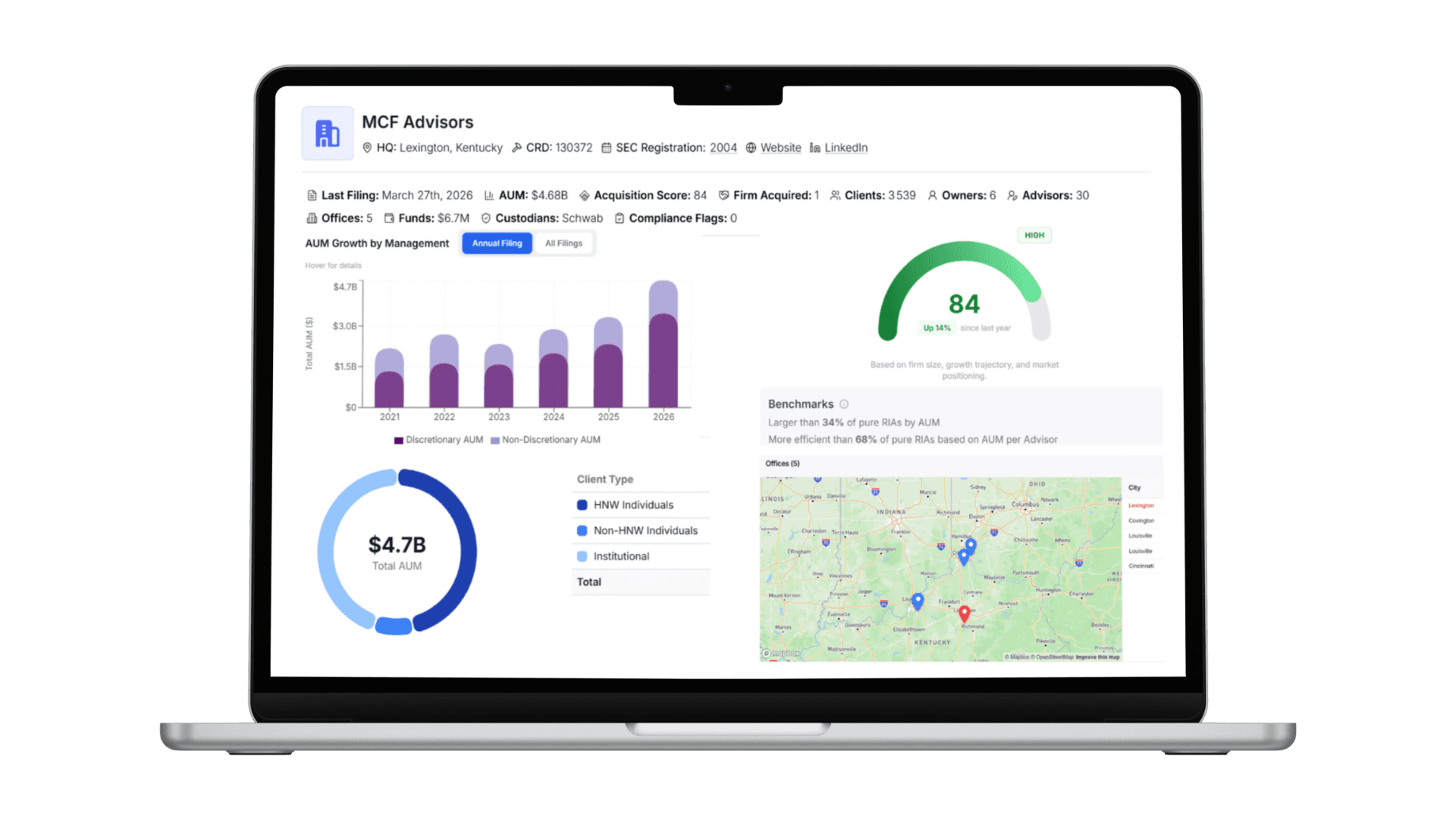
RIA Catalyst's proprietary Acquisition Score synthesizes growth trajectory, advisor productivity, organic asset flows, compliance signals, and other factors into a single composite measure across 15,000+ SEC-registered RIAs — the same kinds of signals a sophisticated buyer evaluates. For a founder preparing to go to market, understanding how the firm reads on these dimensions is a way to see the business through a buyer's eyes well before the first conversation, and to fix what would otherwise become a discount in diligence.
FAQ
How far in advance should I prepare my RIA for sale?
Ideally twenty-four to thirty-six months. The highest-impact levers — distributing client relationships, building an organic growth track record, and cleaning up compliance — take time to show results. A firm prepared over two-plus years presents to buyers as de-risked and growing, which directly supports a higher multiple and better terms.
What single factor most increases an RIA's sale value?
Reducing key-person dependence. A firm where the founder personally holds most of the important relationships carries significant retention risk, and buyers discount it heavily or structure much of the value as contingent. Distributing those relationships across a team — well before going to market — is often the largest available lever on valuation.
Does organic growth really matter more than total AUM growth?
To a sophisticated buyer, yes. Total AUM growth can simply reflect a rising market and says little about the firm's quality. Organic growth — net new clients and net new assets generated by the firm's own efforts — demonstrates a repeatable engine, and it is one of the strongest drivers of a premium multiple.
Should I cut costs to improve efficiency before selling?
Not indiscriminately. The goal is an intentional, defensible operating structure, not a stripped-down one. Service-intensive models can be entirely appropriate, and cutting staff that supports retention can backfire. The right move is to ensure technology is scaling advisor capacity and that the firm's productivity metrics reflect genuine efficiency, read across both AUM per advisor and AUM per employee.
Will cleaning up compliance issues really change my valuation?
It protects it. Unresolved compliance and documentation problems rarely kill a deal outright, but they create diligence friction, slow the process, and push value into escrow and contingencies. Resolving them in advance — while there is no transaction pressure — keeps that value in the purchase price rather than negotiating it away later.
Conclusion
The value an RIA realizes at sale is decided long before the firm goes to market. De-risking the revenue base, distributing relationships away from the founder, building a clean organic growth story, professionalizing compliance, and running an intentional operating model are not transaction tactics — they are the substance of what a buyer pays for. Each can be built deliberately in the two to three years before a process begins, and each closes a discount the firm would otherwise absorb in diligence. Founders who treat the preparation window as the real valuation work, rather than waiting for an intermediary to find value at the table, are the ones who go to market from strength and leave with the number they were owed.