Date Published:

The best RIA acquisition targets are rarely available. They are not in broker databases, not responding to cold outreach campaigns, and not entertaining preliminary conversations with buyers they haven't met before. When they do decide to explore a transition, they move quickly — often reaching a shortlist of buyers within weeks, then signing within a few months. By the time they appear on most buyers' radar, the proprietary access window has already closed.
This is the structural reality of high-productivity RIA identification: the firms worth acquiring the most are the ones with the least reason to seek buyers. They have pricing power, stable client bases, strong organic growth, and often a waiting list. The transaction happens on their timeline and at their terms — unless a buyer has established the relationship before the decision is made.
Finding these firms before competitors requires a specific combination of productivity signals, market intelligence, and timing discipline. This article covers all three.
What "High Productivity" Actually Means in the RIA Context
AUM per Advisor as the Primary Productivity Proxy
Productivity in an RIA context is most directly measured by AUM per advisor — total firm AUM divided by the number of client-facing advisors. This metric captures how efficiently the firm converts advisor capacity into managed assets and, by extension, revenue.
A firm managing $450M with three advisors operates at $150M per advisor. A firm managing $450M with seven advisors operates at $64M per advisor. The first firm is running a lean, high-output model. The second is either a very high-touch service firm with deliberate capacity constraints, or it has an advisor productivity problem. The AUM number alone cannot tell you which — the per-advisor figure can.
High-productivity RIAs typically run between $150M and $300M+ in AUM per advisor depending on client segment, service model, and firm age. Firms in the top quartile of productivity at a given AUM band are disproportionately likely to command acquisition premiums, generate stronger post-close retention, and operate with the kind of scalable infrastructure that makes integration tractable.
Revenue per Advisor and Revenue per Client as Secondary Lenses
AUM per advisor is the primary screen, but two secondary metrics add important nuance.
Revenue per advisor captures fee rate differences that AUM per advisor obscures. At 70 bps blended, $150M per advisor generates $1.05M in revenue per advisor. At 95 bps, the same AUM generates $1.43M. That 36% difference directly affects acquisition price, integration economics, and earnout performance.
Revenue per client measures wallet share depth — how much of each client household's investable assets the firm is actually managing. A firm with $1.2M in average revenue per client household is capturing a far more concentrated relationship than a firm averaging $4,800. Both can be high-quality businesses; the former is easier to retain and harder to replicate.
Why Productivity Predicts Acquisition Premium
High-productivity firms earn acquisition premiums for a specific reason: their unit economics are better. Higher AUM per advisor means lower integration cost per dollar of revenue acquired. Higher revenue per advisor means the buyer is acquiring a more efficient business, not just a larger one. Normalized EBITDA margins tend to be higher in high-productivity firms because the cost base scales favorably against elevated advisor output.
When buyers compete for these firms, they compete on price. When a buyer finds them early and establishes a relationship before a competitive process begins, they often transact at terms that reflect proprietary access — which typically means 0.5x–1.5x lower revenue multiple than a fully brokered competitive process, with better terms and a more cooperative integration.
Productivity Benchmarks by AUM Band
Thresholds are illustrative benchmarks based on industry data. Calibrate against your platform's specific service model and client segment.
AUM Band | Average AUM/Advisor | Top-Quartile AUM/Advisor | Red Flag Threshold |
|---|---|---|---|
<$250M | $65M–$100M | >$130M | <$45M |
$250M–$500M | $100M–$160M | >$200M | <$70M |
$500M–$1B | $150M–$220M | >$280M | <$100M |
$1B–$2B | $180M–$260M | >$325M | <$120M |
>$2B | $200M–$300M | >$375M | <$140M |
Firms in the top quartile of AUM per advisor within their AUM band are the identification targets. They are demonstrably more efficient than their peers, which translates to stronger margins, better scalability, and higher acquisition multiple justification.
The Timing Problem: Why High-Productivity Firms Disappear Fast
The 12–18 Month Pre-Sale Window
Most RIA founders who eventually sell begin contemplating the idea 12 to 18 months before they engage a banker or take the first serious buyer conversation. During that window, they are doing internal housekeeping — evaluating options, talking informally to trusted advisors, occasionally having casual conversations with buyers they already know and trust.
A buyer who is present during that pre-contemplation period is positioned to have a genuine conversation about partnership, culture, and vision — before the transaction framing takes over. A buyer who shows up at the LOI stage is competing on price alone.
How Brokered Processes Eliminate Proprietary Access
Once a high-productivity RIA engages an M&A advisor, the process moves from proprietary to competitive within weeks. The banker's job is to maximize seller optionality — which means broadening the buyer universe, running structured bid processes, and setting price expectations at the high end of the range. That is entirely rational from the seller's perspective. From the buyer's perspective, it means the relationship advantage disappears and price becomes the primary differentiator.
The proprietary identification window closes at the moment the banker is engaged. The strategic imperative is to have established a credible relationship before that moment arrives.
Where High-Productivity RIAs Hide (and Why They're Hard to Find)
They're Often Sub-Scale on AUM But Not on Quality
The most counterintuitive location for high-productivity targets is just below the most common AUM acquisition bands. A firm at $280M with 1.5 advisors running $187M per advisor is a more productive business than a $600M firm with six advisors running $100M each. The second firm is twice the size. The first is the better acquisition.
Most buyers' AUM floor filter explicitly excludes the first firm. That exclusion is the opportunity: it means fewer buyers are reaching out, the founder hasn't been approached by competing buyers recently, and the relationship can be built on substance rather than transaction mechanics.
They Grow by Client Depth, Not by Advisor Headcount
High-productivity RIAs don't grow by hiring advisors and giving each one a client segment. They grow by deepening relationships with existing clients — capturing more wallet share, expanding into estate planning, adding next-generation family members, providing more comprehensive planning. This growth model produces stronger margins and lower attrition, but it doesn't announce itself loudly in AUM headlines. It shows up in revenue per client trends over time.
They Rarely Show Up in Broker Outreach Lists
M&A brokers focus their outreach on firms that are likely to transact in the near term. High-productivity firms with a stable client base and a founder who isn't yet ready to sell aren't at the top of broker call lists. They don't respond to cold outreach from buyers they don't know. They are running their businesses — until the moment they decide they're not.
The Identification Framework: 8 Signals to Track
Signals 1–4: Data-Observable Signals (ADV-Based)
Signal 1 — AUM per advisor above the top-quartile threshold for their band. Identify firms in your target geography and AUM range where the ratio of AUM to advisor headcount exceeds the benchmark table above. This is a first-pass filter that narrows a large universe quickly.
Signal 2 — Consistent organic AUM growth over 3+ years. Cross-reference Form ADV AUM figures across consecutive annual filings and normalize for market appreciation. Firms with genuine organic growth of 6%+ annually for three or more years have a validated client acquisition model — the engine you're actually buying.
Signal 3 — Founder age between 55 and 67. Available in ADV Part 2 in most cases, or estimable from LinkedIn and bio pages. Founders in this age range are within the realistic succession planning horizon but haven't necessarily started the process. This is the pre-contemplation window.
Signal 4 — Clean ADV compliance history. A five-minute review of disclosure reporting confirms no material actions. Filter these firms out of the watch list early — they are not worth monitoring further regardless of productivity.
Signals 5–8: Relationship and Behavioral Signals
Signal 5 — Conference presence without deal-seeking behavior. High-productivity RIA founders who attend industry conferences for professional development — not to meet potential acquirers — are often in the pre-contemplation phase. They're engaged with the industry, intellectually curious, and not yet in transaction mode.
Signal 6 — Thought leadership and community activity. Founders who write, speak, or engage actively in professional communities are building their next chapter's identity — which sometimes involves a transition. Track advisors who are increasingly public-facing.
Signal 7 — Second-generation talent signals. A firm that recently hired a junior advisor or promoted from within is making an implicit statement about succession. Either they're building internal capacity, or they're preparing for an eventual transition by reducing key-person dependency. Both are useful signals.
Signal 8 — Custodian relationship changes. A firm that moves custodians — or adds a second custodian — is undergoing internal review. Custodian transitions often coincide with broader strategic reassessments that include ownership structure.
Building a Proprietary Watch List
Universe Definition and Initial Filter
Start by defining the target geography and AUM band. Apply the four data-observable signals above to narrow the full universe to a watch list of 30–60 firms that meet the productivity threshold, have clean compliance histories, have founders in the relevant age range, and show consistent organic growth. This is the group worth monitoring actively.
Ongoing Monitoring and Trigger Events
The watch list is not static. Track it quarterly for trigger events: founder age crossing a threshold, a new ADV filing showing AUM that adjusts the productivity calculation, a junior advisor hire, or a custodian change. These events signal that the firm's internal dynamics are shifting — and that a conversation, if timed well, will land differently than it would have six months earlier.
Outreach Timing and Approach
The first outreach to a watch list firm should not be transactional. It should be genuinely relational — sharing an insight about the market, referencing a firm-specific data point that demonstrates you've done your homework, or connecting through a shared professional network contact. The goal of the first conversation is not to discuss a deal. It is to be remembered as a thoughtful, credible buyer when the founder eventually decides they're ready to have that conversation.
Data Advantage: Early Identification at Scale Requires a Structured Data Layer
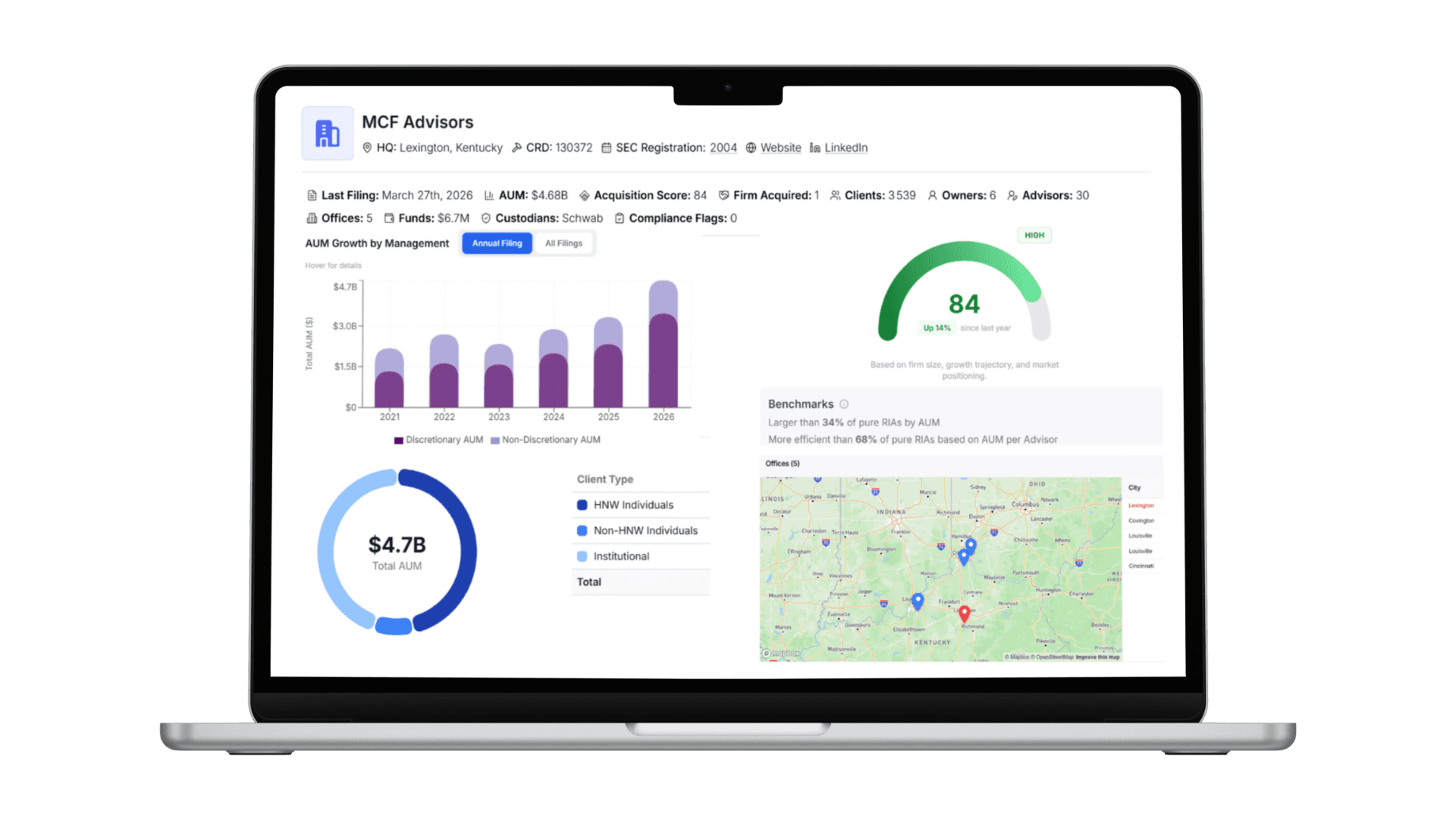
Monitoring 30–60 firms across four data-observable signals manually requires continuous ADV research, demographic tracking, and growth trend analysis. Maintaining that intelligence across a larger universe — while managing an active acquisition pipeline — is not feasible without structured data infrastructure. Platforms like RIA Catalyst continuously update firm-level intelligence across 15,000+ RIAs, enabling buyers to monitor productivity signals, advisor demographics, and growth trends systematically. The firms that get identified 12–18 months before they're ready to sell aren't found through luck — they're found through a data layer that catches the signals before they become obvious.
FAQ
How many firms should be on an active watch list?
For a team closing 2–4 deals per year, a watch list of 40–80 firms provides enough coverage to ensure a steady flow of relationship-building activity without spreading outreach too thin to be meaningful. Quality of engagement matters more than list size: ten genuine relationships with highly productive firms in your target market are more valuable than 200 names in a spreadsheet no one monitors.
What's the biggest mistake buyers make when reaching out to watch-list firms?
Transactional framing too early. A first outreach that mentions acquisition, deal structure, or valuation immediately positions the buyer as a transaction-seeker rather than a strategic partner. Founders of high-productivity firms have plenty of options. If the first conversation is about a deal, the relationship starts in the wrong register. Lead with genuine insight, market data, or a referral — and let the strategic conversation develop over multiple touches.
How do I know when a watch-list firm is actually entering the contemplation phase?
Look for behavioral changes rather than direct signals: increased conference activity, new team announcements, changes to the firm website or leadership bios, and LinkedIn activity from the founder around topics of legacy, succession, or life transitions. These soft signals often precede formal sale processes by 9–15 months. A buyer who is already in dialogue at that point is effectively pre-qualified before the banker call ever happens.
Can this identification framework work without a dedicated corporate development team?
Yes, but with constraints. The framework requires consistent time investment — quarterly ADV reviews, regular outreach, and active monitoring of trigger events. For a team without dedicated corporate development resources, focus the watch list on 20–30 firms and prioritize the highest-productivity candidates. One high-quality proprietary relationship per quarter is more valuable than a broad but inconsistent outreach effort across a list of 200.
Conclusion
High-productivity RIA identification is ultimately a timing problem disguised as a data problem. The firms worth acquiring the most are the ones that receive the least outreach, respond to the fewest cold approaches, and disappear fastest once they enter a formal process. Finding them before competitors requires the combination of structured productivity signals, disciplined watch-list management, and relationship-building that begins well before any deal conversation is appropriate. The buyers who consistently access these firms proprietary are not better connected — they are better organized. They know which firms to watch, why to watch them, and precisely when to make the call.