Date Published:

When you finally decide to sell, the instinct is to optimize for one number: the headline price. It is the most visible term, the easiest to compare, and the one every buyer will lead with. But the highest bid is not the same as the best deal — and the buyer who courts you most aggressively is not necessarily the one who will treat your clients, your team, or your legacy well after the check clears.
Choosing a buyer is one of the few decisions in your career that is genuinely irreversible. Once the deal closes, the firm you spent decades building belongs to someone else, and the people who trusted you with their money and their careers are now in someone else's hands. The price is paid once. The consequences of who you sold to last for years.
This article lays out how to actually evaluate the buyers at your table — the criteria that matter more than the headline number, the courtship tactics to see through, and a scorecard for comparing offers on the dimensions that determine whether the deal creates the outcome you wanted.
Why the Highest Bid Is Not the Best Deal
A purchase price is a promise, and promises vary in how likely they are to be kept. Two offers with the same headline number can put wildly different amounts of actual money in your pocket, depending on how the deal is structured and what has to happen for the full price to materialize.
A large share of most RIA purchase prices is not paid in cash at close. It is held in earnouts contingent on retention or growth, in rollover equity whose future value is uncertain, and in deferred payments spread over years. An offer that looks higher on paper can deliver less in practice if the contingent portion is aggressive, the targets are unrealistic, or the equity is in a vehicle that never achieves the liquidity event the buyer projected.
So your first discipline is to stop comparing headline numbers and start comparing what you would actually realize under realistic assumptions — how much arrives at close, how much you are genuinely likely to earn, and how much depends on conditions you will no longer control once you have handed over the firm.
The Flattery Trap
The buyer who pursues you hardest is often the one who has the most to gain from your specific firm — which can be a good sign — but aggressive courtship is also a sales tactic, and it is easy to mistake enthusiasm for fit.
Sophisticated acquirers know that you are making an emotional decision as much as a financial one. They will invest in the relationship, praise your track record, and emphasize how much they admire what you built. None of that is dishonest, and a buyer who values your firm is worth more to you than one who sees it as a commodity. But attention is not alignment. A buyer can be deeply interested in acquiring you and still be the wrong home for your clients and team.
The tell is whether the courtship is about you or about the mechanics that will affect your clients and staff. A buyer who spends all their time on how much they respect you, and very little on how they will service your clients, retain your advisors, and integrate your firm, is selling you a feeling, not a plan. Keep redirecting the conversation from flattery back to substance — how you respond to being courted is the first real test of whether a buyer is right for you.
The Criteria That Actually Matter
Price and courtship are inputs, not the decision. The criteria below are what will separate a good outcome from one you regret.
Certainty of Close
An offer is only worth what it is worth if the deal actually closes. A buyer with committed financing, a clean record of completing deals, and the capacity to execute is worth more to you than one offering a higher price on shakier funding or with a history of retrading terms late in the process. A deal that collapses after months of exclusivity costs you time, momentum, and leverage — and signals to the market that something was wrong, even when nothing was. Weigh the reliability of the buyer as heavily as the size of the offer.
Quality of the Structure
The structure determines how much of the headline price you actually receive and how much risk you carry to get it. A higher proportion of cash at close means more certainty for you and less dependence on post-close performance. A reasonable earnout with achievable targets is very different from an aggressive one designed to claw value back out of your pocket. Rollover equity can be a real source of future upside or a way to inflate a headline number with paper that may never convert. Scrutinize the shape of the consideration as carefully as its size.
Fit for Your Clients
You spent years earning your clients' trust, and they did not consent to the new owner. A buyer whose service model, investment philosophy, fee structure, and technology are broadly compatible with what your clients are used to will keep them. A buyer who imposes disruptive change — a new platform, a different investment approach, higher fees, unfamiliar advisors — risks the attrition that hurts everyone, including you if any of your price is tied to retention. The best buyer for the price is not always the best buyer for your clients, and you have to weigh both.
Fit for Your Team
The advisors and staff who helped you build the firm have careers and livelihoods riding on who you choose. A buyer who offers them genuine roles, growth, and a compatible culture will retain them, which protects both your client relationships and your reputation. A buyer who treats your people as redundancies to be rationalized may improve their own economics while leaving the people you brought this far worse off. For most founders, this is not a soft consideration — it is central to whether you can live with the decision.
The Buyer's Track Record
The clearest predictor of how a buyer will treat you after close is how they treated the founders who sold to them before. A buyer with a history of acquisitions can be diligenced in reverse: talk to those founders, find out whether their firms retained clients and staff, and check whether the reality after close matched the promises made before it. You have far more power to do this than most sellers use. A buyer's past sellers are the best reference available to you, and a reluctance to connect you with them tells you something.
Cultural and Strategic Alignment
Beyond the mechanics, ask whether the buyer's vision for the combined firm makes sense to you and whether you believe in it. A strategic acquirer with a coherent plan for your clients and people is a different proposition from a financial buyer optimizing for a resale in a few years. Neither is wrong, but they lead to different outcomes — and you should choose the one that matches what you want your firm to become after you are gone.
A Buyer Scorecard
You can turn these dimensions into a structured comparison. The point is not to reduce your decision to a single score, but to force an honest look across the factors the headline price hides.
Evaluation dimension | What to assess | Why it matters to you |
|---|---|---|
Realized value | Cash at close vs. contingent and equity portions; realistic earnout likelihood | The number you actually receive, not the one on the term sheet |
Certainty of close | Committed financing, deal track record, history of honoring terms | A higher offer that doesn't close is worth nothing to you |
Structure quality | Cash/equity/earnout mix; reasonableness of targets | Determines how much risk you carry after close |
Client fit | Service model, investment philosophy, fees, technology compatibility | Drives retention — and any retention-based part of your price |
Team fit | Roles offered, culture, growth path for advisors and staff | Protects your people and your reputation |
Track record | References from prior sellers; post-close outcomes at their firms | The best predictor of how they will treat yours |
Strategic alignment | Coherence of the buyer's plan; alignment with your intent | Shapes what your firm becomes after you leave |
Running a Process That Surfaces the Truth
Most of these criteria cannot be judged from a single conversation or a term sheet. You need a process designed to surface substance rather than flattery.
That means asking every serious buyer the same pointed questions about structure, integration, client service, and staff — and comparing their answers side by side. It means requesting, and actually calling, references from founders who sold to them before. It means modeling what you would realize under conservative assumptions rather than taking headline numbers at face value. And it means bringing in experienced M&A counsel and an intermediary who has seen how these buyers behave across many deals, not just how they present themselves while courting you.
Running a competitive process helps you in a way that goes beyond price. When several credible buyers are at your table, you gain the leverage to demand clarity on the terms that matter and to walk away from any buyer whose answers do not hold up. The goal of your process is not only to maximize the number — it is to reveal which buyer is telling you the truth about what happens after close.
Data Advantage: Know Your Buyers Before They Know You
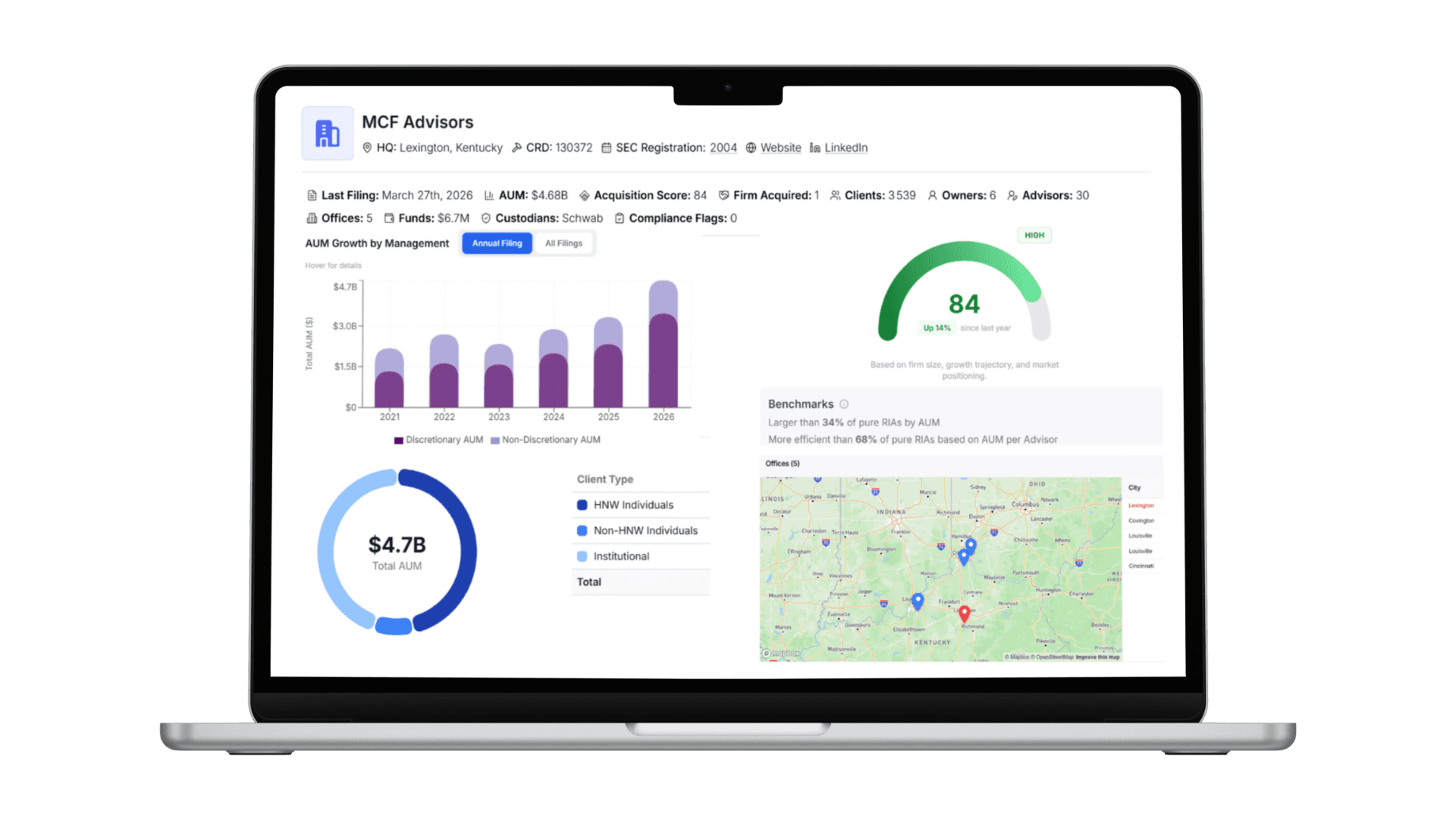
Buyers come to the table knowing far more about your firm than you know about them — and that asymmetry works against you. RIA Catalyst tracks acquisition activity across the industry, including which acquirers are most active, how frequently they transact, and the kinds of firms they target, drawing on structured data across 15,000+ SEC-registered RIAs. Instead of relying on a buyer's own narrative about themselves, you can walk into the negotiation understanding their real pattern of activity — and know who you are actually dealing with before you commit.
FAQ
Should I always sell my RIA to the highest bidder?
Not necessarily. The highest headline bid is not the same as the most money you receive or the best outcome for you. A large portion of most RIA purchase prices is contingent or paid in equity, so an offer that looks higher can deliver less in practice. Certainty of close, structure quality, and fit for your clients and team often matter more than the top-line number.
How do I evaluate a buyer beyond price?
Assess what you would realize under realistic assumptions, how certain the buyer is to close, the quality of the deal structure, and how well the buyer fits your clients and team. The single most useful step is calling founders who sold to that buyer before and learning what actually happened after close.
Why should the buyer who pursues me hardest make me cautious?
Aggressive courtship is partly a sales tactic. A buyer who values your firm is worth more to you than one who sees it as a commodity, but enthusiasm is not the same as alignment. Watch whether they spend their time flattering your track record or explaining concretely how they will service your clients and retain your team. The latter signals a real plan.
How important is cultural fit when I sell my RIA?
It is central if you care what happens to your clients and staff after close, and it has direct financial consequences for you. A buyer whose service model and culture clash with yours risks client attrition and staff departures — which can reduce any retention-based part of your price and damage the legacy you spent years building.
Can I check a buyer's track record before I sell?
Yes, and most sellers underuse this. Buyers with prior acquisitions can be diligenced in reverse: ask for references from founders who sold to them, find out whether those firms kept their clients and staff, and confirm that the reality after close matched the promises made before it. A buyer reluctant to connect you with past sellers is giving you useful information.
Conclusion
Choosing a buyer is the last and most consequential decision you will make about the firm you built, and it is far more than a price comparison. The headline number hides how much you will actually realize, how certain the deal is to close, and what becomes of the clients and people you are leaving in someone else's hands. The buyer who courts you hardest is selling you a feeling; the buyer worth choosing is the one whose plan for your clients and team survives your scrutiny and whose past sellers confirm the promises were kept. Run a process built to surface that truth — rather than to reward flattery or the biggest number — and you will close a deal you do not come to regret.
De : Julien Baneux <Julien@riagrowthcatalyst.com>
Date : jeudi, 9 juillet 2026 à 13:56
À : Leo Cabriere <leo@riagrowthcatalyst.com>
Objet : Re: #23 - How to Choose the Right Buyer for Your RIA (It's Not Just About Price)
I think the point of view is incorrect in this article. It's not personal enough - I don't get the sense that it is speaking to the seller. The content is absolutely spot on. However, if the article is for sellers - it should be speaking to sellers, and right now it feels like its written by a buyer speaking to sellers. Does that make sense?
From: Leo Cabriere <leo@riagrowthcatalyst.com>
Sent: Wednesday, July 8, 2026 12:30 PM
To: Julien Baneux <Julien@riagrowthcatalyst.com>
Subject: #23 - How to Choose the Right Buyer for Your RIA (It's Not Just About Price)
When a founder finally decides to sell, the instinct is to optimize for one number: the headline price. It is the most visible term, the easiest to compare, and the one every buyer leads with. But the highest bid is not the same as the best deal — and the buyer who courts you most aggressively is not necessarily the one who will treat your clients, your team, or your legacy well after the check clears.
Choosing a buyer is one of the few decisions in a founder's career that is genuinely irreversible. Once the deal closes, the firm you spent decades building belongs to someone else, and the people who trusted you with their money and their careers are now in someone else's hands. The price is paid once. The consequences of who you sold to last for years.
This article lays out how sellers should actually evaluate buyers — the criteria that matter more than the headline number, the courtship tactics to see through, and a scorecard for comparing offers on the dimensions that determine whether a deal creates the outcome you wanted. It is written for founders preparing to choose, but it doubles as a map of how the best-prepared buyers position themselves.
Why the Highest Bid Is Not the Best Deal
A purchase price is a promise, and promises vary in how likely they are to be kept. Two offers with the same headline number can deliver wildly different amounts of actual money to the seller, depending on how the deal is structured and what has to happen for the full price to materialize.
A large share of most RIA purchase prices is not paid in cash at close. It is held in earnouts contingent on retention or growth, in rollover equity whose future value is uncertain, and in deferred payments spread over years. An offer that looks higher on paper can deliver less in practice if the contingent portion is aggressive, the targets are unrealistic, or the equity is in a vehicle that never achieves the liquidity event the buyer projected.
So the first discipline is to stop comparing headline numbers and start comparing realized value under realistic assumptions — how much arrives at close, how much is genuinely likely to be earned, and how much depends on conditions the seller does not control after they have given up control of the firm.
The Flattery Trap
The buyer who pursues you hardest is often the one who has the most to gain from your specific firm — which can be good — but aggressive courtship is also a sales tactic, and it is easy to mistake enthusiasm for fit.
Sophisticated acquirers know that founders are making an emotional decision as much as a financial one. They invest in relationship-building, they flatter the founder's track record, they emphasize how much they admire what was built. None of that is dishonest, and a buyer who values your firm is genuinely worth more than one who sees it as a commodity. But attention is not alignment. A buyer can be deeply interested in acquiring you and still be the wrong home for your clients and team.
The tell is whether the courtship is about you or about the deal mechanics that will affect your clients and staff. A buyer who spends all their time on how much they respect you and very little on how they will service your clients, retain your advisors, and integrate your firm is selling a feeling, not a plan. The founders who choose well are the ones who keep redirecting the conversation from flattery back to substance.
The Criteria That Actually Matter
Price and courtship are inputs, not the decision. The criteria below are what separate a good outcome from a regrettable one.
Certainty of Close
An offer is only worth what it is worth if the deal actually closes. A buyer with committed financing, a clean track record of completing deals, and the organizational capacity to execute is worth more than one offering a higher price with shakier funding or a history of retrading terms late in the process. A deal that collapses after months of exclusivity costs the seller time, momentum, and leverage — and signals to the market that something was wrong, even when nothing was.
Quality of the Structure
The structure determines how much of the headline price the seller actually receives and how much risk they carry to get it. A higher proportion of cash at close means more certainty and less dependence on post-close performance. A reasonable earnout with achievable targets is very different from an aggressive one designed to claw value back. Rollover equity can be a meaningful source of future upside or a way to inflate a headline number with paper that may never convert. Sellers should evaluate the shape of the consideration as carefully as its size.
Fit for Your Clients
The founder spent years earning client trust, and those clients did not consent to the new owner. A buyer whose service model, investment philosophy, fee structure, and technology are broadly compatible with what clients are used to will retain them. A buyer who will impose disruptive change — a new platform, a different investment approach, higher fees, unfamiliar advisors — risks attrition that hurts everyone, including the seller if any of the price is tied to retention. The best buyer for the price is not always the best buyer for the clients, and a thoughtful founder weighs both.
Fit for Your Team
The advisors and staff who helped build the firm have careers and livelihoods riding on the choice of buyer. A buyer who offers genuine roles, growth, and a compatible culture will retain the team, which protects both client relationships and the seller's own reputation. A buyer who treats the staff as redundancies to be rationalized may improve their own economics while leaving the founder's people worse off. For many founders, this is not a soft consideration — it is central to whether they can live with the decision.
The Buyer's Track Record
The clearest predictor of how a buyer will behave after close is how they have behaved after previous closes. A buyer with a history of acquisitions can be diligenced in reverse: talk to founders who sold to them, look at whether those firms retained clients and staff, and check whether the post-close reality matched the pre-close promises. Sellers have far more power to do this than they typically use. A buyer's past sellers are the best reference available, and a reluctance to provide them is itself a signal.
Cultural and Strategic Alignment
Beyond the mechanics, there is the question of whether the buyer's vision for the combined firm makes sense and whether the founder believes in it. A strategic acquirer with a coherent plan for the firm's clients and people is a different proposition from a financial buyer optimizing for a resale in a few years. Neither is wrong, but they produce different outcomes, and the seller should choose the one that matches what they want their firm to become.
A Buyer Scorecard
The dimensions above can be turned into a structured comparison. The point is not to reduce the decision to a single score, but to force an honest evaluation across the factors that headline price obscures.
Evaluation dimension | What to assess | Why it matters |
|---|---|---|
Realized value | Cash at close vs. contingent and equity portions; realistic earnout likelihood | The number you actually receive, not the one on the term sheet |
Certainty of close | Committed financing, deal track record, history of honoring terms | A higher offer that doesn't close is worth nothing |
Structure quality | Cash/equity/earnout mix; reasonableness of targets | Determines how much risk the seller carries post-close |
Client fit | Service model, investment philosophy, fees, technology compatibility | Drives retention — and any retention-based portion of your price |
Team fit | Roles offered, culture, growth path for advisors and staff | Protects your people and your reputation |
Track record | References from prior sellers; post-close outcomes at acquired firms | The best predictor of how they'll treat your firm |
Strategic alignment | Coherence of the buyer's plan; alignment with founder's intent | Shapes what the firm becomes after you leave |
Running a Process That Surfaces the Truth
Most of these criteria cannot be evaluated from a single conversation or a term sheet. They require a process designed to surface substance rather than flattery.
That means asking every serious buyer the same pointed questions about structure, integration, client service, and staff — and comparing the answers. It means requesting and actually contacting references from founders who previously sold to them. It means modeling realized value under conservative assumptions rather than accepting headline numbers. And it means bringing in experienced M&A counsel and an intermediary who has seen how these buyers behave across many deals, not just how they present themselves in courtship.
A competitive process helps here in a way that goes beyond price. When multiple credible buyers are at the table, the seller gains the leverage to demand clarity on the terms that matter and to walk away from a buyer whose answers do not hold up. The goal of the process is not only to maximize the number — it is to reveal which buyer is telling the truth about what happens after close.
Data Advantage: Knowing Your Buyers Before They Know You
RIA Catalyst tracks acquisition activity across the industry, including which acquirers are most active, how frequently they transact, and the profiles of the firms they target, drawing on structured data across 15,000+ SEC-registered RIAs. For a founder evaluating buyers, this context turns an information disadvantage into a level field: instead of relying on the buyer's own narrative, a seller can understand a prospective acquirer's pattern of activity and approach the negotiating table knowing who they are actually dealing with.
FAQ
Should I always sell my RIA to the highest bidder?
Not necessarily. The highest headline bid is not the same as the most money received or the best outcome. A large portion of most RIA purchase prices is contingent or paid in equity, so an offer that looks higher can deliver less in practice. Certainty of close, structure quality, and fit for your clients and team often matter more than the top-line number.
How do I evaluate a buyer beyond price?
Assess realized value under realistic assumptions, the buyer's certainty of closing, the quality of the deal structure, and how well the buyer fits your clients and team. The single most useful step is contacting founders who previously sold to that buyer and learning what actually happened after close.
Why does the buyer who pursues me most aggressively make me cautious?
Aggressive courtship is partly a sales tactic. A buyer who values your firm is worth more than one who sees it as a commodity, but enthusiasm is not the same as alignment. Watch whether the buyer spends their time flattering your track record or explaining concretely how they will service your clients and retain your team. The latter signals a real plan.
How important is cultural fit when selling an RIA?
It is central if you care what happens to your clients and staff after close, and it has direct financial consequences. A buyer whose service model and culture clash with your firm's risks client attrition and staff departures — which can reduce any retention-based portion of your price and damage the legacy you spent years building.
Can I check a buyer's track record before selling?
Yes, and most sellers underuse this. Buyers with prior acquisitions can be diligenced in reverse: request references from founders who sold to them, ask whether those firms retained clients and staff, and verify that the post-close reality matched the pre-close promises. A buyer reluctant to provide prior-seller references is giving you useful information.
Conclusion
Choosing a buyer is the last and most consequential decision a founder makes about the firm they built, and it is far more than a price comparison. The headline number obscures how much value is actually realized, how certain the deal is to close, and what happens to the clients and people left in the buyer's hands. The buyer who courts hardest is selling a feeling; the buyer worth choosing is the one whose plan for your clients and team survives scrutiny and whose past sellers confirm the promises were kept. Founders who run a process designed to surface that truth — rather than to reward flattery or the biggest number — are the ones who close a deal they do not come to regret.