Date Published:

Every strategic buyer in wealth management wants to grow through acquisitions. Few can execute systematically at scale while retaining what makes their platform distinct. The first deal often works because it gets the full attention of senior leadership, a personal relationship with the seller, and a bespoke integration effort. The second and third deals expose the cracks: diligence gets reinvented each time, integration timelines slip, scoring criteria live in one person's head, and the team starts cutting corners to keep up.
A repeatable RIA acquisition strategy is what separates serial acquirers from firms that simply do multiple one-off deals. The market demands it. According to DeVoe & Company's RIA Deal Book, 322 RIA transactions were announced in 2025, up from a then-record 272 in 2024. That pace rewards acquirers who have built the infrastructure to evaluate, close, and integrate multiple deals concurrently without losing rigor or differentiation.
This guide covers the full system: acquisition thesis, sourcing engine, qualification scorecard, standardized diligence, pre-LOI integration planning, and the internal operating model that holds it together. Whether you're building a platform strategy or evaluating your third tuck-in, the framework applies.
Define the Acquisition Thesis (and What "Good" Looks Like)
Before sourcing a single deal, clarify what you're buying and why. An acquisition thesis is the strategic filter that keeps your RIA acquisition pipeline focused and your team aligned.
Target Profile
Define your ideal target across these dimensions:
AUM range: e.g., $200M–$1.5B (large enough to move the needle, small enough to integrate without excessive complexity)
Client mix: HNW vs. mass affluent, retirees vs. accumulators, institutional vs. retail
Fee model: AUM-based, flat fee, hybrid (and how each maps to your revenue assumptions)
Geography: Regional clustering for operational efficiency vs. national reach
Service model: Financial planning-led, investment management-only, or comprehensive wealth management
Non-Negotiables vs. Preferences
Separate your criteria into two tiers. Non-negotiables are binary: if the target doesn't meet them, the deal stops. Preferences influence valuation and priority but don't disqualify.
Example non-negotiables: clean ADV history, no material compliance actions, minimum 80% recurring revenue, founder willing to stay through transition.
Example preferences: same custodian, compatible tech stack, geographic overlap, average client age under 65.
Writing these down (and revisiting them quarterly) prevents thesis drift, the slow erosion of standards that happens when deal flow slows and pressure to transact increases.
Build a Sourcing Engine (Not a One-Time Deal Search)
Sustainable RIA deal sourcing requires infrastructure, not just introductions.
Market Mapping and Segmentation
Start with a comprehensive view of the addressable market. Segment RIA firms by AUM, geography, advisor age, growth trajectory, and custodial relationship. RIA market mapping at scale requires consistent, current firm-level data, which means going beyond static lists and building a living database that reflects real-time changes in the landscape.
Relationship-Driven vs. Data-Driven Sourcing
Approach | Strengths | Weaknesses |
|---|---|---|
Relationship-driven | Higher trust, better pricing, off-market deals | Hard to scale, dependent on individuals, inconsistent flow |
Data-driven | Scalable, systematic, identifies patterns | Requires investment in tooling, can feel impersonal to sellers |
The best acquirers combine both. Use data to identify and prioritize targets, then deploy relationships to initiate conversations.
Pipeline Stages and Stage-Gate Criteria
Structure your RIA acquisition pipeline like a sales funnel with clear RIA M&A stage gates:
Universe: All firms matching basic thesis criteria
Identified: Firms with confirmed succession or sale interest
Engaged: Initial conversation completed, mutual interest established
Qualified: Scorecard completed, passes minimum thresholds
Diligence: Active workstreams underway
LOI/Closing: Terms negotiated, deal in execution
Each stage requires specific entry criteria. Moving a deal from "Engaged" to "Qualified" should require a completed scorecard (covered next). Moving to "Diligence" should require leadership consensus.
Data Advantage: Keeping the Pipeline Accurate
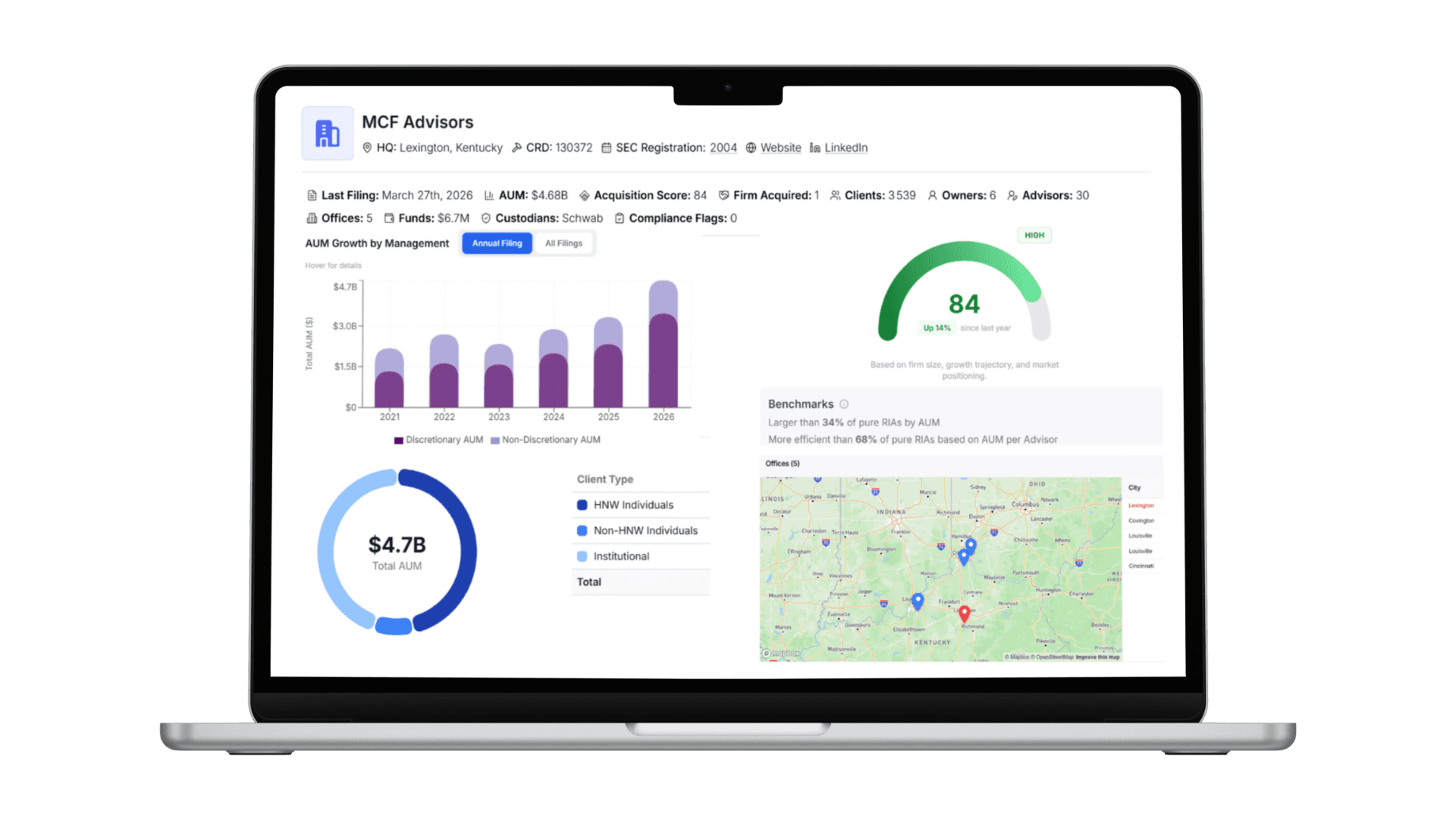
Pipeline accuracy degrades fast. Advisor ages change, AUM shifts, firms merge or close. Maintaining clean, current RIA firm intelligence is what separates a functioning pipeline from a stale spreadsheet. Platforms like RIA Catalyst provide continuously updated data on RIA firms, including AUM, advisor demographics, custodial relationships, and geographic footprint. Using a maintained data source for market mapping, segmentation, and RIA pipeline hygiene reduces manual research time and keeps your pipeline grounded in reality rather than six-month-old snapshots.
Create a Repeatable RIA Acquisition Strategy Scorecard
A standardized RIA acquisition scorecard replaces gut-feel evaluation with consistent, comparable analysis across every opportunity.
Quantitative Factors
Score each target (e.g., 1–5 scale) on measurable criteria:
Organic growth rate: 3-year trailing organic growth; target >5% annually
Revenue quality: % recurring AUM-based fees vs. one-time or transactional revenue; target >85%
Client concentration: Revenue from top 10 clients as % of total; red flag if >25%
Advisor productivity: Revenue per advisor; benchmark against your platform average
Profit margin: EBITDA margin adjusted for owner compensation; target >25%
Client demographics: Weighted average client age; younger books have longer revenue runways
Qualitative Factors
Culture alignment: Advisory philosophy, client service standards, team dynamics
Succession risk: Depth of next-generation talent, key-person dependency
Service model fit: How closely the target's offering mirrors (or complements) your platform
Brand reputation: Client satisfaction signals, community presence, online reviews
Red Flags That Should Stop a Deal Early
Material compliance deficiencies or pending regulatory actions
Founder unwilling to participate in any transition period
Client concentration exceeding 30% in a single household
Significant technology debt with no clear migration path
Revenue declining for 2+ consecutive years without a clear, reversible cause
Build the scorecard into a shared template. Every deal gets scored by the same criteria, making it possible to compare opportunities across your pipeline objectively.
Standardize Diligence into Repeatable Workstreams
When diligence is ad hoc, it takes too long, misses risks, and exhausts your team. Standardized RIA diligence workstreams compress timelines and improve consistency.
Financial and Operational Diligence
Revenue validation (AUM reconciliation, fee schedule analysis, billing accuracy)
Expense normalization (owner comp adjustments, one-time costs, run-rate operating expenses)
Contract review (client agreements, vendor contracts, lease obligations)
Working capital and cash flow analysis
Client and Advisor Retention Risk Assessment
Client tenure distribution (what % joined in the last 3 years?)
Advisor relationship mapping (which advisor manages which client relationships, and how portable are those relationships?)
Historical attrition data (client departures over 3 years, annualized)
Client satisfaction indicators (NPS if available, complaint history, referral patterns)
Technology and Data Readiness
CRM data quality (completeness of records, data hygiene, migration feasibility)
Portfolio management and reporting systems (compatibility with your tech stack)
Cybersecurity posture (basic assessment of policies, incident history, vendor risk)
Data migration complexity estimate (measured in weeks, not "easy/medium/hard")
Create a diligence checklist template with owners, deadlines, and status tracking. Reuse it for every deal, refining after each close.
Integration Planning Starts Before LOI
The acquirers who retain the most clients and advisors start integration planning before the letter of intent is signed. Waiting until close to think about integration is the single most common (and most expensive) mistake in RIA M&A.
30/60/90-Day Integration Plan
Your RIA integration checklist should map the first 90 days in detail:
Days 1–30: Communication (client letters, advisor meetings, staff town halls), compliance filings, system access provisioning, brand transition decisions announced.
Days 31–60: Technology migration begins, compensation structures finalized, client re-papering initiated, first retention check-ins with top-20 clients.
Days 61–90: Operational processes fully aligned, performance reporting unified, first post-close KPI review completed.
Operating Model Decisions
Before signing the LOI, have clear answers to these questions:
Brand: Will the acquired firm retain its name, rebrand immediately, or transition over 12 months?
Compensation: How will advisor comp align with your platform's structure? What's the transition timeline?
Service model: Which services expand, contract, or stay the same for acquired clients?
Technology: Full migration to your stack, or a phased approach?
KPI Dashboard for Post-Close Performance
Track RIA post-merger integration KPIs weekly for the first 90 days, then monthly:
KPI | Target | Measurement Frequency |
|---|---|---|
Client retention rate | >95% at 12 months | Monthly |
AUM retention rate | >93% at 12 months | Monthly |
Advisor retention rate | 100% through earn-out | Monthly |
Revenue run-rate vs. model | Within 5% of projection | Monthly |
Client satisfaction (NPS) | No decline >5 points | Quarterly |
Technology migration completion | 100% by day 90 | Weekly |
Build the "Acquisition Machine" (People, Process, Data)
Scaling an RIA platform acquisition strategy requires dedicated capacity, not just senior leaders squeezing deals between client meetings.
Roles and Responsibilities
Corporate development: Sourcing, relationship management, deal structuring, negotiation
Operations: Integration planning, technology migration, process alignment
Finance: Valuation modeling, diligence, post-close financial tracking
Compliance: Regulatory review, ADV analysis, client agreement review
Leadership: Thesis governance, final deal approval, seller relationship management
Cadence
Weekly: Pipeline review (new opportunities, stage progression, blockers)
Monthly: Thesis review (are we seeing what we expected? do criteria need adjustment?)
Quarterly: Retrospective (what worked in recent deals, what didn't, what changes to the playbook)
Data Infrastructure Needed to Scale
Your RIA M&A playbook is only as good as the data feeding it. Track:
Full pipeline by stage with aging metrics (how long deals spend at each stage)
Scorecard results across all evaluated opportunities (to calibrate scoring over time)
Post-close KPIs for every completed acquisition (to validate your thesis)
Market intelligence on prospective targets (updated at least quarterly)
Tools like RIA Catalyst can serve as the foundation for target identification and ongoing firm intelligence, keeping your universe current as firms grow, shrink, or change hands. Layering CRM and deal-tracking systems on top of current market data creates the infrastructure that distinguishes a repeatable process from a heroic individual effort.
Common Failure Modes (and How to Prevent Them)
Thesis drift: Acquiring firms that don't fit because deal flow is slow. Prevention: codified non-negotiables reviewed quarterly.
Integration neglect: Treating integration as a post-close problem. Prevention: pre-LOI integration planning with dedicated ownership.
Key-person dependency: The entire acquisition rationale rests on one advisor staying. Prevention: retention risk scoring during diligence, structured earn-outs tied to client retention.
Stale pipeline data: Spending time on targets that sold six months ago or no longer fit. Prevention: systematic data refresh using current firm-level intelligence sources.
Diligence fatigue: Team burns out because every deal feels new. Prevention: standardized workstreams, templates, and clear stage-gate criteria.
Over-indexing on AUM: Buying large books without evaluating revenue quality or growth trajectory. Prevention: scorecard discipline with weighted criteria beyond AUM.
FAQ
How long does it take to build a repeatable RIA acquisition strategy?
Most firms need 6–12 months to build the full system (thesis, sourcing engine, scorecard, diligence templates, integration playbook). The first acquisition using the new process will still feel imperfect. By the third deal, cycle times typically compress by 30–40% and diligence gaps shrink significantly.
What's the right team size for a serial RIA acquirer?
It depends on pace. Firms closing 2–4 deals per year can often operate with a dedicated corporate development lead, a fractional integration manager, and shared resources from finance and compliance. At 5+ deals per year, dedicated integration and diligence teams become necessary. The key constraint is usually integration capacity, not sourcing capacity.
How do you keep pipeline data current without a full-time research team?
Leverage data platforms that maintain firm-level intelligence continuously. RIA Catalyst, for example, tracks advisor demographics, AUM changes, and custodial relationships across the RIA landscape. Supplementing platform data with periodic direct outreach (quarterly emails, annual calls to warm contacts) keeps both quantitative and qualitative intelligence fresh.
What's the biggest predictor of post-acquisition client retention?
Communication speed and quality. Clients who hear from the acquiring firm within the first week, with a clear message about what changes and what stays the same, retain at significantly higher rates. Delayed or vague communication triggers uncertainty, and uncertain clients call their friends who are CFPs.
Should we use the same scorecard for tuck-in acquisitions and platform deals?
Use the same framework, but weight criteria differently. Tuck-in deals can tolerate more technology debt and less operational independence because you're absorbing the firm entirely. Platform acquisitions require stronger standalone operations, deeper management teams, and greater cultural alignment since those firms will likely operate with more autonomy.
Conclusion
A repeatable RIA acquisition strategy is a system with defined inputs, decision criteria, and feedback loops. The components (thesis, sourcing engine, scorecard, standardized diligence, pre-LOI integration planning, and a dedicated operating cadence) compound over time. Each deal refines the playbook. Each retrospective sharpens the scorecard. Each integration improves the template. Start by codifying your acquisition thesis and building the scorecard. Layer in sourcing infrastructure and diligence templates. Invest in current, reliable data to keep your pipeline grounded. The wealth management M&A strategy that wins isn't the one with the most capital; it's the one with the most consistent process.
Title tag: How to Build a Repeatable RIA Acquisition Strategy
Meta description: Step-by-step playbook for building a repeatable RIA acquisition strategy, covering deal sourcing, scorecards, diligence workstreams, and integration planning.