Date Published:

Understanding how RIAs are valued in 2026 requires moving past headline multiples and into the mechanics of what buyers actually underwrite. The M&A market for registered investment advisors has matured considerably: buyers are more disciplined, data rooms are deeper, and the gap between "asking price" and "closing price" often comes down to factors that never appear in a pitch book.
Today's acquirers discount key-person risk, fee compression exposure, and client concentration more aggressively than they did even two years ago. They reward recurring revenue, demonstrable organic growth, and operational scalability. The result is a wider spread between top-quartile and bottom-quartile deal multiples than most sellers expect.
This guide covers the four primary valuation methods, the real underwriting drivers that move multiples, a valuation bridge framework for translating market ranges into firm-specific pricing, and a worked hypothetical example showing implied value under each approach. It's written for private equity teams, strategic buyers, and corporate development professionals evaluating RIA targets.
The 4 Most Common RIA Valuation Approaches
No single method captures the full picture. Each approach carries embedded assumptions about growth, margin, and risk. The table below summarizes when each method works best and where it breaks down.
Method | Primary Metric | Best Used When | Key Limitation |
EBITDA Multiple | Normalized EBITDA | Mature, profitable firms with stable margins | Sensitive to normalization assumptions |
Revenue Multiple | Recurring revenue | Early screening, low-margin or high-growth firms | Ignores profitability and cost structure |
AUM-Based (bps) | AUM × fee rate | Homogeneous fee-only practices | Breaks with non-fee revenue, alternatives, concentration |
Hybrid / Cash-Flow | Blended inputs | Confirmatory diligence, complex firms | Requires granular data; harder to benchmark |
EBITDA Multiple (What "Normalized EBITDA" Means for RIAs)
The RIA EBITDA multiple remains the most commonly cited valuation anchor for firms above roughly $500M in AUM. EBITDA (earnings before interest, taxes, depreciation, and amortization) provides a proxy for cash-generating capacity, but the raw number almost never reflects the economics a buyer will inherit.
Normalized EBITDA for RIAs involves adjusting for owner compensation above market-rate replacement cost, one-time expenses (legal settlements, office buildouts, technology migrations), related-party transactions, and below-market rent or service agreements with affiliates. A principal earning $1.2M at a firm where a replacement CIO would cost $400K creates an $800K add-back. These adjustments can swing implied enterprise value by 30% or more, which is why buyers scrutinize normalization tables line by line.
RIA valuation multiples 2026 for mid-market firms (example range: 8–14× normalized EBITDA) vary meaningfully based on growth, margin, and risk profile. EBITDA multiples work well when the firm has a stable, scalable cost structure. They mislead when margins are artificially inflated by underpaid staff, deferred technology spending, or a founder doing three jobs.
Revenue Multiple (When It's Used; Pitfalls)
The RIA revenue multiple typically surfaces in early-stage screening, for firms with thin or negative margins, and in roll-up strategies where the buyer plans to restructure the cost base post-close. Revenue multiples (example range: 3–8× recurring revenue) offer simplicity: they sidestep the normalization debate entirely.
Revenue quality matters more than revenue quantity. Buyers differentiate between fee-based recurring AUM revenue, hourly or project-based planning fees, one-time financial plan charges, and insurance or commission-based income. A firm billing 60 bps on $1B in fee-based AUM has a very different revenue profile than one generating the same top line through a mix of commissions and hourly planning work.
The pitfalls are real. Revenue multiples obscure margin differences (a 45% EBITDA margin firm and a 20% margin firm can show the same revenue), ignore pass-through costs that inflate the top line, and fail to capture pricing pressure risk when a firm's average fee rate sits well above market.
AUM-Based Models (Bps of AUM; When It Makes Sense)
The RIA AUM valuation model expresses enterprise value as a percentage of assets under management, typically quoted in basis points (example range: 1.0%–3.0% of AUM, or 100–300 bps). The logic is straightforward: AUM is the revenue-generating base, and valuing it directly captures the asset pool a buyer is acquiring.
AUM-based models work cleanly for homogeneous, fee-only RIAs where the fee schedule is well-understood and the asset mix is relatively standard. They become less reliable when fee rates vary significantly across client tiers, when large portions of AUM sit in lower-fee model portfolios or passives, when net flows are negative (the asset base is shrinking), or when the firm earns material revenue outside of AUM-based fees.
Concentration risk also distorts AUM-based valuations. If 25% of AUM sits with two households, the buyer isn't really acquiring $1B in assets; they're acquiring $750M with an option on the rest, and that option has real attrition risk.
Hybrid / Cash-Flow Underwriting (Why Many Buyers Blend Methods)
Sophisticated buyers rarely rely on a single method. The standard approach for wealth management M&A valuation in 2026 is triangulation: run EBITDA, revenue, and AUM models independently, then converge on a range that accounts for the strengths and blind spots of each.
A discounted cash-flow (DCF) lens adds a forward-looking dimension, projecting free cash flows under various growth and margin scenarios and discounting them back at a rate that reflects the firm's specific risk profile. DCF models are sensitive to terminal value assumptions, which means they work better as a reasonableness check than as a standalone answer.
Hybrid approaches reduce model risk. If EBITDA and AUM models converge at $50M but the revenue multiple implies $70M, that gap forces a conversation about whether margins are sustainable or whether the revenue base carries hidden risk. Divergence between methods is a diagnostic signal, not a problem to average away.
What Drives RIA Valuation in 2026 (How RIAs Are Valued in 2026 Through Real Underwriting Factors)
Multiples are outputs. The RIA valuation drivers below are the inputs that move a baseline range up or down by turns.
Revenue Quality (Fee Schedule, Recurring vs. One-Time, Billing, Breakpoints)
Buyers underwrite revenue durability. Firms with simple, AUM-based fee schedules, quarterly billing in advance, and minimal breakpoint exposure command higher multiples. Firms with complex tiered pricing, monthly billing in arrears, or heavy reliance on financial planning fees face scrutiny about revenue stickiness.
Growth Profile (Organic vs. Market Beta; Net Flows)
RIA organic growth valuation separates firms that grow because markets rise from firms that grow because clients and assets flow in. A firm with 5% annual organic net new asset growth over three years tells a fundamentally different story than one that rode a 20% equity market rally. Buyers pay for organic growth; they discount market beta.
Client Concentration and Retention Risk
RIA client concentration risk is one of the fastest ways to reprice a deal. If the top 10 clients represent more than 25% of revenue, buyers will either discount the headline multiple, require retention agreements, or structure earnouts tied to client retention. Historical retention rates (measured over 3–5 years) matter more than verbal assurances.
Advisor Capacity, Productivity, and Succession Risk
A firm where two advisors manage 300 relationships each is at capacity. A firm where four advisors manage 150 each has room to grow without adding headcount. Succession risk, particularly when a founder manages the largest client relationships directly, can compress multiples by 1–3 turns depending on severity.
Margin Profile and Scalability (Operating Leverage)
Buyers look for firms where revenue can grow faster than expenses. EBITDA margins in the 30–45% range are typical for well-run RIAs. Margins above 45% warrant questions about deferred investment. Margins below 25% require a clear thesis for improvement post-close.
Service Model + Investment Platform Complexity
Firms running unified managed accounts on a single TAMP are simpler to integrate and operate than firms with bespoke portfolios across multiple custodians. Complexity adds transition risk and integration cost, both of which reduce the effective price a buyer will pay.
Compliance and Operational Maturity
Clean compliance histories, documented processes, and current ADV filings are table stakes. Firms with open regulatory matters, deficient books and records, or informal compliance programs create real diligence risk. Buyers may still proceed, but the risk shows up in price or structure.
The Valuation Bridge: From "Market Multiple" to "Your Multiple"
The RIA valuation bridge translates a broad market range into a firm-specific number by layering adjustments on top of a baseline.
Start With a Baseline Range
For a mid-market RIA ($750M–$3B AUM, 35% EBITDA margins, moderate growth), a reasonable 2026 baseline might be 10–12× normalized EBITDA. That range reflects a composite of recent transactions, buyer competition, and financing conditions.
Add/Subtract Adjustments by Driver
Driver | Positive Adjustment | Negative Adjustment |
Organic growth >5% annually | +1–2× EBITDA | — |
Negative net flows | — | -1–2× EBITDA |
Top 10 clients <15% of revenue | +0.5–1× | — |
Top 10 clients >30% of revenue | — | -1–2× |
EBITDA margin >40% | +0.5–1× | — |
EBITDA margin <25% | — | -1–2× |
Founder succession unresolved | — | -1–3× |
Clean compliance, strong ops | +0.5× | — |
Regulatory or operational gaps | — | -0.5–1.5× |
Common Reasons Deals Reprice Late-Stage
RIA deal underwriting often reveals surprises in confirmatory diligence: revenue that looked recurring turns out to include lumpy planning fees, client retention is lower than represented, or key advisor compensation arrangements are above market. Each discovery reopens the valuation conversation, usually in the buyer's favor.
Worked Example (Hypothetical)
Assumptions
Metric | Value |
AUM | $1.5 billion |
Annual revenue | $10.5 million (70 bps average fee) |
Normalized EBITDA | $3.8 million (36% margin) |
Organic growth (net flows) | +4% annually |
Top 10 client concentration | 22% of revenue |
Founder dependency | Moderate (transition plan in place) |
Implied Value Under EBITDA Multiple
Baseline: 10–12× normalized EBITDA. Adjustments: moderate organic growth (+0.5×), acceptable concentration (no adjustment), founder transition plan in place (no penalty). Implied range: 10.5–12.5× → $39.9M–$47.5M
Implied Value Under Revenue Multiple
Baseline: 4–6× recurring revenue. Revenue is 95%+ fee-based and recurring. Moderate margin profile suggests mid-range. Implied range: 4.5–5.5× → $47.3M–$57.8M
Implied Value Under AUM Model
Baseline: 1.5%–2.5% of AUM (150–250 bps). Fee rate at 70 bps is near market average. Positive net flows support mid-to-upper range. Implied range: 1.8%–2.4% → $27.0M–$36.0M
The AUM model produces a lower range here because it doesn't fully capture the firm's above-average margin and revenue density. Triangulating across all three methods, a buyer would likely converge on an enterprise value near $40M–$48M, with the EBITDA model serving as the primary anchor.
How Terms Change "Real Economics" (Earnout/Rollover/Retention)
A $45M headline valuation might include $30M in cash at close, $7.5M in a two-year earnout tied to revenue retention, and $7.5M in rollover equity. The seller's realized value depends on client retention, post-close performance, and the eventual exit multiple on that rollover equity. RIA earnout rollover retention structures can shift 15–25% of total value into contingent or deferred components, meaningfully changing the risk-adjusted economics for the seller.
Data advantage: valuation starts with clean firm intelligence
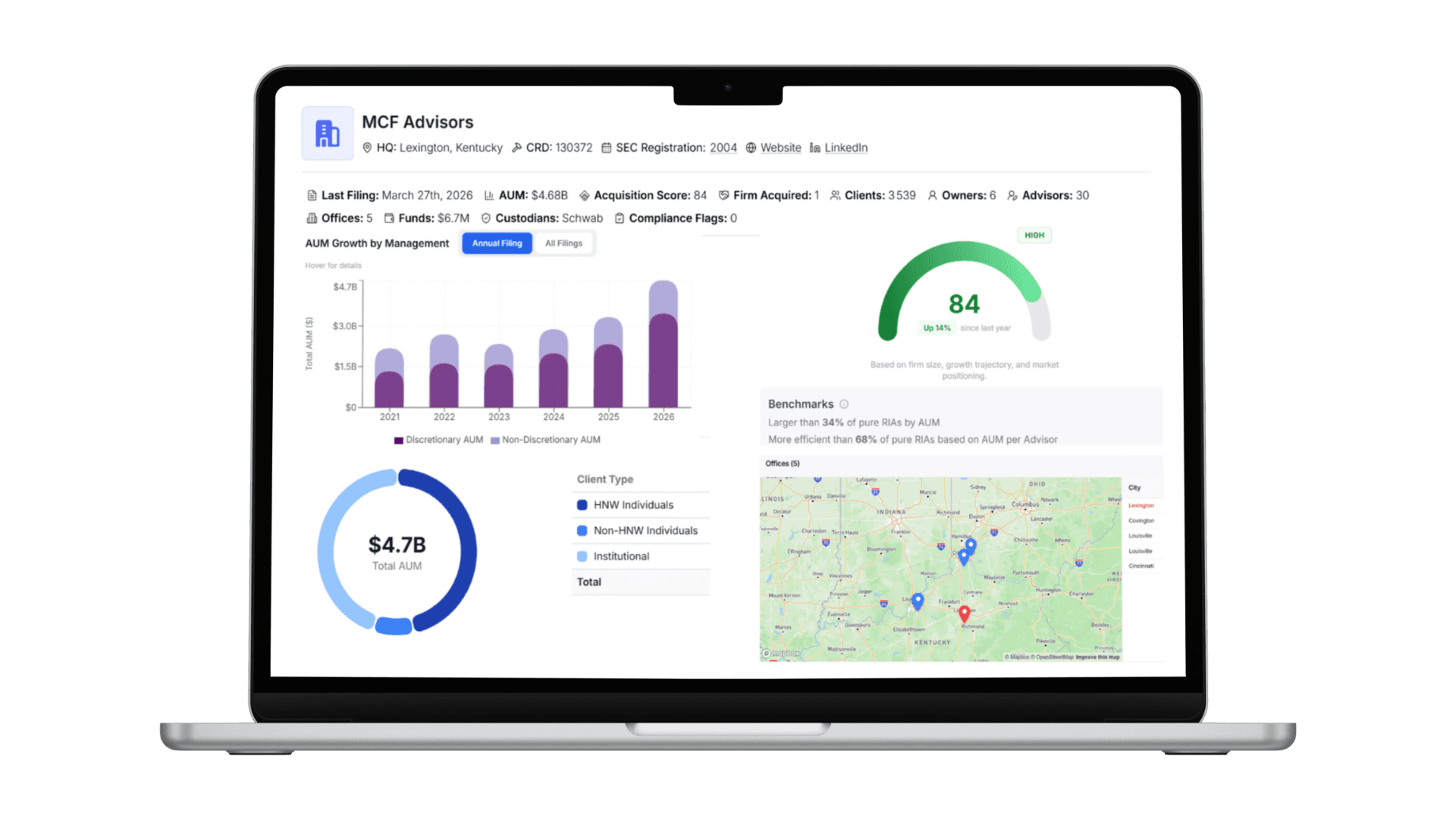
Accurate valuation requires structured, current data on the target and its peers. Platforms like RIA Catalyst provide the firm-level intelligence layer that PE and strategic buyers use for market mapping, competitive benchmarking, and pre-LOI screening. Having clean, comparable data on AUM, growth, fee rates, and advisor headcount before the first management meeting compresses diligence timelines and reduces the risk of late-stage repricing.
How Buyers Choose the Right Model for a Given RIA
Buyer Type Differences (Strategic vs. Financial)
Strategic buyers (large RIAs, aggregators, broker-dealers) often lean on revenue and AUM models because they plan to extract cost synergies post-close, making current EBITDA less relevant. Financial buyers (private equity, family offices) anchor to EBITDA because they underwrite to a return threshold that depends on cash flow, leverage capacity, and margin expansion potential.
When to Prioritize Cash Flow vs. AUM vs. Growth
For mature, high-margin firms, EBITDA multiples provide the tightest valuation signal. For high-growth, lower-margin firms, revenue multiples better capture the trajectory a buyer is paying for. For large, fee-only practices with straightforward models, AUM-based approaches offer a clean, intuitive frame. Most competitive processes involve buyers running all three and negotiating from whichever method supports their view.
Data Requirements to Value RIAs Accurately
What Data Is Needed Pre-LOI vs. Confirmatory Diligence
Pre-LOI, buyers need AUM history (3–5 years), revenue by type, a normalized EBITDA bridge, client count and segmentation, advisor headcount, and high-level fee schedule data. Confirmatory diligence adds client-level AUM and revenue data, billing records, employment agreements, compliance files, and technology vendor contracts. RIA Catalyst and similar structured data sources reduce the time required to assemble pre-LOI intelligence from weeks to days.
How to Benchmark a Target Against Peers
Benchmarking requires comparable firms matched on AUM range, geography, service model, and client segment. Relevant metrics include revenue per advisor, EBITDA margin, organic growth rate, client retention, and average fee rate. Without a peer set, multiples float without context.
FAQ
What is a typical RIA EBITDA multiple in 2026?
Mid-market RIAs (example range: $500M–$3B AUM) are trading at approximately 8–14× normalized EBITDA, with significant variation based on growth, margin, and risk profile. Top-quartile firms with strong organic growth and clean operations trade at the upper end; firms with succession risk or client concentration trade at the lower end.
How does organic growth affect RIA valuation?
Organic growth, measured as net new asset flows excluding market appreciation, is one of the strongest positive valuation drivers. Firms demonstrating consistent 5%+ organic growth can see 1–2 additional EBITDA turns compared to peers with flat or negative flows.
Why do EBITDA, revenue, and AUM models produce different values?
Each method captures a different dimension of the business. EBITDA reflects profitability, revenue reflects top-line scale and durability, and AUM reflects the asset base generating fees. Differences in implied value between methods are diagnostic: they surface assumptions about margin sustainability, fee rate risk, and growth.
How do earnout structures affect seller economics in RIA M&A?
Earnouts shift risk from buyer to seller by making a portion of the purchase price contingent on post-close performance (typically revenue retention or growth). Sellers should model downside scenarios, including client attrition and market declines, when evaluating earnout-heavy offers. A $45M deal with 20% in earnouts is not economically equivalent to a $40M all-cash deal for most sellers.
What is client concentration risk and how does it affect valuation?
Client concentration risk measures how much revenue or AUM depends on a small number of households. When the top 10 clients exceed 25–30% of revenue, buyers typically apply valuation discounts of 1–2× EBITDA or structure retention-based earnouts to protect against attrition.
How should sellers prepare for RIA valuation diligence?
Start by assembling a clean data room with 3–5 years of AUM, revenue, and expense history, a normalized EBITDA bridge with documented add-backs, client segmentation data, advisor productivity metrics, and compliance records. Firms that present organized, accurate data negotiate from a position of strength and reduce the risk of late-stage repricing.
Conclusion
How RIAs are valued in 2026 comes down to method selection, driver analysis, and deal structuring, each of which interacts with the others. EBITDA multiples anchor most mid-market conversations, but revenue and AUM models provide useful cross-checks that surface risks and opportunities the primary method might miss. The valuation bridge framework turns generic market ranges into firm-specific pricing by quantifying the impact of growth, concentration, margin, and operational maturity. Use multiple methods as a triangulation discipline, not as a way to cherry-pick the highest number. The firms that attract the strongest bids are the ones that present clean data, demonstrate organic growth, and reduce buyer uncertainty at every stage.