Date Published:

Valuation in RIA M&A is often framed as a function of AUM, revenue, and earnings multiples. Those are the inputs that appear in models and get discussed in investment committee presentations. What gets discussed less explicitly — but affects deal economics just as materially — is regulatory history. A firm's compliance track record is not a binary pass/fail condition. It exists on a spectrum, and where a firm sits on that spectrum influences headline multiples, deal structure, escrow requirements, and the allocation of post-close risk in ways that can shift total deal economics by millions of dollars.
This article covers how different types of regulatory history affect RIA deal pricing, what the mechanisms are, and how buyers should think about quantifying and structuring around compliance risk rather than simply walking away from it.
The Regulatory History Spectrum
Not all compliance history is created equal. Before assessing pricing impact, buyers need to categorize what they're looking at across three dimensions: type, recency, and pattern.
Type refers to the nature of the regulatory event — a formal SEC action, an examination deficiency, a customer complaint, a civil proceeding, or a state regulatory matter. Formal actions carry more weight than deficiency letters. Customer complaints that resulted in settlements carry more weight than complaints that were resolved without payment.
Recency is often the most important modifier. A regulatory action from eight years ago, fully remediated with clean examinations since, tells a very different story than a deficiency letter from eighteen months ago in an area the firm still hasn't fixed. Most buyers treat findings within three years as active considerations in pricing and within five years as requiring active explanation.
Pattern is the dimension most often missed in early screening. A single isolated event can be an anomaly. The same type of finding recurring across multiple examination cycles is a control culture problem — and control culture problems are rarely fixed by an ownership change alone.
How Regulatory History Affects Headline Multiples
Clean History: The Baseline
A firm with no disciplinary history, clean examination findings, and a documented compliance program commands the full range of multiples justified by its financial profile. Compliance cleanliness is increasingly treated as a prerequisite for premium pricing — not a differentiator that earns extra credit. Buyers paying 10x+ EBITDA multiples are implicitly assuming a clean regulatory environment. Anything less requires an explicit downward adjustment.
Historical Actions — Fully Remediated
A regulatory action that is historical, disclosed, and verifiably remediated — where the firm can point to specific operational changes, compliance infrastructure investments, and subsequent clean examinations — typically produces a moderate pricing impact rather than a deal-stopper. Buyers will generally apply a 0.5x–1.5x EBITDA multiple discount to account for residual uncertainty and the reputational overhang, even when the legal exposure has been resolved.
The discount reflects two things: the risk that the disclosed action is not fully representative of the firm's compliance history, and the cost of additional diligence required to verify remediation. A firm that can provide clean examination reports from the two cycles following the remediation, documented compliance policy changes, and evidence of staff training or enhanced supervision will command a narrower discount than one that can only offer management's assurance that the issue was fixed.
Ongoing Deficiencies — Unresolved
A firm with unresolved examination deficiencies — areas where the SEC has identified issues that have not been remediated to the examiner's satisfaction — presents a different pricing problem. The exposure is not historical; it is ongoing. And ongoing exposure is harder to price because it can escalate.
In these situations, buyers have two basic options: price the remediation cost into the deal and require it as a condition of closing, or apply a more significant multiple discount that accounts for the uncertainty of what full remediation will require. The former is preferable when the scope of remediation is well-defined. The latter is more appropriate when the deficiency is systemic enough that the cost of correction is genuinely unknown.
Pattern Findings — Cultural Risk
The most difficult regulatory history to price is a pattern of findings in the same category across multiple examination cycles. If a firm has been cited for inadequate supervision of outside business activities in 2018, 2020, and 2023, the issue is not a compliance policy gap — it is a management and control culture problem. And management culture does not automatically change when ownership changes.
Pattern findings typically result in one of three outcomes in pricing: a significant multiple discount (2x–3x EBITDA or more) that reflects the probability of ongoing regulatory cost, a mandatory compliance remediation condition that must be completed before close, or a pass. The choice depends on the acquirer's own compliance infrastructure and whether they have the operational capacity to impose the cultural change that the target has been unable to make independently.
Active Investigations — Deal Pause or Exit
An active SEC investigation or examination with material findings pending is generally not a priceable risk — it is a deferral or exit condition. The range of outcomes from an active investigation is too wide to model accurately, the timeline is uncertain, and the reputational risk during the pendency of the process creates client and advisor retention uncertainty that compounds the financial exposure.
Most experienced acquirers will either pause the process pending resolution or structure a contingent transaction with conditions precedent tied to regulatory resolution. Contingent structures of this type are complex and rarely favored by sellers, which means active investigations most often result in a deal pause rather than a close.
Deal Structure as a Pricing Mechanism
When regulatory history exists but doesn't disqualify a target, deal structure does the work that headline multiple alone cannot. The most common structural mechanisms for pricing compliance risk are:
Escrow Holdbacks
A portion of the purchase price is held in escrow for a defined period (typically 12–24 months post-close) subject to release upon satisfaction of compliance-related conditions — no new regulatory actions, successful completion of remediation, or clean examination findings. Escrow holdbacks are the most direct way to transfer uncertainty from buyer to seller: if the compliance history proves benign post-close, the seller gets the escrowed amount; if it generates new exposure, the escrow provides a remedy fund.
Representations and Warranties
The compliance-related representations in an RIA purchase agreement are among the most heavily negotiated provisions. Sellers represent that all required disclosures have been made, that there are no undisclosed proceedings, that the compliance program meets applicable regulatory standards, and that no material compliance violations have occurred in a defined lookback period. Breach of these representations triggers indemnification obligations, which effectively makes the seller financially responsible for pre-close compliance failures discovered post-close.
The scope of these representations matters enormously. A seller's counsel will push for narrow definitions, short survival periods, and low liability caps. A buyer's counsel will push for broad definitions, longer survival periods, and caps that reflect the actual magnitude of potential regulatory exposure. The negotiated outcome determines how much pre-close risk actually transfers.
Rep and Warranty Insurance
Rep and warranty insurance (RWI) allows buyers to shift indemnification obligations from the seller to an insurer. In RIA acquisitions, RWI is increasingly common and particularly useful for compliance representations — because it allows buyers to secure coverage for pre-close regulatory exposure without requiring sellers to maintain large escrow holdbacks. The insurer underwrites the compliance risk and pays claims if representations prove false.
The availability and cost of RWI coverage for RIA compliance representations has improved as the market has matured, but insurers will carve out known issues — so RWI is not a substitute for diligence. It is a complement to it.
Purchase Price Adjustments
When compliance history generates a quantifiable remediation obligation — a specific dollar amount owed to clients for billing overcharges, a documented cost to implement a required compliance infrastructure improvement, or a penalty amount from a settled proceeding — the most straightforward mechanism is a direct purchase price adjustment. The remediation cost is estimated, verified, and subtracted from the agreed enterprise value before the price is set.
Quantifying the Impact: A Framework
Buyers who assess regulatory history systematically need a way to translate qualitative findings into pricing adjustments. The framework below provides a starting structure — calibrate ranges to your specific situation and tolerance.
Regulatory History Category | Typical Multiple Impact | Structural Response |
|---|---|---|
Clean — no findings | None | Standard representations |
Historical action, fully remediated (5+ years) | 0x–0.5x EBITDA discount | Enhanced compliance reps, shorter escrow |
Historical action, fully remediated (2–5 years) | 0.5x–1.5x EBITDA discount | Escrow holdback, compliance reps, RWI |
Unresolved deficiency — defined scope | Price adjustment for remediation cost | Remediation as closing condition |
Pattern findings — same category, recurring | 2x–3x EBITDA discount or pass | Compliance remediation plan, mandatory CCO hire |
Active investigation or proceeding | Deal pause or contingent structure | Close conditioned on resolution |
Undisclosed exposure discovered in diligence | Renegotiate or pass | Broadened reps, escrow, or exit |
The Compliance Infrastructure Premium
The inverse of compliance risk is also worth noting. Firms that have invested meaningfully in compliance infrastructure — a dedicated CCO with regulatory experience, documented written supervisory procedures, regular compliance training, and a history of proactive disclosure — command a modest premium in competitive processes because they reduce post-close integration cost and regulatory risk.
The compliance infrastructure premium is not captured in standard EBITDA multiples, but it shows up in the speed and certainty of close, the narrowness of escrow requirements, and the relative simplicity of compliance representation negotiations. For buyers who are themselves subject to regulatory oversight, acquiring a firm with a strong compliance culture reduces their own regulatory exposure — a benefit that is real even if it doesn't appear on a pro forma income statement.
Data Advantage: Regulatory History Before the Pitch
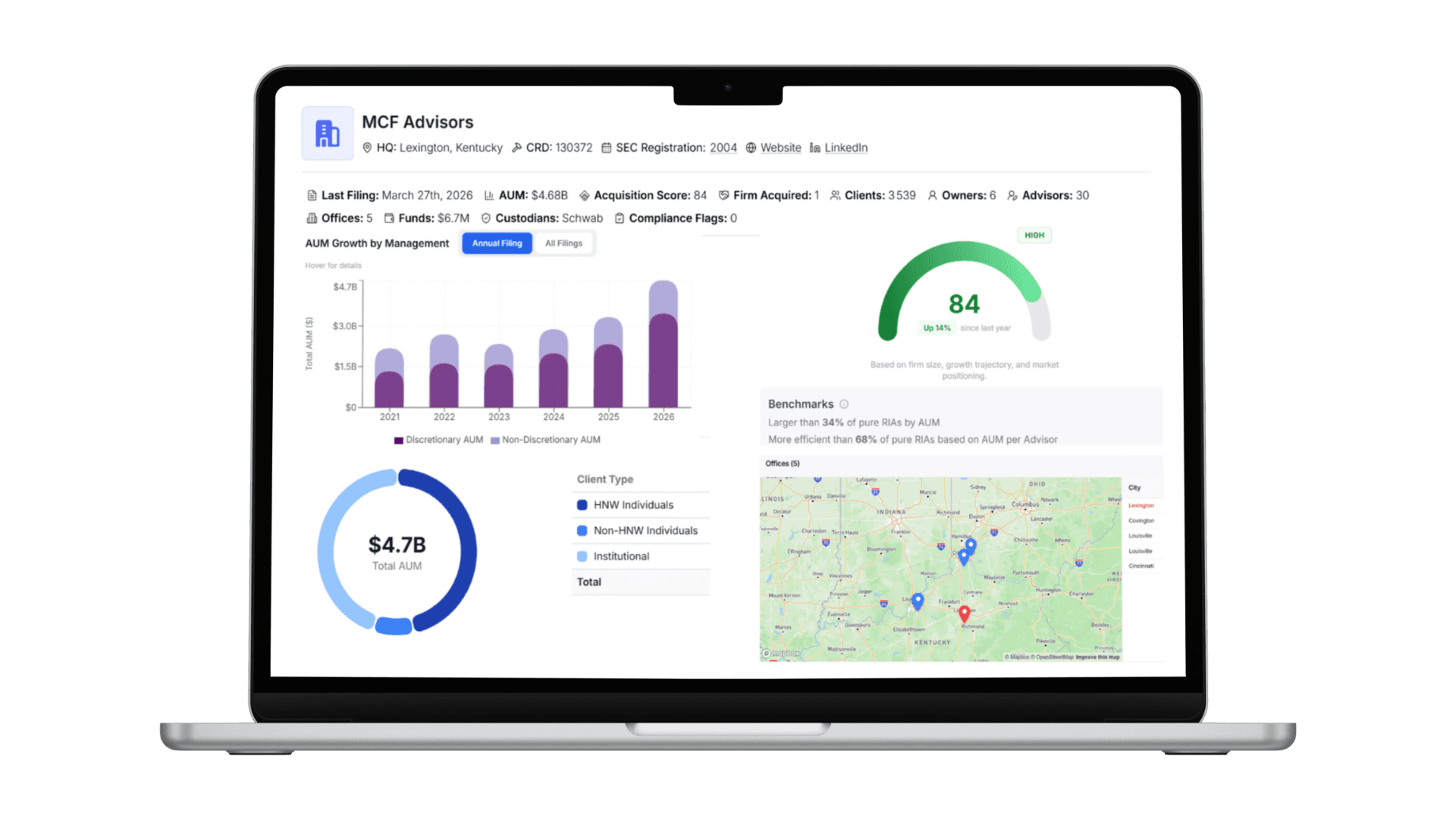
RIA Catalyst's platform aggregates Form ADV data including disciplinary history and disclosure events across 15,000+ registered advisers, enabling buyers to screen for regulatory history as part of standard pipeline qualification — before the first outreach call. Identifying firms with material compliance history at the sourcing stage allows buyers to deprioritize those targets, adjust relationship-building timelines to account for the complexity of those deals, or price compliance risk into early valuation ranges before management presentations create anchoring effects.
FAQ
How much does a single historical regulatory action typically discount an RIA's valuation?
It depends on recency, severity, and remediation. A fully remediated action from more than five years ago with clean subsequent examinations may produce no pricing impact or a minimal discount in a competitive process. The same action from two years ago that is still being remediated could reduce the headline multiple by 1x–2x EBITDA, with additional structural protections required. There is no universal formula — the pricing impact must be calibrated to the specific facts of the action and the buyer's risk tolerance.
Can a buyer fully protect itself from pre-close regulatory exposure through deal structure?
Not fully. Asset purchase structures limit liability transfer, but regulatory obligations tied to advisory relationships and ongoing supervision can attach to the acquirer regardless. The goal of structural protections — escrow, indemnification, RWI — is to compensate the buyer financially for pre-close exposure, not to eliminate the operational and reputational consequences of regulatory issues that surface post-close.
What compliance representations should buyers insist on in the purchase agreement?
At minimum: no undisclosed regulatory proceedings, full and accurate ADV disclosures, no material compliance violations in the lookback period, compliance program meets applicable regulatory standards, all required client disclosures have been made, and no pending or threatened regulatory actions. The survival period for compliance reps should be at least 24 months post-close, and the indemnification cap should reflect the potential magnitude of regulatory exposure identified in diligence.
How do state regulatory actions differ from SEC actions in deal pricing?
State regulatory actions are disclosed in Form ADV Part 1 alongside SEC and FINRA actions. Their pricing impact depends on severity and whether the firm is state-registered, dual-registered, or SEC-registered. For SEC-registered firms, state regulatory actions carry somewhat less weight than SEC formal proceedings — but they are still meaningful, particularly if they reflect conduct that would also be subject to SEC oversight.
When does compliance history become a deal-stopper vs. a pricing input?
The line is active vs. resolved. Active investigations, unresolved examinations with material findings, and ongoing enforcement proceedings are difficult to price with enough certainty to justify closing a deal. Resolved historical matters — even significant ones — can usually be priced through structural mechanisms if the remediation is verifiable. The practical test: if you cannot quantify the worst-case post-close regulatory cost within a range you are willing to absorb, the deal is not priceable and should be deferred or passed.
Conclusion
Regulatory history is one of the most systematically underpriced variables in RIA acquisitions — not because buyers ignore it, but because they assess it too late and without a consistent framework for translating findings into deal economics. Compliance risk is priceable when it is discovered early, characterized accurately, and addressed through the right combination of headline multiple adjustment and structural protections. The buyers who do this consistently are the ones who close deals that others walk away from — not because they accept more risk, but because they understand it well enough to price it correctly.