Date Published:

In RIA M&A, the same target can attract materially different offers — different headline multiples, different structures, and different post-close expectations. That's not because one buyer is smarter or one seller is better positioned. It's because each buyer type brings a distinct cost of capital, synergy set, governance model, and time horizon — and those differences ripple through every component of a deal.
For buy-side teams, understanding how buyer profiles impact RIA valuations matters for two reasons. First, it clarifies why "market multiple" is an incomplete concept. Valuation includes structure (cash vs. rollover equity vs. earnouts), certainty of close, speed, and post-close requirements that can materially shift real economics. Second, it helps buyers avoid overpaying for synergies they cannot capture and design terms that protect downside without killing the deal.
What "Buyer Profile" Really Means in RIA M&A
A buyer profile is a bundle of constraints and advantages that shapes what can be paid, how risk is priced, and what must be true post-close for the deal to work. Three factors drive most of the variation.
Cost of capital and return requirements. Strategic buyers — established RIA platforms, banks, asset managers — may have a lower blended cost of capital and can sometimes accept lower IRR targets when an acquisition supports a broader strategic plan. Financial buyers underwrite to explicit return thresholds and a defined exit path, which tightens the range of acceptable entry multiples unless synergies or growth are highly credible.
Synergy potential. Synergies are buyer-specific. A scaled RIA platform may have real, near-term cost takeout through shared compliance, billing, and technology infrastructure. A bank's distribution and cross-sell thesis is harder to underwrite and slower to realize. An asset manager values wallet-share expansion but may be more sensitive to channel conflict.
Hold period and governance. Longer hold periods can support higher upfront cash when cash flows are stable. Shorter sponsor-driven holds increase emphasis on clean metrics, integration milestones, and equity alignment. Governance expectations around reporting cadence, budget control, and investment authority can become hidden price items that affect retention and growth post-close.
The Major Buyer Profiles
Strategic RIA Platforms and Aggregators
Strategic RIA platforms underwrite around integration playbook maturity, cost synergies from shared services and vendor leverage, and advisor and client retention as the gating factor for the entire thesis. Valuation approaches blend EBITDA multiples for scaled, margin-stable firms with revenue heuristics for smaller or faster-growing targets. Hybrid structures with rollover equity and performance components are common when the founding advisor remains central to client relationships.
Banks and Trust Companies
Banks bring a distinct set of constraints: regulatory and risk management requirements increase diligence depth and extend timelines, and capital allocation frameworks prioritize stable cash flows over growth optionality. Cross-sell logic — trust services, lending, deposits — can anchor the synergy thesis, but it is harder to underwrite and slower to realize than cost-side synergies. Bank buyers typically prefer more fixed consideration, fewer contingent structures, and higher certainty around compliance and supervision.
Asset Managers and Diversified Wealth Managers
Asset managers underwrite based on distribution dynamics, client experience alignment, and advisor productivity. They pay for strategic adjacency — geography, client segment, planning capability — as well as durable organic growth. What distinguishes this buyer type is sensitivity to forced product migration and channel conflict. The synergy thesis tends to be longer-duration and harder to stress-test than a cost-driven integration play.
PE-Backed Platforms
PE-backed platforms sit between strategic and financial logic. They often have real operating synergies similar to a strategic platform, but underwriting is anchored to sponsor return requirements and a defined hold period. Emphasis falls on scalable EBITDA, margin expansion, and equity alignment through rollover incentive pools. The headline multiple can look competitive, but the structure carries more contingency — particularly when retention or integration outcomes are uncertain.
Independent Sponsors and Family Offices
Independent sponsors and family offices vary widely but tend to use flexible capital structures (seller notes, preferred equity, minority-to-control pathways), potentially longer-duration capital, and conservative synergy underwriting. Reliance on management continuity is higher because operating resources are typically lighter than a scaled platform.
Where Buyer Profiles Change Valuation Mechanics
Multiple Selection
Multiple selection is a proxy for what the buyer believes is real and controllable. Revenue multiples appear in smaller deals or where EBITDA is depressed by growth investment — but buyers always implicitly translate revenue into implied margins, so the margin assumption is present regardless of the headline metric. EBITDA multiples dominate when margins are stable and scalable. Hybrid approaches bridge the gap when a target is in transition.
Synergy Credit
Synergy credit is the biggest source of offer divergence. Strategic platforms may pay for synergies they can capture quickly. Sponsor-backed buyers model synergies but retain more upside to protect returns. Banks apply limited synergy credit unless realization is operationally straightforward. A practical test: if a synergy requires behavior change from advisors or clients, it is harder to underwrite and less likely to be fully paid at signing.
Risk Pricing and Deal Structure
Most buyers price the same risks differently based on integration capacity and governance requirements — client retention, revenue concentration, succession depth, and compliance complexity. Structure is where risk allocation becomes tangible. Rollover equity aligns principals with the platform's equity story. Earnouts bridge valuation gaps and transfer retention risk back to the seller. Seller notes or staged consideration appear when certainty is lower. A higher headline multiple with heavy earnout exposure is not the same economic outcome as a lower multiple with 85% cash at close.
Buyer Profile Comparison
Criterion | Strategic Platform | Bank / Trust | Asset Manager | PE-Backed Platform | Ind. Sponsor / Family Office |
|---|---|---|---|---|---|
Cost of capital | Moderate-to-low | Low, disciplined | Varies | Higher; return-driven | Deal-specific |
Return requirement | Strategic + financial | Risk-adjusted + fit | Strategic adjacency | IRR / MOIC driven | Conservative; deal-by-deal |
Hold period | Long-term / indefinite | Long-term | Long-term | Defined (3–7 years) | Often longer / flexible |
Primary value metric | EBITDA / hybrid | Cash flow stability | Strategic fit + earnings | EBITDA + scalability | Cash flow + mgmt quality |
Synergy thesis | Shared services + recruiting | Distribution adjacency | Distribution + wallet share | Cost takeout + scale | Selective add-ons |
Synergy credit paid | Medium | Low-to-medium | Medium | Lower upfront | Often low |
Integration appetite | Medium-to-high | Medium | Medium | High (to hit plan) | Low-to-medium |
Retention approach | Equity + platform resources | Stability + brand | Brand + career path | Rollover equity + incentives | Management continuity |
Risk tolerance | Medium | Lower | Medium | Medium (via structure) | Lower-to-medium |
Preferred structure | Cash + equity + earnouts | More cash; fewer contingencies | Clean mix | Cash + rollover + earnouts | Seller notes; staged control |
Speed / certainty | Fast if playbook mature | Slower; regulatory | Medium | Medium-to-fast | Financing dependent |
Worked Scenario (Hypothetical)
Target Profile and Baseline
Assume a target RIA with the following simplified profile (illustrative numbers only):
AUM: $1.2B
Revenue: $10.0M (blended fee rate ~0.83%)
Normalized EBITDA: $3.0M (30% margin)
Organic growth: 6% annually
Client concentration: top 10 clients = 18% of AUM
Advisor team: 10 advisors; founder still primary rainmaker
Baseline market range: 8.0x–12.0x EBITDA → implied EV of $24M–$36M. Actual offers diverge meaningfully based on buyer profile and structure.
Strategic Platform Offer
Cost synergies of $0.6M from centralizing compliance, billing, and tech — achievable within 12–18 months. Add-backs on owner compensation and non-recurring expenses can be significant and further expand the synergy case, though they require line-by-line documentation. Pro forma EBITDA: $3.6M at 9.0x → implied EV of $32.4M.
Structure: 75% cash at close ($24.3M), 25% rollover equity ($8.1M), retention-based earnout up to $2.0M over 24 months. Total potential value to seller: $34.4M if earnout is fully realized.
PE-Backed Platform Offer
Similar synergies modeled but partially retained to protect sponsor returns. Entry multiple: 8.5x on current EBITDA → implied EV of $25.5M.
Structure: 60% cash at close ($15.3M), 30% rollover equity ($7.7M), 10% earnout up to $2.6M tied to revenue retention and growth milestones. The equity component carries real upside — and real risk.
Bank / Wealth Manager Offer
Less synergy credit, conservative underwriting. 8.0x on current EBITDA → implied EV of $24.0M.
Structure: 85% cash at close ($20.4M), 15% deferred consideration ($3.6M) over 24 months subject to retention and compliance conditions. Lowest headline EV across the three scenarios — but highest upfront cash. For a seller prioritizing liquidity over total value, the economics may be closer than the multiples suggest.
Practical Takeaways for Buyers
Separate available synergies from capturable ones. If capture requires advisor or client behavior change, assume slower realization and lower probability. Underwrite integration capacity honestly — a mature playbook is a valuation asset; limited capacity should reduce synergy credit.
Normalize economics consistently. Owner comp, one-time expenses, and growth investments should be treated the same way across every target to prevent multiple drift across the pipeline.
Segment comps by buyer type. A comp set dominated by sponsor-backed transactions may not translate to a strategic platform's underwriting logic — or a bank's. Buyer-specific benchmarking produces more defensible pricing.
Use structure to price the specific risk identified in diligence. Retention risk warrants a retention-based earnout. Growth uncertainty warrants a growth-based earnout. Keep metrics observable and auditable — ambiguous definitions create post-close friction at the worst possible moment.
Treat certainty and speed as economic variables. A faster close with fewer conditions can justify a cleaner structure even at a slightly higher price.
Data advantage: buyer-specific comps and benchmarking
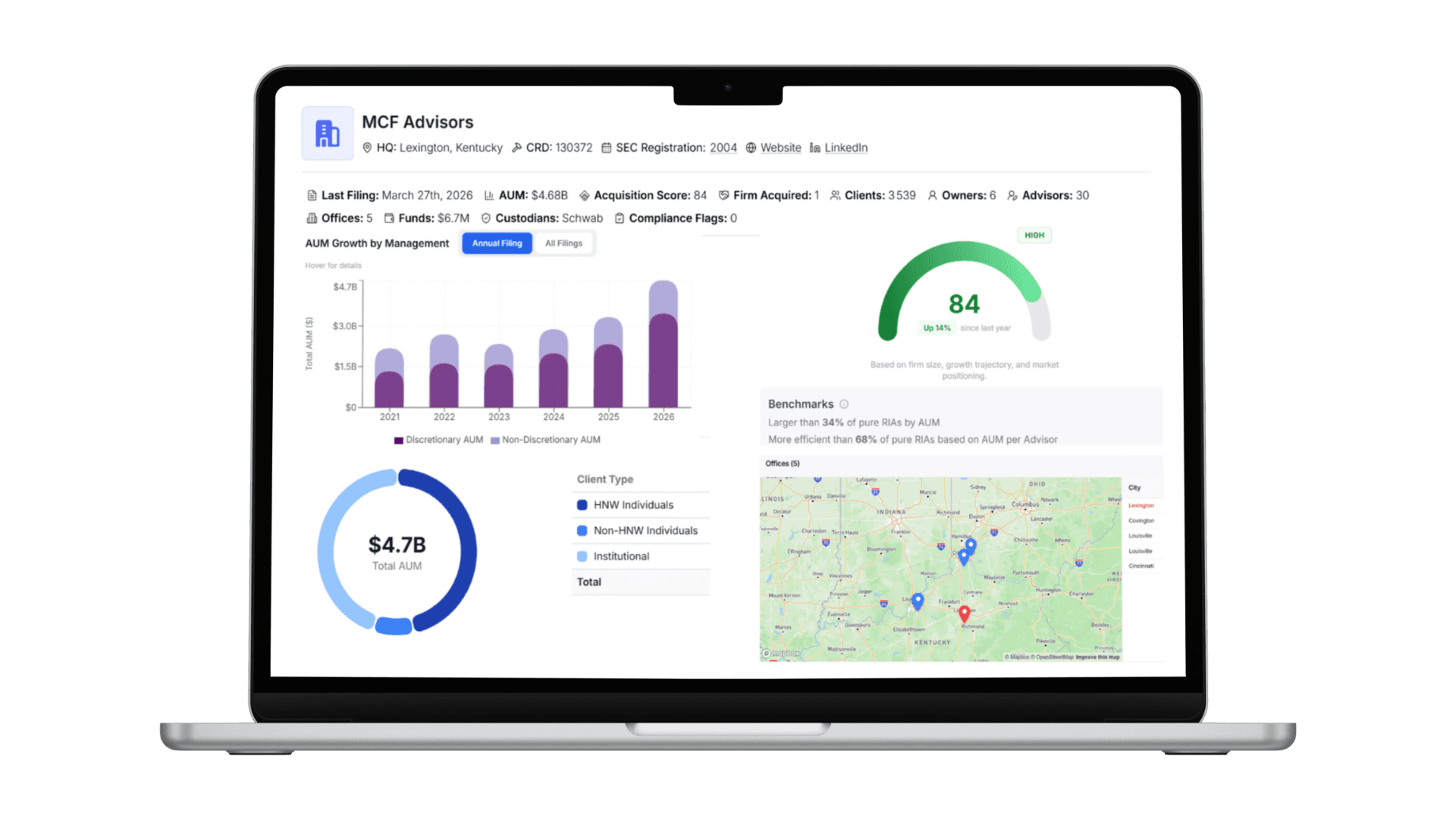
Buyer-profile underwriting improves when comps and benchmarks are segmented by buyer type and normalized for firm attributes — AUM, advisor headcount, client mix, geography, ownership signals, and growth indicators. Platforms like RIA Catalyst maintain structured firm intelligence across 15,000+ SEC-registered RIAs, supporting faster screening, consistent valuation logic across the pipeline, and peer benchmarking that reflects actual deal conditions rather than generic market averages.
FAQ
How do buyer profiles impact RIA valuations beyond the headline multiple?
Through structure (cash vs. rollover equity vs. earnouts), certainty of close, speed, and post-close requirements such as governance and integration expectations. Two offers at identical headline enterprise values can produce materially different seller outcomes depending on upfront liquidity, earnout probability, and the terms attached to rollover equity.
What is the key difference between strategic buyer and private equity RIA valuation?
Strategic buyers may pay more for near-term synergies they can capture quickly — shared services, vendor leverage, integration infrastructure already in place. PE-backed buyers anchor valuation to return thresholds and a defined exit path, using more contingent structure to protect downside while preserving upside through platform-level equity appreciation.
Which valuation drivers change the most across buyer types?
Synergy credit, integration capacity, and risk tolerance drive the largest differences. Synergy credit is the most visible because it directly explains divergence between offers that look similar on EBITDA multiple but differ significantly on implied enterprise value and structure.
How can buyer teams benchmark valuations more consistently?
Consistency requires firm-level data that is structured, current, and comparable — and comp sets segmented by buyer type rather than drawn from the full deal universe. Normalizing for AUM, advisor headcount, client mix, geography, and growth indicators produces benchmarks that reflect relevant deal conditions and reduce pricing drift across the pipeline.
Conclusion
Understanding how buyer profiles impact RIA valuations is a practical advantage in competitive processes. Different buyer types bring different costs of capital, synergy sets, governance models, and time horizons — so valuation must be framed as more than a headline multiple. The most disciplined approach aligns multiple selection, synergy credit, risk pricing, and deal structure to what the buyer can actually execute post-close. When underwriting is grounded in buyer-specific comps and consistent firm intelligence, pricing becomes more defensible, terms become easier to negotiate, and the gap between offer price and realized value narrows.