Date Published:

Form ADV is the most important document in any RIA acquisition — and the most consistently underread. It is the primary regulatory disclosure for every SEC-registered investment adviser: a structured, standardized filing that contains operational details, compliance history, business description, conflict disclosures, and ownership information that no pitch book or management presentation will replicate. Most acquirers skim it. The ones who read it carefully find things that change deals.
This guide covers what Form ADV actually contains, which sections matter most for acquisition diligence, what the disclosures signal beyond their literal content, and how to use ADV data systematically across a pipeline of targets rather than deal by deal.
What Form ADV Is — and What It Isn't
Form ADV is a registration document, not a marketing document. It is filed with the SEC and updated annually, with interim amendments required when material information changes. Because it is filed under penalty of perjury and subject to SEC examination, the information it contains is generally more reliable than self-reported data in a management presentation or CIM.
It is structured in two parts, each serving a different purpose. Part 1 is a structured data form — checkboxes, numbers, and categorical disclosures that provide the quantitative and regulatory backbone of the firm profile. Part 2 is a narrative brochure written in plain English that describes the firm's services, fees, conflicts of interest, and personnel. Both parts matter for acquisition diligence, but they answer different questions.
What ADV cannot tell you: client-level revenue data, advisory contract terms, detailed financial statements, or information the firm chose not to disclose. It is a starting point, not a complete picture — but it is the most reliable starting point available before direct engagement with the target.
Part 1: The Structured Data Layer
Schedule A and B — Ownership and Control
The first thing any acquirer should check is who owns and controls the firm. Schedule A lists direct owners and executive officers with 25% or more ownership. Schedule B lists indirect owners. Together, they tell you the legal ownership structure, whether there are outside investors, private equity sponsors, or family trusts in the picture, and who holds enough equity to be a material stakeholder in a sale process.
For acquisitions, ownership structure directly affects deal structure. A firm owned entirely by its founding advisors is a very different negotiation than one that has a minority PE investor with board representation and a preferred liquidation preference. Identifying the ownership complexity before LOI prevents structural surprises during negotiation.
Item 5 — Information About the Advisory Business
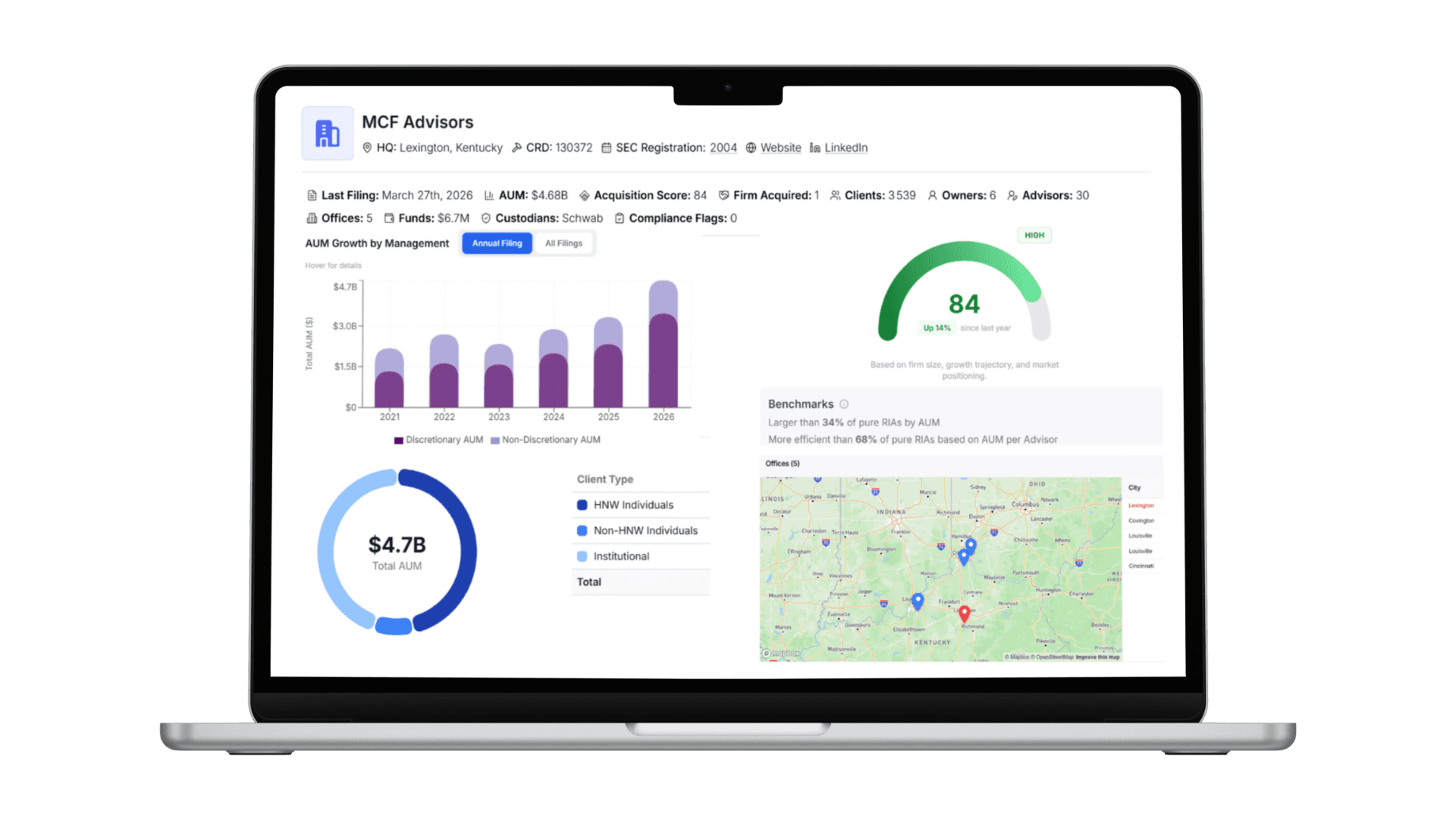
Item 5 contains the firm's reported AUM broken down by discretionary and non-discretionary, the number of client accounts, and the types of clients served (individuals, high-net-worth individuals, institutional). This is the baseline for any revenue estimation.
Key figures to extract: total regulatory AUM, number of accounts, and the breakdown between discretionary and non-discretionary. Non-discretionary AUM is generally worth less in an acquisition because the advisory relationship is less sticky and the revenue is more dependent on continued client engagement. A firm reporting $800M in total AUM with $300M non-discretionary is a different acquisition than one with $800M fully discretionary.
Item 5 also discloses the types of compensation arrangements — whether the firm is fee-only, fee-based, or receives commissions. This directly affects revenue quality assumptions in the valuation model.
Item 7 — Financial Industry Affiliations
Item 7 discloses whether the firm or its personnel have affiliations with broker-dealers, investment companies, banking institutions, or other financial entities. These affiliations can create conflicts of interest that affect the firm's fiduciary obligations to clients — and they can also affect the structure of an acquisition if the affiliated entities have rights or relationships that don't automatically transfer.
A firm affiliated with a broker-dealer that routes client orders for payment, for example, has a conflict disclosure obligation that may become more prominent post-close if the acquiring firm doesn't maintain the same affiliation. Understanding these affiliations before LOI prevents integration surprises.
Item 9 — Custody
Item 9 discloses whether the firm has custody of client assets. Custody arrangements are one of the SEC's current examination priorities and a frequent source of regulatory exposure. A firm that checks "yes" to custody but cannot demonstrate compliance with the surprise audit requirement of the custody rule has a compliance deficiency that will require remediation.
More subtly, a firm that has custody because it directly deducts fees from client accounts — which is the most common form of "inadvertent" custody — may have a simpler compliance posture than one that holds client securities directly or serves as trustee for client accounts. Understand what kind of custody is disclosed before assessing the risk.
Item 11 — Disciplinary Information
This is the section most acquirers check first — and for good reason. Item 11 requires disclosure of criminal proceedings, regulatory actions, civil proceedings, and self-regulatory organization proceedings against the firm, its affiliates, or its management persons. A "yes" answer to any Item 11 question triggers a detailed disclosure requirement.
Read every Item 11 disclosure carefully. Note the date, the nature of the proceeding, the outcome, and whether any conditions were imposed on the firm's registration. Then cross-reference against the SEC's IAPD database, which often provides more detail than the ADV summary. What you are looking for is not just the presence of a disclosure — it is the pattern, recency, and severity of what's disclosed.
Part 2: The Narrative Intelligence Layer
The Brochure (Part 2A) — Services, Fees, and Conflicts
Part 2A is the firm's narrative disclosure document, written in plain English and intended to give clients a clear picture of the firm's services, fees, and conflicts of interest. For acquirers, it is a window into the firm's actual business model, advisory philosophy, and conflict structure that no pitch book provides.
Fee schedule: The fee schedule in Part 2A discloses how the firm charges clients — percentage of AUM, flat fee, hourly, or some combination. Compare the disclosed fee schedule to the blended fee rate implied by total AUM and estimated revenue. If the disclosed schedule suggests average fees of 90 bps but the implied blended rate is 65 bps, something is discounting — grandfathered clients, fee negotiations, or institutional accounts with separate arrangements. Understanding why the realized rate diverges from the disclosed schedule is an important valuation input.
Conflict disclosures: Item 10 and Item 11 of Part 2A require disclosure of all material conflicts of interest — third-party compensation arrangements, referral fees, affiliated product recommendations, and any situation where the firm's financial interests could differ from the client's. Read these disclosures carefully. Conflicts that are adequately disclosed and managed are very different from conflicts that are undisclosed or inadequately managed — but both affect the firm's relationship with clients and its regulatory standing.
Investment strategy: The description of the firm's investment philosophy and strategy in Part 2A tells you what the firm actually does — which may or may not match what management describes in meetings. Significant divergence between the disclosed strategy and management's narrative is a due diligence flag.
Part 2B — Brochure Supplement (Individual Advisor Disclosures)
Part 2B provides individual disclosure brochures for each supervised person who provides investment advice to clients. This is where personal disciplinary history, outside business activities, and educational and professional background are disclosed at the advisor level rather than the firm level.
For acquisitions, Part 2B is essential for assessing key-person risk. The founding advisor's brochure will show their professional history — which firms they've worked at, how long they've been at the current firm, and any personal disciplinary history. Multiple prior employer relationships in a short period can indicate relationship or performance issues that the firm-level ADV won't reveal. Individual disciplinary disclosures in Part 2B can also surface issues that aren't present at the firm level.
Reading Between the Lines: What ADV Language Signals
Form ADV is a regulatory document, which means its language is formulaic — but the specifics within the formulas carry real information.
Vague or circular conflict disclosures — disclosures that acknowledge a conflict exists but provide no specific detail about how it is managed — suggest a compliance program that is checking boxes rather than managing risk. Specific, detailed conflict disclosures with documented management procedures suggest a more mature compliance culture.
Significant AUM changes between filings that don't match the narrative of organic growth can indicate large client departures, inorganic book purchases, or market-driven changes that management hasn't foregrounded in conversations.
New or expanded disclosure of outside business activities in a recent amendment can signal that a compliance review identified previously undisclosed arrangements. This is a positive indicator of compliance culture — but the newly disclosed activities still require evaluation.
Recent amendments to Item 11 that add or modify disciplinary disclosures after a period of clean history are among the most important signals in the ADV. Understand what triggered the amendment before assessing its significance.
A Pre-LOI ADV Reading Checklist
Before signing any letter of intent, an acquirer should be able to answer the following questions from Form ADV:
Who are the direct and indirect owners, and what is their equity structure?
What is the total AUM, and how much is discretionary vs. non-discretionary?
What types of clients does the firm serve, and how does that match the acquisition thesis?
Does the firm have any Item 11 disclosures, and if so, what are the recency and severity?
Does the firm have custody, and is the custody arrangement compliant?
Are there affiliated entities that could complicate deal structure or integration?
Does the disclosed fee schedule align with the implied blended fee rate?
Are conflicts of interest specifically and adequately disclosed?
Do individual advisor brochures (Part 2B) reveal any personal disciplinary history or concerning outside business activities?
Have there been any amendments in the past 24 months, and what triggered them?
Data Advantage: ADV at Scale
Reading Form ADV carefully for a single target is a 30–60 minute exercise for a trained reviewer. Doing the same across a pipeline of 50–100 targets is a research project. RIA Catalyst structures and aggregates Form ADV data — including AUM figures, advisor headcount, ownership information, client types, and disciplinary disclosures — across 15,000+ registered advisers, allowing buyers to apply systematic pre-LOI screening criteria at the top of the funnel without building a manual research operation.
FAQ
Where can I access Form ADV for any registered investment adviser?
The SEC's Investment Adviser Public Disclosure (IAPD) system at adviserinfo.sec.gov provides public access to every registered investment adviser's Form ADV, including historical filings and amendments. Search by firm name, CRD number, or location. The database is free and updated in real time.
How often is Form ADV updated?
Registered investment advisers are required to file an annual amendment within 90 days of their fiscal year-end and an interim amendment within 30 days whenever certain information becomes materially inaccurate. Acquisitions of significant significance — material changes in ownership, AUM, or disciplinary history — trigger interim amendment requirements.
How reliable is the information in Form ADV?
ADV is filed under penalty of perjury and subject to SEC examination. Materially inaccurate information in a Form ADV filing is itself a regulatory violation. That said, the reliability of specific data points varies — AUM figures reflect the adviser's own calculation methodology and may not be independently verified, while disciplinary disclosures are generally more reliably complete because the consequences of non-disclosure are severe.
What is the difference between Part 1 and Part 2 of Form ADV?
Part 1 is a structured data form with checkbox and numerical disclosures covering ownership, business description, regulatory AUM, client types, and disciplinary history. Part 2 is a narrative brochure written in plain English that describes services, fees, conflicts, and investment strategies in more detail. Both are filed with the SEC but Part 2 is also delivered to clients. Part 1 provides the quantitative and regulatory backbone; Part 2 provides the operational and conflict narrative.
Can I request prior ADV filings to see how the firm has changed over time?
Yes. The IAPD provides access to historical ADV filings, allowing you to compare current disclosures against prior years. Tracking changes over time — particularly in ownership structure, AUM, disciplinary history, and conflict disclosures — is one of the most productive uses of ADV data in acquisition diligence.
Conclusion
Form ADV is the most information-dense, most reliable, and most consistently underread document in RIA M&A. Buyers who read it carefully — both parts, in full, with attention to what has changed between filings — arrive at the LOI stage with a materially more accurate picture of the target than buyers who rely on management presentations and CIMs. The information is public, free, and available before the first conversation. The question is whether you are using it as a sourcing filter or discovering its implications after the LOI is signed.