Date Published:

RIA acquirers spend their attention on other RIA acquirers. Reasonable — private-equity-backed consolidators and serial strategics account for most of a record volume of deals, with 2026 on pace to set another all-time high for RIA M&A.
Research published this week suggests the competitive set is about to widen from an unexpected direction.
Bain & Company projects that between five and seven US commercial banks will exceed $1 trillion in assets by 2030, up from four today. The expansion comes at the expense of the middle and the bottom: large regional banks holding $50 billion to $1 trillion are forecast to fall from 49 to as few as 30, and community banks from roughly 4,200 to between 3,600 and 3,800. Bain expects the pace to reaccelerate after a first-half pause and intensify through 2028 and 2029, with three forces driving it — a large capital overhang, a markedly more permissive approval environment, and acquisitions increasingly justified by technology and digital infrastructure rather than balance sheet alone.
The report’s own framing is worth noting: it argues that banks screening for targets on size and geographic overlap will systematically miss the most strategically valuable candidates, and that a structured, multi-dimensional screen backtested against prior large North American bank deals would have ranked most of the eventual targets near the top using only pre-announcement data. That is a familiar argument to anyone in RIA M&A. It is the same argument, in a different asset class.
Why Banking Consolidation Reaches Into RIA Deal Flow
Bank consolidation touches independent wealth management through four channels, none of which require a single bank to buy a single RIA.
Advisor books get displaced. When banks merge, advisor teams inside the acquired institution face new platforms, new payout arrangements, and new management. A predictable share leave. Some go independent, some join RIAs, some join independent broker-dealers. Every merger cycle in the past decade has produced a wave of moves. This one is projected to be larger than the last.
Bank-owned wealth units become sellable — and buyable. Consolidating banks review non-core businesses. Some divest wealth divisions; others decide wealth is core and go acquire scale in it. Both outcomes create transactions. A bank that concludes wealth management is strategic and has excess capital is a well-funded, low-cost-of-capital bidder for exactly the firms independent acquirers want.
Custody, lending, and platform relationships shift. Fewer and larger institutions means fewer counterparties for banking services RIAs depend on: lending against securities, cash management, trust services, and in some cases custody. Bain explicitly flags this window as the time for advisory firms to assess which platform dependencies to prioritize and which to diversify away from.
Referral economics change. Bank and credit union referral channels are a meaningful growth source for some RIAs. Consolidation reshuffles them, sometimes eliminating a relationship that took years to build and sometimes opening one at a larger institution.
What a Bank Bidder Does to a Competitive Process
Bank acquirers behave differently from PE-backed consolidators and from strategic RIAs. Understanding how is the difference between losing a deal and knowing you were never going to win it.
Factor | PE-backed consolidator | Strategic RIA | Bank acquirer |
|---|---|---|---|
Cost of capital | Fund return target; highest | Internal cash and debt | Deposit-funded; typically lowest |
Primary motive | Multiple expansion at exit | Capability, geography, talent | Fee income, cross-sell, deposit relationships |
Speed | Fast; built for repetition | Moderate | Slow; regulatory approval layers |
Seller autonomy offered | Partial to none | Often meaningful | Usually least |
Currency | Cash plus platform equity | Cash plus notes or equity | Cash |
What they underwrite | Growth and integration synergy | Strategic fit | Balance sheet and relationship value |
The uncomfortable line in that table is the first one. A bank funding an acquisition against deposits can rationally clear a price that a fund underwriting a five-year exit cannot, because it is not solving for the same return. Where a bank genuinely wants a franchise, competing on price is usually a losing strategy for an independent buyer.
The offsetting lines are speed and autonomy. Bank processes move slowly and carry regulatory dependencies, and bank ownership typically offers sellers the least operational independence of any buyer type. For a founder who cares about brand, decision rights, and the shape of their team, the bank’s higher number frequently loses. That is the gap an independent acquirer competes in, and it is a durable one.
Where the Deal Flow Actually Appears
The most useful implication of a wave that intensifies later this decade is that the displacement is not evenly distributed. It concentrates geographically, in the markets where consolidating regionals overlap.
That gives a disciplined buyer something specific to do now.
Start by identifying the metropolitan areas where two or more large regional banks hold meaningful share. Those are the markets where a merger produces overlapping branch networks, redundant wealth teams, and platform changes — and therefore where advisor movement and firm-level sale decisions cluster.
Then map the independent advisory landscape in those same markets: which RIAs are already there, how productive they are, whether they have absorbed lift-outs before, and which are thin enough that a displaced team materially changes their trajectory. A bank merger does not just create sellers. It creates buyers who suddenly need capital and infrastructure, and firms with a sudden influx of advisors and no operating capacity to support them.
Consider two firms in the same overlap market (illustrative numbers only):
Firm A: $600M AUM, four IARs, nine total employees. AUM per advisor: $150M. AUM per employee: $66.7M. At 0.75%, revenue of roughly $4.5M.
Firm B: $600M AUM, seven IARs, sixteen total employees. AUM per advisor: $85.7M. AUM per employee: $37.5M. Same revenue.
Firm A is the more productive business and the better acquisition on the standard screen. Firm B is the firm with the operating capacity and staffing depth to absorb a displaced eight-person bank team without breaking, which makes it the better platform for a market-entry strategy built around advisor displacement. Which one you want depends on whether you are buying a book or buying a beachhead — and buyers rarely make that distinction explicit before they start calling.
The Form ADV caveat applies: AUM per advisor counts only registered IARs, not tax coordinators, planners, or client service staff. A firm that looks inefficient on that ratio may simply be staffed for capacity rather than for the ratio.
Data Advantage: Building the Overlap Map
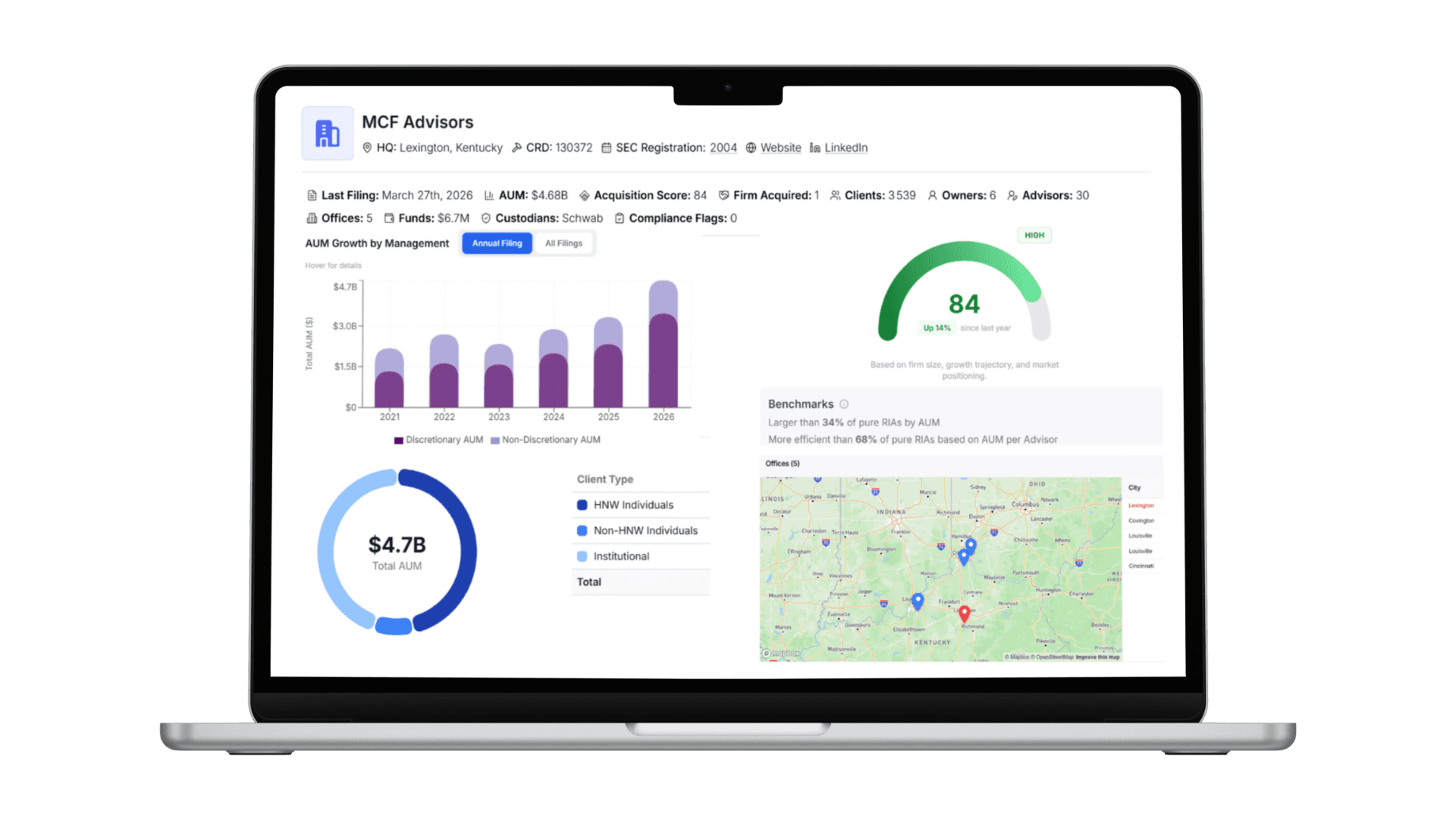
RIA Catalyst tracks Form ADV data across 15,000+ SEC-registered RIAs, including office locations, IAR and employee counts, AUM growth net of market appreciation, and compliance disclosures. That makes it possible to build a market-by-market view of the independent advisory landscape — which firms operate in a given metro, how they are staffed, and how their headcount and assets have moved across successive filings. A buyer anticipating displacement in specific markets can identify the firms positioned to absorb it, and see advisor movement register in the filings as IAR counts shift between firms, well before it becomes a news item.
Timing Without Guessing
Bain notes that announced US commercial banking deal value rose 7% year over year in the first half of 2026 against 19% growth in 2025 — a pause, in the firm’s reading, ahead of reacceleration as the wave builds through the back half of the decade. Forecasts about regulatory and rate environments years out deserve appropriate skepticism, and any buyer restructuring its strategy entirely around this one is over-indexing on a projection.
The defensible version is cheaper than that. Relationships in a target market take eighteen to thirty-six months to mature into proprietary conversations. If displacement is likely to concentrate in identifiable markets, the work that captures it — mapping firms, opening dialogue, building a watch list — is work that has to start well before the event and is worth doing regardless of whether the forecast lands. A buyer who has spent two years cultivating the independent firms in an overlap market is positioned if the wave arrives and has a better pipeline if it does not.
FAQ
Are banks actually likely to buy RIAs, or just consolidate among themselves?
Both, unevenly. Bank-to-bank consolidation is the primary projection. Wealth management enters the picture secondarily, when consolidating banks decide whether fee-based advice is core. Historically that decision has split, with some banks divesting wealth units and others acquiring into them, which is why the wave produces transactions in both directions rather than a single trend.
Should an independent buyer avoid markets where banks are likely to bid?
No. Bank bidders are slow, subject to approval processes, and offer sellers the least autonomy. They win specific franchises, usually the largest and most balance-sheet-relevant. The independent buyer’s advantage sits with founders who value identity and decision rights, and that segment is not contested by banks on comparable terms.
What is the most immediate practical exposure for an RIA?
Platform and lending dependencies. Fewer and larger institutions means fewer counterparties for securities-based lending, cash management, and trust services. Bain frames the current period as a window to assess which banking relationships to deepen and which to diversify. For an acquirer, that assessment should extend to targets — a firm heavily dependent on one regional bank relationship carries a risk worth naming.
How does bank consolidation affect advisor recruiting versus firm acquisition?
It generates more of the former. Displaced teams are individually smaller and faster to move than firms are to sell, so the near-term volume shows up as lift-outs and team moves rather than change-of-control transactions. Buyers with the infrastructure to onboard teams capture that flow; buyers built only for whole-firm acquisition largely watch it pass.
Does this change how a seller should run a process?
It argues for including at least one bank or insurance bidder if the firm’s profile fits, because their cost of capital can produce a higher number. It also argues for being honest about what that number costs in autonomy. Sellers who invite a bank bid purely to set a price floor should expect the process to run longer.
Conclusion
The next wave of RIA competition may not come from another RIA. A projected five to seven trillion-dollar US banks by 2030, built partly out of the 49 large regionals that exist today, will displace advisor teams, force decisions about non-core wealth units, and concentrate the platform relationships independent firms rely on.
The window between the projection and the event is the useful part. Overlap markets can be identified now. The independent firms in them can be mapped, ranked, and cultivated now. Displacement rewards the buyer who already has the relationships when a team goes looking — not the one who reads about the merger and starts making calls.