Date Published:

Ask most RIA owners what drives their firm's valuation, and they'll cite AUM, revenue, and margins. Ask most buyers what they look for in a target, and you'll get a similar list. What rarely comes up in either conversation is AUM per advisor — or its equally revealing companion, AUM per employee — despite the fact that both are among the most direct predictors of the metrics everyone agrees on.
AUM per advisor is the ratio of total firm assets under management to the number of registered Investment Adviser Representatives (IARs). AUM per employee extends that lens to the full headcount — including operations, compliance, client service, and administrative staff. At $150M per advisor and $50M per employee, a firm is running efficiently. When those ratios compress significantly below their peer benchmarks, the constraint shows up in operating costs and ultimately in acquisition price.
The relationship is not incidental. Advisor productivity and firm efficiency are the operational foundations from which revenue efficiency is built. Firms that score well on both metrics run leaner cost structures relative to revenue, scale more gracefully with AUM growth, and absorb integration costs more efficiently. Those economics are exactly what acquirers pay premiums for. Understanding both metrics — whether you're buying or preparing to sell — is one of the most underutilized levers in wealth management M&A.
What These Metrics Actually Measure
AUM per Advisor: Productivity vs. Capacity
AUM per advisor measures how efficiently the firm is converting IAR capacity into managed assets — which is a proxy for how effectively the business model translates registered advisory headcount into revenue.
Two firms can have similar total AUM with vastly different advisor productivity profiles. The firm where productivity is high is generating more revenue per unit of IAR compensation expense. The firm where productivity is low may have a deliberate service model that justifies the ratio — or it may have a structural problem that the AUM number alone obscures.
A large team with individual advisors managing modest books is not the same as a lean team with each advisor running a high-output practice. The distinction matters because it affects margins, scalability, and what a buyer is actually paying for when they apply an earnings multiple to the deal.
AUM per Employee: The Operational Efficiency Lens
AUM per employee captures something advisor productivity cannot: the overhead structure of the entire firm. A firm with $500M AUM, three advisors, and twelve total employees is running a fundamentally different cost model than a firm with the same AUM, three advisors, and six employees. The advisor ratios look identical. The employee ratios expose the difference.
High AUM per employee signals that the firm has built scalable operations — that growth in AUM does not require proportional growth in total headcount. Low AUM per employee can indicate over-staffing, operational complexity, or a service model that relies heavily on manual processes. Both are meaningful signals for acquirers modeling post-close integration costs and efficiency potential.
The two metrics should always be read together. A firm with strong AUM per advisor but weak AUM per employee has productive IARs sitting on top of a heavy operational base. A firm with strong AUM per employee but weak AUM per advisor may have lean operations but under-performing relationship capacity. The combination tells a more complete story than either metric alone.
How These Metrics Differ Across Service Models
Service model matters significantly when interpreting both ratios — but in different ways for each metric.
AUM per advisor reflects only registered IARs as reported in Form ADV. It does not capture estate attorneys, tax coordinators, concierge staff, or other non-IAR personnel that a high-touch or family office model might employ. This means a firm can show a deceptively high AUM per advisor ratio — because the denominator only counts people who carry an IAR registration, not everyone involved in delivering the service.
AUM per employee is where the true cost structure of a service-intensive model becomes visible. A firm with two registered advisors and twelve total employees — including planning, tax, and client service staff — will show strong AUM per advisor but compressed AUM per employee. That gap is diagnostic: it tells you how much of the firm's human capital sits outside the IAR count, which directly affects the cost base a buyer inherits.
When evaluating both metrics, always identify what the denominator actually includes. For AUM per advisor, verify whether the ADV advisor count reflects only client-facing IARs or also includes support staff with advisory registration. For AUM per employee, confirm total headcount from the ADV filing and cross-reference with any available organizational context. The benchmark table below provides reference ranges by firm size tier — adjust interpretation based on what the denominators actually contain.
Why These Metrics Drive Valuation
The Revenue Efficiency Connection
Higher AUM per advisor means each IAR generates more revenue. In a model where advisor compensation is partly fixed and partly variable, higher per-advisor revenue increases the revenue-to-compensation ratio — one of the primary drivers of operating efficiency in an advisory firm.
A firm generating $1.6M in revenue per advisor at 35% advisor compensation cost is running a materially lower compensation-to-revenue ratio than a firm generating $900K per advisor at the same compensation structure. That difference compounds across a full advisor team and flows directly into the firm's earnings capacity. AUM per employee amplifies this signal by capturing whether the support infrastructure scales efficiently alongside advisor output.
The Scalability Premium
Acquirers pay a scalability premium for high-productivity, high-efficiency firms because the math of growth works better. If a firm with $200M per advisor adds $50M in new AUM through organic growth, that growth requires no additional IAR headcount. If the same firm also runs at $60M+ per employee, the operational infrastructure can likely absorb that growth without proportional hiring. The incremental revenue flows more fully toward earnings.
If a firm with $75M per advisor and $25M per employee adds the same $50M in AUM, it may require both a new advisor and additional support staff — absorbing a meaningful portion of the incremental revenue before it reaches the bottom line. That difference compounds significantly over a 4–6 year hold period and materially affects exit returns for PE-backed platforms.
The Integration Cost Argument
Integration costs are largely fixed per deal — compliance filings, technology migration, client communication, advisor onboarding. A high-productivity, high-efficiency firm generates more revenue per advisor and per employee, which means integration costs represent a smaller percentage of the acquired firm's revenue base. That difference directly improves the post-close return on integration investment, which acquirers implicitly price into the offer.
Benchmarks: Industry Ranges by Firm Size Tier
Benchmarks reflect AUM-based advisory model firms. Figures are illustrative industry reference ranges. Always verify what the ADV denominator includes before applying these benchmarks.
Firm AUM | Typical AUM/Advisor | Top Quartile AUM/Advisor | Productivity Flag | Typical AUM/Employee | Top Quartile AUM/Employee |
|---|---|---|---|---|---|
<$200M | $50M–$100M | >$125M | <$40M | $15M–$35M | >$45M |
$200M–$400M | $85M–$140M | >$175M | <$60M | $25M–$50M | >$65M |
$400M–$750M | $120M–$180M | >$220M | <$85M | $35M–$65M | >$85M |
$750M–$1.5B | $160M–$240M | >$290M | <$110M | $45M–$80M | >$105M |
>$1.5B | $200M–$310M | >$350M | <$140M | $55M–$100M | >$130M |
Firms in the top quartile of both metrics within their size tier consistently command acquisition premiums of 0.5x–1.5x revenue multiples above the midmarket average. Firms below the productivity flag on AUM per advisor typically trade at discounts unless there is a credible operational improvement thesis. Firms that score poorly on AUM per employee despite strong advisor productivity are signaling a cost structure problem that post-close integration will need to absorb.
The Valuation Impact in Practice: A Worked Example
Consider two firms with identical AUM of $600M and identical blended fee rates of 80 bps, generating $4.8M in gross revenue.
Firm A: Six IARs, fourteen total employees. AUM per advisor: $100M. AUM per employee: $42.9M. Revenue per advisor: $800K.
Firm B: Three IARs, eight total employees. AUM per advisor: $200M. AUM per employee: $75M. Revenue per advisor: $1.6M.
Same AUM. Same gross revenue. But Firm B generates twice the revenue per IAR and 75% more revenue per employee. That gap does not stay at the top line — it flows through the cost structure. Fewer advisors managing more AUM means lower compensation expense relative to revenue. Fewer total employees means lower operational overhead. The result is a materially stronger earnings profile for Firm B, achieved without any difference in AUM or fee rate.
At a premium multiple that reflects the productivity and efficiency advantage, that earnings difference compounds into a valuation gap of several million dollars.
This is the practical reason both metrics belong in the screening framework — not just one.
What Depresses These Metrics (and How to Read It)
Overstaffing vs. Intentional Service Model Choice
A low AUM per advisor or AUM per employee ratio is not automatically a problem. Some firms deliberately staff generously to provide high-touch service, reduce advisor burnout, and create internal succession capacity. These are legitimate strategic choices — and they should be reflected in higher fee rates that compensate for the lower per-unit output.
The key diagnostic question is whether the fee structure justifies the staffing levels. A firm with $75M per advisor charging 65 bps on a mass-affluent client base has a structurally challenged cost model. The same firm charging 110 bps on a complex HNW client base with full financial planning and tax coordination may be entirely defensible. The gap between AUM per advisor and AUM per employee will tell you how much of the staffing sits outside the IAR count — and whether those non-IAR roles are generating fee justification.
Growth Phase vs. Structural Underperformance
Young advisors growing their books, and recent operational hires ahead of growth, naturally depress both ratios during a growth phase. A firm that hired two junior IARs and a new operations manager in the past two years may show temporarily compressed productivity that will correct as AUM catches up to headcount. This is a staging effect — but it requires a multi-year view to distinguish from genuine structural underperformance.
For Sellers: How to Improve Both Metrics Before Going to Market
Client segmentation and minimum account thresholds. Graduating smaller clients to a tiered or self-service model frees IAR capacity for larger relationships, directly improving AUM per advisor. Firms that implement genuine minimums 18–24 months before a sale process typically see measurable improvement.
Technology that reduces manual overhead. Automating client reporting, rebalancing, and compliance documentation reduces the support headcount required per dollar of AUM. This improves AUM per employee without requiring advisor consolidation — often the faster lever of the two.
Advisor book restructuring. If multiple IARs are managing overlapping client segments at similar AUM levels, restructuring those books to concentrate relationships more efficiently improves the per-advisor ratio before an exit process begins. This requires careful management of advisor incentives and client relationships, but the valuation impact is direct.
A 15–25% improvement in AUM per advisor over 18 months is achievable with deliberate focus. AUM per employee responds faster to operational changes — technology investment and process redesign can produce visible results within 12 months.
For Buyers: Using Both Metrics as Screening and Pricing Inputs
First-Pass Screen Application
In a first-pass screen, both ratios serve as quality filters on top of AUM size. Using Form ADV IAR headcount and total employee data combined with AUM, buyers can calculate both ratios for every firm in a target geography and immediately stratify the universe into productivity and efficiency tiers.
Firms below the productivity flag on AUM per advisor get deprioritized unless there is a specific operational improvement thesis. Firms that score well on AUM per advisor but poorly on AUM per employee get flagged for operational cost scrutiny — their IARs are productive, but the firm is carrying overhead that will affect integration economics. Firms in the top quartile on both metrics get elevated as high-efficiency acquisition candidates.
This dual screen takes the same time as a single AUM filter but produces a materially more differentiated list.
Adjusting the Valuation Model
A top-quartile firm on both metrics earns assumptions at the high end of the peer range for revenue efficiency and scalability. A below-flag firm on either metric warrants a more conservative earnings assumption and a lower entry multiple — unless the buyer has a specific plan to close the gap post-close, which should be stress-tested in the model.
Data Advantage: Quantifying Productivity and Efficiency Alongside 80+ Acquisition Signals
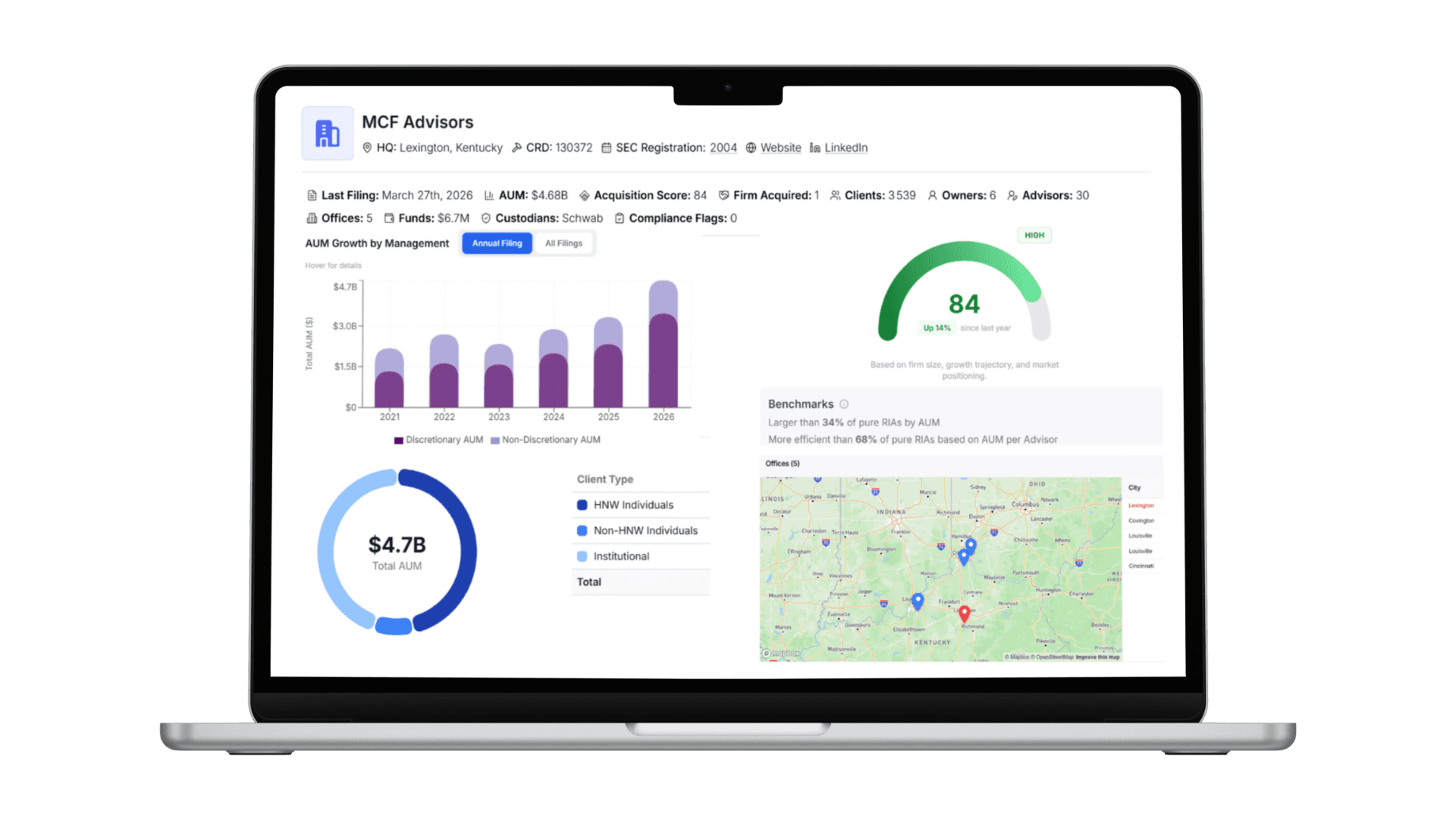
AUM per advisor and AUM per employee are two of the most important inputs in an acquisition scorecard — but they are two of many. RIA Catalyst's proprietary Acquisition Score synthesizes productivity metrics, growth trajectory, advisor demographics, revenue quality, and compliance history into a single composite score across 15,000+ firms. Rather than calculating individual metrics manually for each target, buyers can use the Score as a first-pass prioritization tool that surfaces the highest-quality opportunities before the screening process begins. Productivity and efficiency aren't just diligence inputs. They're sourcing filters.
FAQ
How do I calculate AUM per advisor and AUM per employee for a target firm?
Form ADV Part 1 reports total AUM, the number of registered investment advisers, and total employees. AUM per advisor = total AUM ÷ client-facing IARs. AUM per employee = total AUM ÷ total headcount. Note that the IAR count in ADV may include support staff who carry advisory registration but are not client-facing — treat the advisor ratio as a floor estimate if you cannot distinguish registered non-advisors, and refine it during initial conversations.
Which metric matters more — AUM per advisor or AUM per employee?
They answer different questions. AUM per advisor tells you about IAR-level revenue-generating capacity and relationship efficiency. AUM per employee tells you about operational scalability and total cost structure. A firm can score well on one and poorly on the other — and both gaps have different implications for post-close integration. Read them together for a complete picture.
Does AUM per advisor accurately reflect service intensity for complex client models?
Not always. AUM per advisor only counts registered IARs — not tax coordinators, estate specialists, client service staff, or other non-IAR personnel. A firm serving complex HNW clients with a full team of non-IAR specialists may show a high AUM per advisor simply because those specialists don't appear in the IAR denominator. AUM per employee corrects for this by capturing total headcount, which is why both metrics are necessary for a complete productivity and efficiency picture.
Can a firm improve both ratios significantly in 12–18 months before a sale?
Meaningfully, yes. AUM per employee tends to respond faster — technology investment and process redesign can show results within 12 months. AUM per advisor is slower to move because it depends on organic book growth or client segmentation decisions that take time to implement without disrupting client relationships. A 15–25% improvement across both metrics over 18 months is achievable with deliberate focus.
What's the relationship between these metrics and RIA Catalyst's Acquisition Score?
Both productivity and efficiency metrics are core inputs in a well-constructed acquisition scoring model. A firm with top-quartile AUM per advisor and AUM per employee, combined with strong organic growth and clean compliance history, will systematically score higher than a firm with the same total AUM but compressed productivity ratios — because the underlying economic engine is demonstrably stronger. RIA Catalyst's Acquisition Score synthesizes these dimensions simultaneously rather than requiring manual calculation for each target.
Conclusion
AUM per advisor and AUM per employee are not secondary metrics. Together, they are the operational foundation from which revenue efficiency, scalability premiums, and acquisition valuations are built. Firms in the top quartile of both ratios within their size tier earn higher multiples, attract stronger acquirer interest, and create more durable post-close value than their AUM-equivalent peers. For buyers, both metrics belong at the top of the screening framework — not buried in late-stage diligence. For sellers, improving these ratios in the 18–24 months before a sale process is one of the highest-return investments available. The firms that understand this dynamic — and act on it early — consistently transact at better terms than those who discover it at the negotiating table.